

1968 was an inflection point for the US. Is another one coming in 2024?
- Written by: Liam Byrne, Honorary Fellow, School of Historical and Philosophical Studies, The University of Melbourne
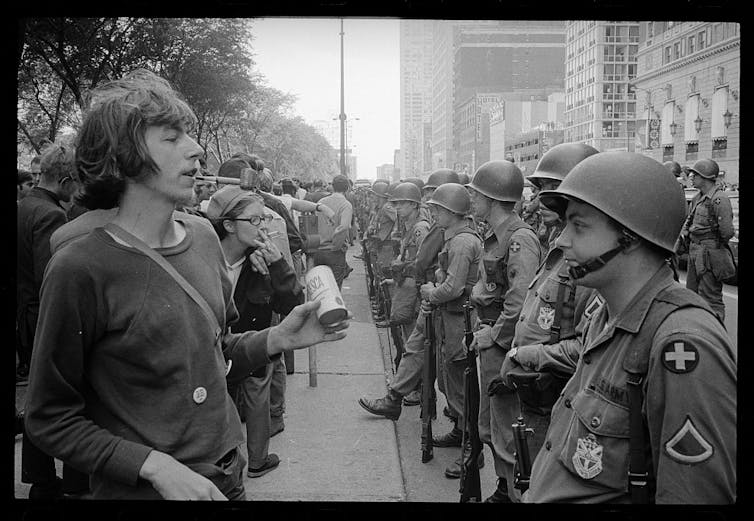
For many reasons, the 2024 US presidential election will be like no other.
Republican nominee Donald Trump’s campaign is unprecedented. Never before has a former president who so openly threatens the existence of democracy in the United States been this close to retaking the oath of office.
At the same time, university campus protests over the war in Gaza are growing. Escalations in these protests and the responses from university administrations have led to scenes of militarised police forcefully arresting protesters.
Almost universally, commentators are reaching for the same touchstone as they seek to understand what is happening in the US today: the protests and civil discord that framed the 1968 election.
But how apt are these comparisons, and do they help us understand what is at stake in the election of 2024?
Read more: Could the Israel-Gaza war hurt Joe Biden's chances of re-election? History might provide a guide
What happened in 1968?
The year 1968 was a tumultuous and decisive inflection point in the history of the US. The events of that year exposed the deep contradictions at the heart of American society – contradictions that have yet to be resolved.
As the year got underway, the US had proclaimed its moral leadership of the free world, while ruthlessly escalating its prosecution of the war on Vietnam. Democratic President Lyndon Johnson had assured the American public the US was in the ascendancy – a claim swiftly undermined by the Tet offensive in January.
Johnson’s legitimacy suffered due to disaffection on both the left and right, combined with his administration’s incoherent war objectives and ineffective strategy. Challenged by several candidates in his own party in the primaries, Johnson announced in late March he would not run again.
The gap between the promises of racial justice and reality of ongoing racism was also stark. Though the Civil Rights Act of 1964 and Voting Rights Act of 1965 were significant in ending legal segregation in the south, civil rights activists argued persistent social and economic racial inequality (including in the north) meant segregation was still the reality for most Black Americans.
The most prominent advocate of this perspective, Martin Luther King, was gunned down on April 4 at the Lorraine Hotel in Tennessee. This act of racist hate sent shockwaves through Black America. Protests erupted, resulting in more than 40 deaths.
Another Civil Rights Act was passed, but for many – especially the burgeoning ranks of militant Black nationalists – King’s devastating assassination represented the entrenched violence of a state built on white supremacy.
After the shooting, former attorney-general and Democratic presidential candidate Robert F. Kennedy famously called for calm. His bid for the presidency inspired many impassioned activists who threw themselves into campaigning. Kennedy had a unique ability to build a coalition incorporating student activists, white suburbanites, Black communities, migrant sharecroppers and sections of organised labour.
On June 5, Kennedy won the Democratic primary in California. Moments after his victory speech, he was shot and rushed to hospital. He died the next day.
Two months later, the Democratic Party held its national convention in Chicago, a city tightly controlled by the old-school conservative Democratic mayor, Richard J. Daley. Daley tried to clamp down on any dissent. Protesters of all stripes assembled in defiance.
Inside the convention centre, the unruly proceedings revealed deep divisions within the Democratic Party over the Vietnam War. Outside, the protesters’ vision of participatory direct democracy clashed violently with the forces of the city police, a symbol of institutional governance.
The Democratic nomination was won by Hubert Humphrey, Johnson’s vice president. Though once lauded for his liberalism, Humphrey had strongly associated himself with Johnson’s war policy. After Kennedy’s assassination, Humphrey’s most serious challenge came from the anti-war candidacy of Eugene McCarthy. But with strong support from within the Democratic establishment, Humphrey prevailed, to the disdain of many anti-war party activists.
The legacies of 1968
For Nixon, the Republican nominee, the scenes from the Democratic convention playing out on the nightly news were a boost. How could a party that could not govern itself govern the nation?
Nixon unleashed a cynical campaign of thinly veiled racism, positioning himself as the candidate of states’ rights and “law and order”.
As the year went on, the third-party candidacy of the avid segregationist and former Democrat George Wallace attracted significant support from white voters in the deep south as part of the racist backlash against civil rights, as well. Nixon similarly appealed to these voters as part of the Republicans’ emerging “southern strategy” to win white voters in the south who had previously been Democratic supporters.
The 1968 election was closer than many expected, but a combination of disenchantment with the Democrats, Wallace’s third-party candidacy and a general sense of malaise led to Nixon’s narrow victory.
Then came the the US bombing campaigns against Vietnam, Cambodia and Laos. And in 1972, Watergate.
The upheaval of 1968 and the years that followed exposed fissures in American society and raised serious questions about how united the country actually was. It made clear there were different Americas – and these versions of the country were not reconciled to each other. The house was divided. These differences remain as stark as ever today.
What’s at stake in 2024?
The year 1968 continues to have such symbolic power because it marked the transformation from the hope and idealism of the 1960s to the cynicism and despondency of the 1970s.
The contradictions of that era were also never resolved. 1968 was a year of contest in which different visions of what America was – and what it could and should be – dramatically clashed. This social polarisation was expressed through regular political violence that fundamentally changed the nation.
Trump exposed these social fissures first as president, and now (again) as nominee. But 2024 is not a repeat of 1968 – it’s a continuation of the same issues that have torn at the country’s fabric for decades.
Read more: Why 'wokeness' has become the latest battlefront for white conservatives in America
Trump’s presidential bids have revealed the deep state of division that persists in the US. His support is sustained by the political revanchism of those who actively seek to perpetuate America’s historic injustices and have mobilised behind his banner to retain their social power.
Their unwavering support for Trump, and willingness to continue to mobilise regardless of electoral outcomes, means that whatever the poll result is in November, the threat to American democracy that Trumpism poses will persist.
Until this fundamental reality is confronted and overcome, the country will continue to live in the shadows of 1968.
Authors: Liam Byrne, Honorary Fellow, School of Historical and Philosophical Studies, The University of Melbourne


















