

Clean energy slump – why Australia’s renewables revolution is behind schedule, and how to fix it
- Written by: Alison Reeve, Deputy Program Director, Energy and Climate Change, Grattan Institute
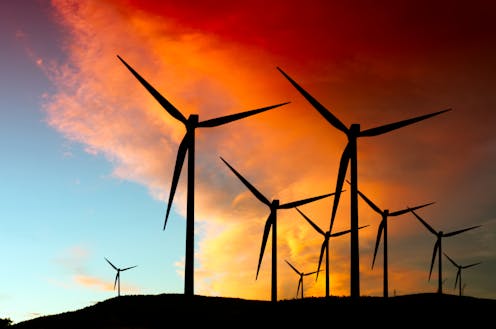
For years, the electricity sector has been the poster child for emissions cuts in Australia. The sector achieved a stunning 26% drop in emissions over the past 15 years, while other sectors have hardly budged. The share of renewable energy has gone from 7.5% to more than 30% in that time.
But unfortunately, this impressive pace is not fast enough.
Investments in renewable energy plants slowed in 2023 – financial approvals for new solar farms shrank more than a third and no new wind farms won backing. By the end of that year, Australia had 56 renewable energy projects under construction, down from 72 a year earlier.
For Australia to achieve the federal government’s 43% emissions cut target by 2030, and the deeper and swifter cuts required after that, we need to accelerate. The federal government wants the electricity sector to be generating at least 82% from renewable sources by 2030. The electricity sector needs to be clean enough by that year to make electrification the better choice for sectors heavily dependent on fossil fuels, from transport to heavy industry to household gas.
And it won’t end there. After 2030, when other sectors start to electrify en masse, the electricity sector will need to keep building more and more new renewable capacity to keep up.
If it doesn’t, it simply won’t be possible to eliminate the remaining 56% of our emissions that come from producing and burning fossil fuels. And that’s before Australia even starts looking at expanding its industrial base to become a so-called “renewable superpower”.
There are three reasons the electricity sector isn’t achieving the required pace at the moment.
Not enough poles and wires
New wind and solar farms need new transmission lines to get their electricity to users. That’s because the good sources of wind and sunshine aren’t in the same places as the existing transmission network. And even if they were, we’d still need to upgrade and build transmission because of the growth in demand.
The Australian Energy Market Operator estimates 50% of the transmission needed to deliver a clean, reliable, affordable energy supply in 2050 needs to be constructed in the next six years.
But most of these transmission lines are yet to be built.

Instead, renewable generators have had to connect to existing lines, which have become congested. So even when new renewable installations get approvals for construction, their output can be curtailed because they can’t get it to consumers. This has hit developer finances hard.
And many rural communities aren’t happy with the new transmission lines planned for their regions. While many of the required lines have been known about in the energy sector for years, the communities that will host them are only finding out about them now. Understandably, many object.
 Thousands of local residents attend a rally at Flagstaff Point in Wollongong to protest against a proposed offshore wind turbine farm.
AAP/Dean Lewins
Thousands of local residents attend a rally at Flagstaff Point in Wollongong to protest against a proposed offshore wind turbine farm.
AAP/Dean Lewins
As well, bottlenecks in the planning approval bureaucracy mean things are slow to get built. This isn’t just about transmission lines: it also applies to new renewable generators and even upgrading roads so equipment and machinery can be used safely.
Coal hanging on
There’s still uncertainty about when coal generators will leave the market.
We need to build replacement capacity for ageing coal generators before they retire but no one wants to build new generators to replace the coal if they aren’t sure when demand for their electricity will emerge.
Generators are required to declare their earliest exit date if that date is less than three-and-a-half years away, but there’s nothing to stop them pushing that date out. That’s what Delta Electricity did last year, when it changed the closure date for the Vales Point power station in New South Wales from 2029 to 2033.
 Vales Point coal-fired power station has had its operating life extended to 2033.
Rob Brady/Shutterstock
Vales Point coal-fired power station has had its operating life extended to 2033.
Rob Brady/Shutterstock
On top of this, nervous state governments have started making opaque deals to pay coal power stations to stay open, as insurance against the slow pace of the renewables build.
Read more: Do we want a wind farm outside our window? What Australians think about the net zero transition
Governments aren’t coordinating well
Every state government on the east coast has a renewable energy target. So does the federal government. But these targets were set as arbitrary percentages linked to arbitrary dates, not chosen to deliver the cleanest, most reliable, cheapest energy system for consumers.
State and federal governments choose their targets in isolation, which drives up overall costs. To give just one example: both New South Wales and Queensland have established “renewable energy zones” in New England shire, located right across the border from each other. Developing these areas as a single zone should cost less overall, but no such interstate efficiency has emerged. Each state has gone its own way.
Is there a way out?
All of the above has led to a policy quagmire that has bogged down Australia’s energy transition.
In our report released last month, my colleagues and I argue the best way forward is to temporarily put aside a desire for neat, market-driven policies. Instead, we think governments and industry need to accept an approach that could feel ad hoc or disorganised at times in the next decade while coal exits are taking place.
During this time, governments will probably need to intervene regularly to coordinate new transmission, new generation, and coal exits, so the lights stay on.
Once coal is a no longer a substantial part of the market, it will be time for governments to step back. Beyond 2030, electricity demand is expected to keep growing, and the renewables building task will continue.
 If current forecasts are right, coal will fall below 10% of our electricity production by 2032. ‘Storage’ includes utility and consumer storage. This is based on AEMO’s 2023 Integrated System Plan, Step Change scenario.
Grattan Institute, CC BY-NC-ND
If current forecasts are right, coal will fall below 10% of our electricity production by 2032. ‘Storage’ includes utility and consumer storage. This is based on AEMO’s 2023 Integrated System Plan, Step Change scenario.
Grattan Institute, CC BY-NC-ND
Governments need to start designing the rules that will govern this new electricity system. It requires asking a fundamental question: what will the respective roles, rights, and responsibilities of energy consumers, industry, and governments be in the future?
Keeping the system reliable will be a fundamentally different task when the amount of electricity generated depends on the weather. Market rules must change to ensure there is always sufficient generation available to meet demand in this new electricity system.
And carbon pricing – a political taboo for so long – will need to be discussed again. Even when the coal generators have closed, a vital share of our electricity will come from gas. The electricity sector needs a clear and enduring carbon price for the energy sector to guide gas-plant entries and exits, and ensure they pay for their emissions.
Governments will need to better integrate and orchestrate all forms of distributed energy resources, from rooftop solar panels to electric vehicles, particularly as electric vehicles become able to use their batteries to help power the grid.
Australia may be able to muddle through the next few years, but voters will not forgive their political leaders if they mess up the post-coal era and fail to deliver the trifecta of clean, affordable, and reliable energy. The hard work starts now.
Authors: Alison Reeve, Deputy Program Director, Energy and Climate Change, Grattan Institute


















