

Ancient DNA from an extinct native duck reveals how far birds flew to make New Zealand home
- Written by: Nic Rawlence, Senior Lecturer in Ancient DNA, University of Otago
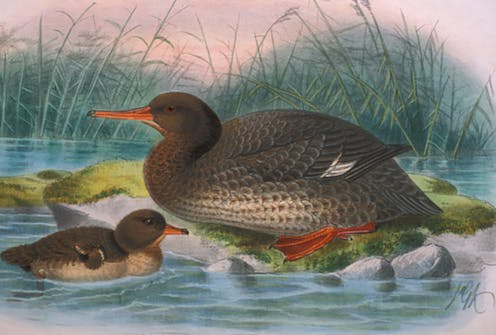
Ask a bird lover if they have heard of the extinct giant moa or its ancient predator, Haast’s eagle, and the answer will likely be yes. The same can’t be said of New Zealand’s extinct, but equally unique, mergansers – a group of fish-eating ducks with a serrated bill.
The only southern hemisphere representatives of this group are the critically endangered Brazilian merganser and those from the New Zealand region, which are now extinct.
Unlike some of New Zealand’s other extinct birds, the biological heritage of our enigmatic mergansers is shrouded in mystery. But our new research on the extinct Auckland Island merganser is changing the way we think about the origins of New Zealand’s birds. Did the ancestors of the merganser come from South America or the northern hemisphere – and when did they arrive?
Lost to humans and pests
Mergansers were spread across the three main islands of New Zealand at the time of Polynesian arrival in the 13th century, as well as the Auckland Islands to the south and the Chatham Islands to the east.
Over-hunting, habitat destruction, and predation from the Pacific rat and Polynesian dog resulted in the extinction of mergansers on the New Zealand mainland and the Chatham Islands. By the time Europeans arrived in the 17th century, mergansers were restricted to an isolated population on the sub-Antarctic Auckland Islands.
European discovery of the Auckland Islands in 1806 led to a formal description of the Auckland Island merganser in 1841. However, European discovery brought new predators like pigs and cats.
Mergansers were also sought after as specimens for the museum trade. The last known Auckland Island merganser was shot and collected in 1902, a mere 61 years after its discovery.
Only recently have merganser bones from the Chatham Islands been described as a distinct species. The distinction of the Chatham Island merganser hints at greater merganser diversity in the New Zealand region than previously thought. It is possible the merganser bones found on mainland New Zealand may be another species, but only ongoing research will be able to confirm this.
From the northern hemisphere to NZ
The extinction of mergansers from the New Zealand region has meant their evolutionary history has remained a mystery. Did their ancestors, and those of the the Brazilian merganser, arrive via independent colonisation events from the northern hemisphere? Or was there a single push into the southern hemisphere, followed by subsequent divergence events?
To find out more, we sequenced ancient DNA from an Auckland Islands merganser and a Brazilian merganser. This allowed us to reconstruct the evolutionary history of the wider group.
We found mergansers originated in the northern hemisphere, diverging from their closest relatives some 18 million years ago, before rapidly evolving into several different species between 14 and seven million years ago.
The mergansers from the New Zealand region are most closely related to the northern hemisphere common merganser. Their ancestors arrived here at least seven million years ago in a separate colonisation event to the one that gave rise to the Brazilian merganser.
Further genetic research is currently underway. The goal is to reconstruct the evolutionary history of mergansers within the New Zealand region.
The global origins of New Zealand’s birds
Many New Zealanders believe the country’s native birds originate from Australia. Increasingly though, genetic and palaeontological research shows a number of our feathered friends hail from further afield.
Kiwi are most closely related to the extinct elephant birds of Madagascar, for example. And the extinct adzebill is related to flufftails, also from Madagascar. The extinct moa is most closely related to the tinamou from South America.
The long journey of blue-eyed shags started in South America, with the birds island hopping via Antarctica and the sub-Antarctic islands to New Zealand. Mergansers arriving from the northern hemisphere add another piece to the puzzle.
It is possible that fossils of extinct mergansers (and other birds with distant geographic origins) will be discovered as palaeontologists increasingly focus on previously neglected and newly discovered southern hemisphere fossil deposits.
Only then, combined with the power of ancient DNA, will we be able to fully understand how New Zealand’s dynamic geological, climatic and human history has influenced the colonisation and diversification of birds on this isolated South Pacific archipelago.
Authors: Nic Rawlence, Senior Lecturer in Ancient DNA, University of Otago


















