

revealing the true origins of the not-so-German cockroach
- Written by: Theo Evans, Associate Professor of Applied Entomology, The University of Western Australia
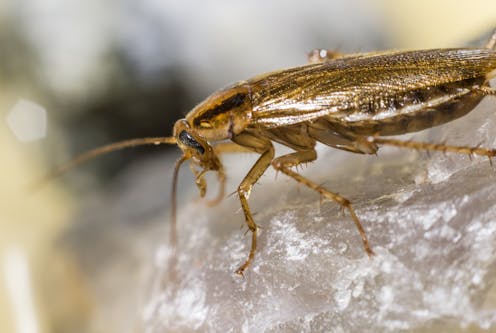
German cockroaches thrive in buildings all over the world. They’re one of the most common cockroach species, causing trouble for people both here and overseas. But in nature, they’re nowhere to be found.
Just how this urban pest evolved and populated our dwellings was unknown – until now.
We used DNA sequencing to study the German cockroach (Blattella germanica) and trace its origins back to east India and Bangladesh.
It’s a fascinating story about how humans enabled the evolution and spread of one of our most hated pests.
A German enigma
The spotlight fell on the star of our story in eastern Europe when it was spotted in army food stores during the Seven Years’ War (1756–63). Each of the opposing forces named the cockroach after the other – the Russians called it the “Prussian cockroach”, while British and Prussian soldiers called it the “Russian cockroach”.
Then in 1767, Swedish biologist Carl Linnaeus classified and named the species (Blatta germanica). Blatta is Latin for “avoids the light” and germanica because the specimens he examined were collected in Germany. (The genus was later changed to Blattella to group the smaller varieties of cockroaches together.)
Eventually scientists discovered related species, with similar anatomy, in Africa and Asia. They variously suggested the German cockroach could have first evolved in either Africa or Asia, before going on to dominate the world.
But they had no way to test their theories. We do.
Enter gene sequencing
We took DNA samples from 281 cockroaches in 17 countries around the world.
Then we compared the DNA sequences for one particular genetic region, called CO1. This is known as “DNA barcoding”.
When we compared the German cockroach with similar species from Asia, we found a match. The sequence of the German cockroach was almost identical to that of Blattella asahinai from the Bay of Bengal.
More than 80% of our German cockroach samples matched perfectly. The remaining 20% barely differed.
This means the two species diverged from one another just 2,100 years ago – an eyeblink in evolutionary terms.

From the Bay of Bengal to the world
We think B. asahinai adapted to living alongside people after farmers cleared their natural habitat, just as other species have done.
So the ancestors of B. asahinai moved from Indian fields into buildings and became dependent on humans. But how did they then spread across the world?
To answer this question, we analysed another set of DNA sequences from the cockroach genome.
This time we studied DNA sequences known as SNPs (single nucleotide polymorphisms). Using our samples from 17 countries across six continents, we were able to work out how the German cockroach spread from their native lands and around the world.
The first wave of migration emerged from the Bay of Bengal around 1,200 years ago and travelled westwards. It’s likely the cockroaches hitched a ride with the traders and armies of the expanding Islamic Umayyad and Abbasid Caliphates.
The next wave moved eastwards around 390 years ago into Indonesia. They probably travelled with European trading companies, such as the British East India Company or the Dutch East India Company. Several such companies traded across South East Asia and back to Europe from the beginning of the 17th century.
Our research suggests German cockroaches arrived in Europe about 270 years ago, which matches the historical records from the Seven Years’ War.
The German cockroach then spread from Europe to the rest of the world about 120 years ago. This global expansion is consistent with historical records of this new species in various countries.
We believe global trade facilitated this spread because more closely related populations are found in countries with cultural links, rather than countries that are simply close to one another. In keeping with this, we found one other expansion in Asia – north and eastwards into China and Korea – about 170 years ago.
As steam-powered ships replaced sail ships, the hitchhikers were transported more rapidly. Shorter journey times meant they were more likely to arrive alive and invade new countries.
Then improvements in housing, such as plumbing and indoor heating, created conditions conducive to surviving and thriving in buildings all around the world.
Why are cockroaches so hard to kill? (Ameya Gondhalekar, TED-Ed)The pest control arms race
Of course, people don’t like cockroaches, so the invaders’ survival depended on their ability to stay hidden.
The German cockroach evolved to become nocturnal (as their name suggests) and avoid open spaces. It stopped flying, yet retained its wings.
These cockroaches are notorious for their ability to rapidly evolve resistance to many of the insecticides used in surface sprays. Resistance can appear within a few years. This makes the challenge of finding new active ingredients difficult, given the high cost of discovery, safety tests and registration.
Cockroach baits were cheap and effective when introduced in the 1980s. But they soon became less effective against German cockroaches. That’s because the baits used sugars to tempt cockroaches. Cockroaches with a “sweet tooth” were killed, while those that preferred other tastes survived and reproduced.
As we develop new strategies to control German cockroaches, we need to consider how they might evolve to evade attack. If we understand how resistance emerges we can then find better ways to counter-attack. We can identify weak spots to exploit.
After all, the German cockroach will continue to evolve and adapt to stay alive, so the arms race between us and the cockroach will go on for years to come.
Authors: Theo Evans, Associate Professor of Applied Entomology, The University of Western Australia


















