

The budget pledged $12.5 million for free menstrual products in Indigenous communities. Here’s why it’s needed
- Written by: Nina Lansbury, Associate Professor in Public Health, The University of Queensland
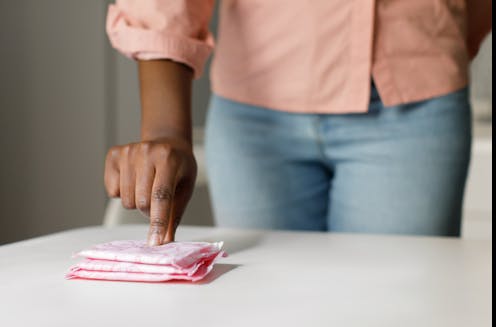
Last week’s federal budget committed A$12.5 million over four years to deliver tampons, pads and other period care products to people who menstruate in rural and remote Indigenous communities.
The provision of these products will be coordinated by the National Aboriginal Community-Controlled Health Organisation (NACCHO), the peak body for Indigenous-controlled health clinics in Australia. These clinics are often highly trusted and well-attended by people in rural and remote Indigenous communities due to their culturally sensitive and holistic approaches to health and wellbeing.
This move follows financial support for menstrual products more broadly over the past few years, including the provision of free period products in public schools across all Australian states and territories.
But people who menstruate in rural and remote Indigenous communities face a unique set of challenges, and have a particular need for better access to period products.
Menstruation in Indigenous communities
One of us (Minnie King) is an Indigenous woman. I have seen members of my family and community challenged at times during menstruation by a lack of period products, as a result of low availability and choice, and high cost. I’ve also witnessed limited knowledge among young people of their changing bodies.
All of these issues are exacerbated by remoteness, which increases costs and reduces access to services.
To open a positive discussion of this natural cycle, the two of us, together with other colleagues, have been involved in a research project on menstrual health in Indigenous communities. We spoke to students and women in these communities about the challenges they face in managing their periods.
Participants have told us about being unable to store period products in their crowded homes, and of other barriers to accessing and using period products, such as cost. In many cases this has meant using alternatives such as wads of toilet paper or cut up clothing.
Reusable products
The advent of reusable period care products in the past decade, including reusable cups, underwear and pads, has offered more options for people who menstruate. Quality products can wash and wear for up to ten years. In essence, this means they’re “inflation-proof”.
Participants in our research talked about not knowing about or being able to purchase reusable options such as pads, cups and underwear.
Our work has distributed both single-use and reusable period care products to people who menstruate in remote Indigenous communities.
When school students in remote Western Cape York trialled reusable period underwear and pads, they told us these products were discreet to wear. They also saw advantages such as the fact reusable products remove the need for waste disposal (with both convenience and environmental benefits), are cheaper over the long term, and can always be available.
These findings suggest NACCHO may wish to offer reusable as well as single-use period products with the budget funding.
Why the budget announcement is needed
Too often, remote and Indigenous voices are not heard by decision-makers. The specific menstruation challenges and costs these people face are likely to be unfamiliar to those living in cities or financially privileged settings.
We were therefore very pleased to see funding in the budget to provide free menstrual products in these communities.
Yet this doesn’t resolve the many associated issues affecting menstrual health in remote Indigenous communities, such as the need for culturally targeted and timely education about menstrual health. This is an opportunity for community-led efforts.
We are currently writing a free teaching guide on menstrual health based on remote and Indigenous students’ views and requests for what they would like to know. This includes information about the types, use, availability and disposal of period care products. It also includes information about the biological reasons for periods and ways that local students have shared to manage the challenges of mood swings and discomfort.
Our teaching guide will augment the existing, non-Indigenous and minimal period education that exists in the Australian curriculum. It will be released later this year.
A step towards ‘period parity’
Providing free menstrual products through NACCHO in remote and rural Indigenous communities is pertinent to the first outcome in the broader target of the National Agreement on Closing the Gap in Indigenous inequity: that Aboriginal and Torres Strait Islander people enjoy long and healthy lives.
Appropriate period care products can enable girls, women and other people who menstruate to participate in school, work, family and recreation, whatever day of the month.
The budget funding for period products through the community-oriented networks of NACCHO supports our aspiration for menstrual health equity, or “period parity”, for all.
Authors: Nina Lansbury, Associate Professor in Public Health, The University of Queensland


















