

We’re helping farmers access future climate projections as easily as checking the weather
- Written by: Stephen Snow, Research Scientist, CSIRO
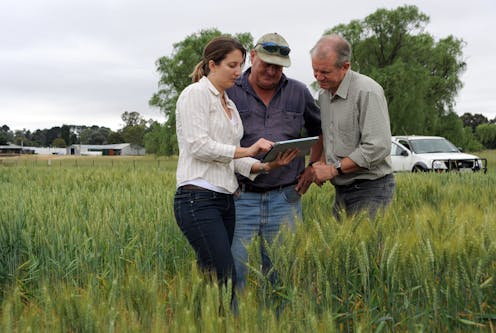
How often do you check your local weather forecast? How about your local climate projections for 2050? For many farmers, the answer to the first question is all the time. But the answer to the second is almost certainly less than that, even though this information is crucial for understanding climate-related risks and opportunities on their patch.
We know climate change could slash Australian farm profits by as much as 32% if agriculture continues as usual. Fortunately, farmers are very good at adapting to other challenges. Developing a better understanding of how the climate will change over the coming decades will help farmers prepare and adapt.
The decision-making process will vary depending on the location and the nature of the business, but it will become increasingly important to engage and respond to climate-related risks. These may include drought, flood, fire, extreme heat or greater rainfall variability. The changing climate can also present opportunities, such as being able to branch out into growing crops or varieties not previously suited to that area.
We wanted to present this information to farmers in a more engaging and meaningful way. So we designed a free tool called My Climate View.
We also interviewed farmers to find out if (and how) My Climate View might help them identify or safeguard against future climate risks. Armed with this knowledge, they might respond by shoring up on-farm water security, diversifying their farming, or adapting their future investment decisions. Whatever the case may be, our tool can get farmers thinking and talking about climate in a different way. And that’s a great start.
Introducing My Climate View (Bureau of Meteorology)Making climate risks personal
Many Australian farmers are experts at using weather information. But they tend to be less familiar with long-term climate projections, to 2050 and beyond.
My Climate View is a collaborative project developed by CSIRO and the Bureau of Meteorology to help Australian farmers and producers better understand the risks and opportunities they face over the next 50 years.
It is part of the A$29 million Climate Services for Agriculture program funded through the Australian government’s Future Drought Fund.
My Climate View provides past climate data, seasonal forecasts and future climate projections at a 5-square-kilometre resolution across Australia.
Users set their location and what they produce. Then they receive commodity-specific information about the future climate in their area.
They can also modify many of the variables, such as growing season length or extreme heat thresholds to see how the output changes, further increasing the relevance of the information to their own farm’s circumstances.
In our new research, we asked 24 Australian farmers about the biggest climate risks they face before and after a demonstration of My Climate View.
We found My Climate View clarified the risks and made the whole issue far more relevant to them (we call that reducing the “psychological distance”).
After the demonstration, perceptions of future climate risks became less ambiguous and more tangible. The farmers began to discuss ways to adapt, such as switching varieties, increasing water security or changing management practices.
Why including end-users in design matters
The ability to discuss risks in this way with farmers depends on the projections being relevant and usable to them in the first place.
This is why it’s so important to involve the end users in the product design process. We need to make sure future climate information is presented in a way that is useful, understandable and actionable to farmers and farm advisors.
We also found farmers to be an untapped source of expertise. They are highly familiar and sometimes even a little bit obsessed with the weather.
Farmers interpret weather information in the context of their knowledge of the land. We want to enable users to apply their local knowledge in My Climate View as well. We can facilitate this by allowing users to tailor the climate projections to what they know works for their farm, such as setting their own thresholds for heatwaves or adjusting the “growing season” months to match their own.
When discussing early prototypes of My Climate View, we found farmers valued the information, but found the original interface “data-heavy”. These insights informed efforts to streamline and simplify the interface into its current form, making it more inclusive and user-friendly.

Kickstarting the climate conversation
Online tools are designed for people to access on their own, anytime and anywhere. But deciding how to adapt to climate change is rarely a purely individual decision. It’s often a collaborative process, with decisions shaped by conversations with advisors, family and peers. That’s because climate risk and adaptation is complex.
There are so many variables to consider, such as market factors, local circumstances (such as farm type, soil type, finances) and personal capacity for change. Climate information is most engaging when it relates directly to someone’s own location and livelihood.
Talking through the on-farm options is much more powerful than reading a report or looking at a trend line on a graph. This discussion might be with a researcher, an advisor, an industry group, a neighbour or family. Including farm advisors – as well as farmers – in design, helps My Climate View kickstart conversations and inform discussions.
Adapting to a distant and uncertain future climate is difficult. But our research shows interactive tools such as My Climate View can help farmers start making difficult decisions around adapting to future climate risks right now.
An exciting new chapter
Being able to access future climate projections as easily as checking the weather represents an exciting new chapter in climate science communication.
It’s no longer enough to simply provide the latest information on climate science. To tackle this challenge effectively, we all need to work together.
We need to start conversations, listen to farmers, work with farm advisers and find new ways to leverage all of this expertise. Only then can we make tools that are truly accessible, inclusive and useful to help future-proof Australian agriculture.
Authors: Stephen Snow, Research Scientist, CSIRO


















