

Honk! These monkeys have truly legendary noses – now we better understand why they evolved
- Written by: Katharine Balolia, Senior Lecturer in Biological Anthropology, Australian National University
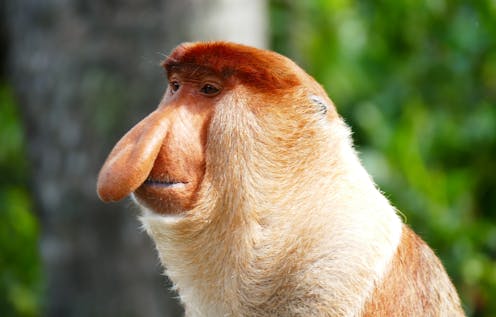
Of all the monkey species around the world, one stands out with its large, bizarre nose. In male proboscis monkeys, their bulbous noses will often hang past their mouths.
But why evolve such a strange feature? Are they a visual sign of health and status to potential female mates, and to other males? Or did they evolve to help the monkeys make honks and other loud sounds?
In our new study, published in Scientific Reports, we have deepened our understanding of these enlarged nasal structures by investigating what lies beneath: the structures in the skull.
Our findings help to explain how these noses function as visual and acoustic signals of health and status. They also add to a growing body of evidence that shows researchers can use close examinations of skulls to glean information about primate social behaviour.
A battle of noses
One of the largest monkey species in Asia, proboscis monkeys (Nasalis larvatus) are endemic to the island of Borneo. They live in coastal mangroves, peat swamps and riverine forests, and have an unusual diet made up mostly of leaves.
They can swim quite well and have webbed fingers and toes. They typically live in harem groups, made up of a single adult male (who tends to have a large, bulbous nose), some adult females and their offspring.
Males don’t often get the opportunity to attract a harem until they reach middle age. These older, dominant and large-nosed males don’t easily tolerate other large-nosed males, often trying to ward them off aggressively with deep honks and “nasal roars” – loud calls they make using their noses.
Young adult males with smaller noses often live in all-male bachelor groups, and don’t tend to fight aggressively with each other. When these bachelor males get older and become large (and large-nosed) enough to compete with males that are part of a breeding group, they are in a position to overthrow the tenured male. Females then often choose to form a harem group with this new, high-status male.

What’s behind the nose?
We investigated the size and shape of the proboscis monkey nasal cavity. That’s the bony chamber of the skull that sits behind the fleshy nose. Our goal was to find out if the size and shape of the nasal aperture – the front part of the cavity, where the fleshy nose tissue attaches – can tell us more about why these peculiar appendages evolved.
Previous research that looked at the bulbous nose in males suggests it evolved to advertise status. In our new research, we wanted to better understand how this could be the case, this time using data taken from the skull.
We used 3D surface models, downloaded from a public repository, to take size and shape measurements from 33 adult proboscis monkey skulls. We compared these with the adult skulls of king colobus monkeys, blue monkeys and crab-eating macaques, three old world monkey species.
 Crab-eating macaques have tiny noses by comparison.
Erik Klietsch/Shutterstock
Crab-eating macaques have tiny noses by comparison.
Erik Klietsch/Shutterstock
We chose some measurements to quantify the nasal cavity, and others to quantify the nasal aperture in all the species. We also looked at tooth wear, since older adult monkeys have more worn teeth than younger adults. That would allow us to find out if older adult males had a larger nasal aperture than younger adult males.
Better honks
If male proboscis monkeys have a different nasal cavity shape to females, and a unique shape compared to the other monkey species, it would support the idea these enhanced nasal structures – both the fleshy nose and the cavity behind it – evolved to allow for more effective honks and nasal roars.
That was indeed what we found. The shape of the male nasal cavity was low and long compared to females. This allows males to build up resonance (sound vibration) in their nasal cavities, allowing them to emit deeper and louder calls through their noses.
The nasal aperture shape was also different between the sexes. In males, it looks a bit like an eggplant, while in females it looks more like an upside-down pear. This unique opening shape in males allows for higher intensity sounds to be emitted through the nose.
 3D model screenshots of a male proboscis monkey (left) and a female proboscis monkey (right). Male nasal aperture size is 29% larger than that of females, and males and females differ in their nasal aperture shape.
Katharine Balolia/Morphosource Media (USNM521841; ID 000345556 and USNM142224; ID 000345144)
3D model screenshots of a male proboscis monkey (left) and a female proboscis monkey (right). Male nasal aperture size is 29% larger than that of females, and males and females differ in their nasal aperture shape.
Katharine Balolia/Morphosource Media (USNM521841; ID 000345556 and USNM142224; ID 000345144)
The sex differences in cavity shape were also larger than what we found in other old world monkey species. This further supports the idea that the nasal cavity of male proboscis monkeys underwent an evolutionary change for the purpose of making certain sounds.
Lastly, the age. Older proboscis monkey males really do have larger nasal apertures than younger adult males, but the cavity itself didn’t increase with age. This supports the idea that the large noses act as a visual signal. It’s also consistent with the fleshy nose size increasing in middle-aged or older adult males, which we know from behavioural studies in the wild.
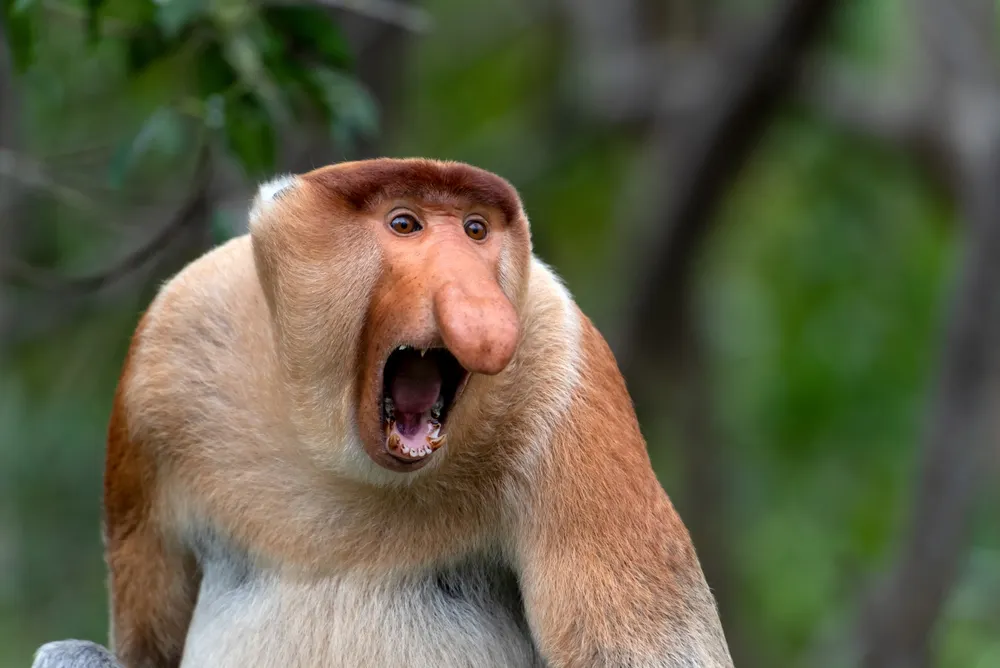 Making honks and nasal roars really does seem to be the evolutionary purpose of these fleshy noses.
Nokuro/Shutterstock
Making honks and nasal roars really does seem to be the evolutionary purpose of these fleshy noses.
Nokuro/Shutterstock
Our evidence from the skull allows us to better understand how nasal structures in male proboscis monkeys evolved for both acoustic and visual signalling.
The more we know about how regions of the skull function as social signals, the better chance we have of reconstructing extinct primate social behaviour using fossilised skull remains.
The author would like to acknowledge the paper’s co-author, former ANU Masters student Pippa Fitzgerald.
Authors: Katharine Balolia, Senior Lecturer in Biological Anthropology, Australian National University


















