

You leave a ‘microbe fingerprint’ on every piece of clothing you wear – and it could help forensic scientists solve crimes
- Written by: Paola A. Magni, Associate Professor of Forensic Science, Murdoch University
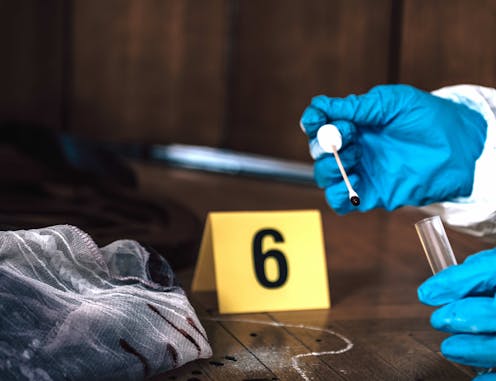
When you think of a criminal investigation, you might picture detectives meticulously collecting and analysing evidence found at the scene: weapons, biological fluids, footprints and fingerprints. However, this is just the beginning of an attempt to reconstruct the events and individuals involved in the crime.
At the heart of the process lies the “principle of exchange” formulated by the French criminologist Edmond Locard in the early 1900s, which states that “every contact leaves a trace”. The transfer of materials between the parties involved in a crime (the victim, the perpetrator, objects, the environment) forms the basis for reconstructing the events.
In Locard’s time, these traces were typically things you could see with a magnifying glass or microscope, such as pollen, sand and fibres. However, such evidence is limited because much of it is not directly associated with a specific individual.
In our latest research, we have shown how the population of bacteria on a person’s skin leaves traces on the clothes they wear – and how these traces last for months and can be used to uniquely identify the wearer.
Microbial traces
Imagine a crime scene where an investigator finds a victim and a piece of clothing that doesn’t belong to them. Pollen or grains of sand might help the investigator find out where it came from, but what about identifying the owner of the clothing?
Skin cells, hairs and biological fluids are good contenders. However, another thing very specific to an individual is the unique community of microorganisms on and within their body.
These microbes are specific to different parts of the body, can persist over long periods of time and can be transferred to other people and to the environment. This makes them useful to address a variety of questions in forensics.
“Forensic microbiology” got its start in the early 2000s, as scientists set out to find ways to defend against bioterrorism. Today forensic microbiology is used to identify individuals after death, understand what their health was like before they died, determine how and why people have died, how long it has been since they died, and where they came from.
In a nutshell, today’s update on Locard’s principle is that “every contact leaves a microbiological trace”.
The ‘touch microbiome’
While this principle has been established, we still want to know more about how much of an individual’s microbiome is transferred to their surroundings. We also need to know how long it persists, and whether certain microbes may be more useful than others for identification.
We also want to understand how microbial traces may be contaminated by other items or the environment, and how different receiving surfaces affect microbial populations.
In 2021, two of the authors (Procopio and Gino) and colleagues at the University of Central Lancashire in the UK and the University of Eastern Piedmont in Italy first described the “touch microbiome” – the unique bacterial populations on individuals’ skin. This work also studied how these bacteria could be transferred and persist for up to a month on non-porous surfaces, such as a glass slide, in uncontrolled indoor surroundings.
This team also analysed DNA from samples belonging to dead bodies from old cases, which had been frozen for up to 16 years. They were able to identify specific populations of microbes linked to the manner of death and the decomposition stage of the bodies. This showed the microbial signature can be used to improve our understanding of cold cases when DNA extracts are still available.
Tracing T-shirts
In our most recent work, the third author (Magni) joined the collaboration to improve the potential of individual identification from clothes, items often collected as evidence at the crime scene.
In our study, cotton T-shirts were worn by two individuals for 24 hours in Australia. The T-shirts were then placed in a controlled environment for up to six months, alongside unworn items used as controls. Samples from both worn and unworn T-shirts were taken at various points in time and frozen.
The samples were then shipped (still frozen) to Italy for microbial DNA extraction. Next, sequencing was conducted in the UK, with the goal of identifying the microbial species present in the samples.
Results showed the two volunteers transferred distinct and recognisable microbes onto the clothing, each unique to the respective individual. Additionally, we could distinguish between worn and unworn items even after an extended period of time. The microbiome remained stable on the worn garments for up to 180 days.
We also observed the transfer of specific bacteria from the worn items to the unworn ones stored closest to them, showing the possibility of microbe transfer between items.
Learning more from clothes
Clothes at any crime scene can provide key evidence for the investigation process.
They can aid in profiling individuals by revealing indicators of gender, occupation, income, social status, political, religious or cultural affiliations, and even marital status.
Additionally, they can provide clues regarding the manner of death, the location of the crime, and in certain cases, even support the estimation of the time since death.
Clothes play a crucial role in reconstructing events associated with the crime and establishing the identity of individuals involved.
Our research shows clothing can provide even more evidence. The discovery of unique microbiomes capable of identifying individuals from clothing marks a significant stride forward.
Authors: Paola A. Magni, Associate Professor of Forensic Science, Murdoch University


















