

Rethinking roads as public spaces – what NZ cities can learn from Barcelona’s ‘superblock’ urban design
- Written by: Simon Kingham, Professor of Human Geography, University of Canterbury
New Zealand is one of the most car-centric countries in the world. With the exception of the capital Wellington, New Zealand cities have some of the highest rates of car ownership globally.
In central Auckland, roads occupy 18% of all land and a further 25% of land is car parks.
Ask people what “public space” means and they probably won’t mention roads because these are assumed to be for cars.
But New Zealanders pay for roads, especially road maintenance, through fuel taxes, road user charges and general taxation. So is there a way road space could be used differently?
Superblock neighbourhoods
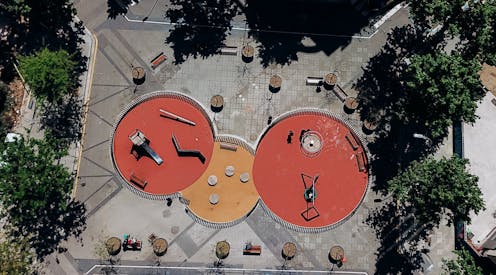
One city that has worked to reinvent the concept of public space is Barcelona. Over 30 years, the city has developed “superblocks” – neighbourhoods where traffic speeds are reduced and through-traffic is limited.
There is no reduction in access for cars or emergency services. It’s more a redefinition of the bus and car network, coupled with lower speed limits in certain areas.
By reducing the priority given to cars in some parts of the city, Barcelona has released public land for a range of uses such as play, business, markets and active travel such as walking and cycling. Significant benefits include lower air pollution and noise, increased green space, more physical activity, fewer premature deaths and higher economic activity.
It is true that cities in Europe are older and denser than in Oceania. But during a recent visit to New Zealand, the inventor of superblocks, urban ecologist Salvador Rueda, outlined how they could work in cities such as Christchurch and Auckland and the benefits this could deliver.
Here are his suggestions, in order of how easy they would be to implement.
1. Stop hoping for a silver bullet
New Zealand has a tendency to favour big infrastructural projects to change cities. Whether it is a new tunnel under Wellington, as proposed by the coalition government, or a light-rail system for Auckland, such projects imply the only solutions are big and expensive.
But because cities are networks, there are often far cheaper options that can be implemented with careful analysis and reallocation of space. This shift in thinking and planning needs to happen first.
2. Use bus networks to identify superblocks
The most climate-efficient, readily available and flexible system to reduce car use in cities is the bus network.
However, organising the bus network in a grid of orthogonal routes that follow perpendicular lines is key. Radial systems leave large gaps of unserviced areas. An orthogonal grid means the city is served equally by buses no matter how large it becomes.
Buses are also frequent and fast. They can easily outcompete cars, and high frequencies can also mitigate any concerns about having to transfer between buses.
3. Better management of on-street parking
Free parking does not actually exist. The question is rather who is paying for it – the user or everyone. In private developments, the user pays in some way. But this is not the case for public spaces.
In Japan, people have to prove they have access to a local parking space before they can buy a car.
But generally, on-street car parking represents a major subsidy to drivers through the use of public space that could be put to other uses. Car parking creates large areas of paved roads that reduce social and business opportunities.
Any revenue gains from parking charges are a false economy, especially when enforcement is weak.
4. Redirect traffic
At the moment, New Zealand cities are designed for unlimited through traffic, with unfettered access across the city.
As much as possible, the city’s public spaces should be divided into those for movement across the network and those which are for mixed uses for all, including pedestrians and those with mobility needs.
In New Zealand, the One Network Framework facilitates this, but few streets seem to actually prioritise people. In Barcelona, in the streets which are for movement, car traffic is aligned with the bus transit, using a one-way system and speed limits of 30km/h.
This comes with many benefits, including less congestion and safer streets.
On the inside of Barcelona’s superblocks, speeds are reduced to 10km/h to allow for different activities.
5. Make targeted investments in public spaces
If the experience of Barcelona demonstrates anything, it is that the creation of public space underwrites a whole range of commercial (as well as social) activity that uncovers latent demand.
In other words, the creation of public space in our cities supports small businesses and commercial activity because people shop and buy coffee, and cars don’t.
6. Encourage density
The New Zealand government acknowledges that boosting density is critical to addressing the housing shortage. Denser housing offers multiple benefits, including lower emissions, reduced infrastcructure costs and better physical and mental health.
Systemic planning changes to enable density are required to maximise the benefits of a superblock approach to development. But a final reason for considering superblocks is their low cost. They don’t require investment in hard infrastructure, demolition of buildings or massive development. They represent very low-tech urbanism.
To mitigate any risk and allay any fears, superblocks can be trialled as low-cost temporary interventions. At a time of necessary cost savings, perhaps New Zealand cities should embrace low-cost, high-impact change.
Authors: Simon Kingham, Professor of Human Geography, University of Canterbury


















