

We know the seas are rising – so why are Australian governments not planning for it?
- Written by: Anthony Boxshall, Enterprise Fellow, The University of Melbourne
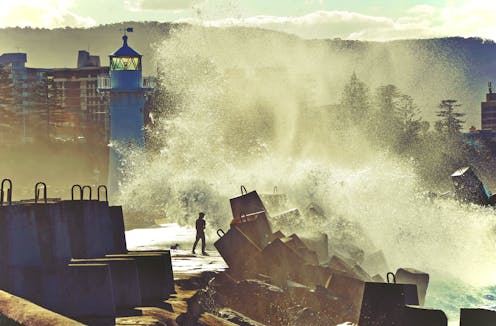
The vast majority of Australians (87%) live within 50 kilometres of a coastline. The coast offers scenery, swimming and cooling from the sea.
But the problem is, coastlines as we know them are going to change. Sea-level rise is accelerating. As seas inch higher, storm surges can reach further inland and coastal erosion intensifies. Australia’s coasts are not immune.
Low-lying areas are particularly vulnerable, such as towns around Western Port Bay in Victoria.
So why aren’t we planning for what will happen? In this year’s federal budget funds were allocated to many long-term needs, such as submarines for defence (around a 20-year timeframe), the Inland Rail project for freight (around 15 years), Sunshine Coast rail link for transport (at least 10 years) and long term policies for green manufacturing. State budgets also make long-term commitments.
But there was nothing to prepare our coastal communities for the water. Sea level rise and storm surge are problems which get steadily worse. If we spend to avoid A$1 billion of damage in 2040, that’s the same as avoiding $4 billion in 2070 and $10 billion by 2100, according to the Kompas report released last year by co-author Tom Kompas and colleagues.

The economic costs are known
If we don’t prepare, we risk damage to housing, the environment, towns and fast-growing coastal and marine industries.
What does sea-level rise cost? The Kompas report found within 75 years, the projected sea-level rise of 0.82 metres coupled with 19% more storm surges would cause staggering economic loss in Victoria, to the tune of $442 billion, flooding 45,000 hectares of inhabited land and affecting almost every coastal community.
Overseas, the scale of the problem is staggering. Estimates for damage to coastal towns and cities in the European Union and United Kingdom are up to $1.4 trillion.
Why aren’t we taking this seriously?
It is good practice to strategically plan for known risks and needs. And we do make long-term plans in many areas. But so far, coastal adaptation is not one of them.
Because greenhouse gas emissions aren’t dropping as needed, we have already locked in a certain level of sea-level rise. That’s because there’s a lag time between emitting gases, warming the atmosphere and oceans, and melting ice flowing into seas.
What does adaptation look like? We have six options:
1. Non-intervention: authorities deliberately let impacts occur. You might use this strategy if it would be too expensive or impossible to protect a coastal area, or if there are no people living there.
2. Avoid: make sure new houses, infrastructure and human uses for coastline are moved away from the area to be affected.
In Australia, local or state-wide sea-level planning benchmarks are used to denote areas where permanent development needs justification. Benchmarks and assessments differ markedly around the nation.
3. Nature-based methods: boost or restore natural systems able to reduce damage.
This method involves working to bring back or improve natural habitats such as coral reefs, sand, shellfish reefs, mangroves, wetlands, saltmarshes, or seagrasses to build up sediment, adding height and natural ways to absorb some of the force of higher seas.
Many Australian states already have examples up and running. In the EU, the REST-COAST program is working on many nature-based restoration projects, while the United States has many examples, such as oyster reef restoration.
4. Managed retreat: relocate away from the danger.
The community of Isle de Jean Charles in Louisiana was the first community globally to retreat inland in a planned way. In Vietnam, farms and villages in Hue province have had to relocate away from the sea.
While no Australian community has gone through a managed retreat due to sea level, the Summerlands estate on Phillip Island was relocated to protect Australia’s most famous penguin colony.
5. Accommodate: rebuild to reduce risk.
When disaster strikes, it makes sense to rebuild to reduce future risk. Australian authorities often use this technique after river floods. But there are no known examples of similar work on our coasts. In the US, areas of New Orleans were rebuilt to let future floodwaters escape rather than stay trapped for weeks, as they did after Hurricane Katrina.
6. Protect: build hard physical barriers to stop the water getting through.
Historically, building seawalls and dikes has been the first response authorities reach for. The problem is, these barriers are expensive to build and maintain, especially at the scale that will be needed.
 Hard protection measures in the form of a two kilometre seawall have been built on Saibai Island in the Torres Strait.
Aaron Bunch
Hard protection measures in the form of a two kilometre seawall have been built on Saibai Island in the Torres Strait.
Aaron Bunch
Where to from here?
What will nudge authorities to start preparing in earnest? Time, for one. As sea-level rise accelerates, authorities will have to act.
But acting late is much more expensive than acting early. We need to avoid the Tragedy of the Horizon, where catastrophe seems far enough away in time that we can delay acting.
What our policymakers need is the social license to act. The planned retreat of the Welsh town of Fairbourne became controversial because when the council’s plans became public, house values plummeted.
To be able to focus on coastal adaptation means decoupling from the political cycle so politicians are supported to make hard but necessary decisions in the interests of the next generation.
A national approach would help. Not everywhere can be protected. It makes sense to focus our efforts on places where many people live, or the special habitats we want to keep.
If we keep putting our heads in the sand, we’ll get soaked.
Acknowledgement: Alan Stokes of the Australian Coastal Councils Association contributed to this article
Authors: Anthony Boxshall, Enterprise Fellow, The University of Melbourne


















