

Hakeem Al-Araibi's case is a test of world soccer's human rights credentials. Here's why
- Written by: Sarah Joseph, Professor, Director, Castan Centre for Human Rights Law, Monash University
Hakeem Al-Araibi is a refugee from Bahrain who plays semi-professional soccer in Melbourne for Pascoe Vale. He is a former member of the Bahraini national football team. He is currently detained in Thailand, the subject of an extradition request by Bahrain. His extradition to that country would breach his human rights against refoulement (the forcible return of refugees) and torture.
Al-Araibi’s case has become a crucial test of world football’s commitment to human rights. Is this commitment real, or is it a public relations statement tossed aside when the going gets tough?
In 2012, Al-Araibi was allegedly one of several athletes who were detained and tortured after pro-democracy protests in Bahrain. Al-Araibi fled Bahrain in 2014, and was accepted as a refugee by Australia in 2017.
In 2014, he was convicted in absentia of vandalising a police station in 2012, for which he was given a sentence of ten years. This was despite an excellent alibi; he was playing in a televised football match at the time of the alleged crime.
Read more: Explainer: what is an Interpol red notice and how does it work?
In 2016, Al-Araibi spoke out against Sheikh Salman Bin Ibrahim Al-Khalifa, who was then running for president of FIFA. Al-Araibi claimed Salman should be investigated for possible involvement in the mass torture of athletes four years earlier. Salman, a member of Bahrain’s ruling royal family, lost his bid for the FIFA presidency. He is and has been the president of the Asian Football Confederation (AFC) since 2013, and a FIFA vice-president.
In late November 2018, Al-Araibi travelled from Australia with his wife for a holiday in Thailand. There he was detained under an Interpol red notice issued pursuant to a request from Bahrain. This notice breached Interpol’s own rules as it was issued against a refugee at the request of the country he had fled.
Al-Araibi has since languished in detention in Thailand for over 60 days. If he is sent back to Bahrain, Thailand will refouler a refugee – that is, return him to the state from which he fled persecution, a grave breach of human rights. There are legitimate fears that he faces torture upon return to Bahrain. His situation has become more dangerous as Bahrain has now formally requested his extradition.
The Australian government is seeking his safe return from Thailand. Former Socceroos captain Craig Foster has been tireless in leading the calls for Al-Araibi’s release and is supported by the World Players Association and the International Olympic Committee. But what of world soccer?
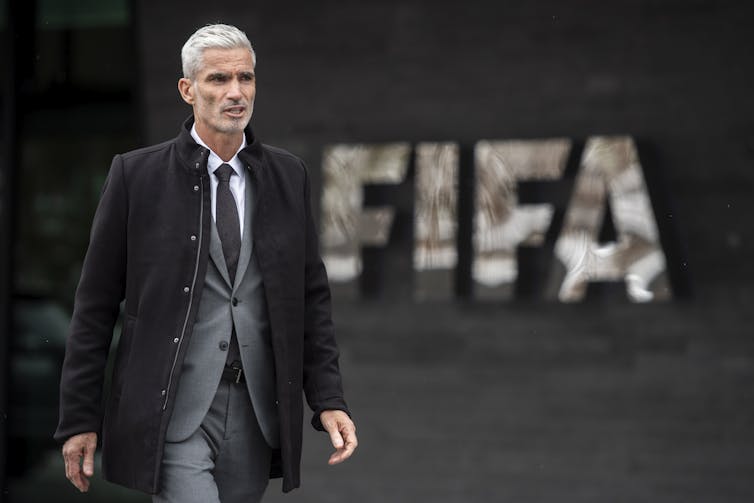 Former Socceroos captain Craig Foster arrives at FIFA headquarters in Switzerland to seek the release of refugee football player Hakeem Al-Araibi.
AAP/EPA/Ennio Leanza
Former Socceroos captain Craig Foster arrives at FIFA headquarters in Switzerland to seek the release of refugee football player Hakeem Al-Araibi.
AAP/EPA/Ennio Leanza
FIFA, which runs world soccer, has recently strengthened its human rights policy. This is part of its efforts to rehabilitate itself after the disgraceful reputation it garnered under the (former) presidency of Sepp Blatter. Its human rights policy filters down to office-holders in its regional confederations, including the AFC. Under its own policy and statutes (see Articles 3 and 4), it has a duty to step in and help Al-Araibi.
Hakeem’s predicament arises from football. His high profile from football is likely why he was tortured in the first place. His outspokenness against Sheikh Salman may be why Bahrain is relentlessly pursuing what looks like a bogus charge and conviction.
This matter is most certainly FIFA’s business. And even more clearly it is the business of the AFC.
FIFA took 45 days to call for Al-Araibi’s safe return to Australia. The AFC took 63 days, finally calling for Al-Araibi’s release on January 29.
Within the AFC, the matter is being managed by its senior vice-president, Praful Patel, with Sheikh Salman being deemed to have a conflict of interest in matters concerning AFC’s Western Zone, which includes Bahrain.
Read more: Qatar saga shows why FIFA should return football to the fans
The admission of such a large conflict of interest must raise questions over the viability of Salman’s position, aside from the implication of his involvement in Al-Araibi’s plight. How can the AFC continue with a president who must eschew involvement in one of only five zones?
The slowness of the FIFA-AFC reaction raises doubts over the robustness with which world soccer is prepared to address human rights issues. Forty-five days is a long time for a person to sit in detention contemplating torture. But … better late than never, perhaps.
Is there more that world soccer can do? In the bad old days of Blatter, FIFA claimed it was powerless to address soccer-related abuses, such as those related to labour rights in erecting stadiums in Qatar for the 2022 World Cup.
Yet that dainty approach to state sovereignty didn’t apply to its intervention in Brazil to ensure the sale of beer in its stadiums, which necessitated a change in Brazilian law for the 2014 World Cup, in aid of the interest of its sponsor Budweiser. In 2011, FIFA threatened to suspend Switzerland from world football after one of its local teams sought to challenge FIFA decisions in Swiss courts. FIFA has not flinched in suspending national football associations that have been deemed to breach FIFA codes, and forcing concessions from national governments.
FIFA has considerable power at its disposal and is capable of flexing its muscle much further in the Al-Araibi case.
Al-Araibi is in arbitrary detention in Thailand, pursuant to an Interpol red notice improperly issued and since cancelled. He is facing some of the most serious human rights breaches, refoulement and torture. The situation calls for urgent measures, including the threat of sporting sanctions against Thailand and Bahrain if Al-Araibi is not released immediately.
If strong measures are not taken in such a clear-cut situation of human rights abuse, FIFA and the AFC will be exposed as lacking the courage of their much-trumpeted human rights convictions. The new human rights policy will be revealed as words devoid of any intended practical effect.
FIFA has shown it can act quickly and decisively for the commercial interests of Budweiser. Now it must show it can act for the human rights of one of its own.
I would like to thank Francis Awaritefe for his assistance in providing materials for this article.
Authors: Sarah Joseph, Professor, Director, Castan Centre for Human Rights Law, Monash University


















