

Back to Back’s Multiple Bad Things takes a sophisticated look at the moral ambiguities of today’s ‘culture wars’
- Written by: Sarah Austin, Lecturer in Theatre, The University of Melbourne
Back to Back Theatre is an internationally lauded ensemble of collaborators based in Geelong. With some members identifying as intellectually disabled and/or neurodiverse, the company has spent more than two decades producing performance works that address the politics of visibility and power.
The company has been described as having an “astonishing ability to dissect the unspoken imaginings of society”. And its latest show, Multiple Bad Things, directed by Tamara Searle and Ingrid Voorendt, showcases this capacity.
With great sophistication and certainty, the performance takes the dynamics of a workplace and reflects it to the audience to reveal the complex power dynamics, inequitable structures and political tensions that underpin and uphold the damaging status quo.
The workplace as a site of tensions
Taking place in a context that seems part-factory and part-construction site, four workers appear. One (Simon Laherty) directly addresses the audience as a narrator, blithely providing trigger warnings for the work they are about to see, and takes a seat at a desk as if he is a supervisor in his site office.
His computer screen is visible to the audience. He begins playing a game of solitaire, but eventually we watch as he doomscrolls through video clips of highly muscled men working out, fast cars, guns, porn and nature documentaries. Laherty’s character implicates the audience in this world, positioning them as present but silent voyeurs.
A second worker (Scott Price) arrives and promptly parks himself on a giant inflatable pool floatie shaped like a flamingo. They are then joined by the other two (Bron Batten and Sarah Mainwaring). Batten appears to be the only non-disabled person on stage.
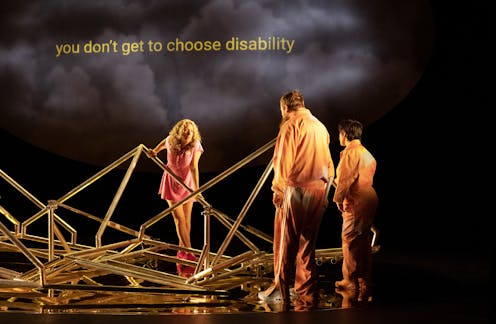
Batten and Mainwaring appear to have the most work ethic. They begin piecing together the structure that dominates the centre of designer Anna Cordingley’s compelling set. It resembles a kind of post-apocalyptic Ikea nightmare: an enormous spiky tangle of poles or pipes that must somehow fit together.

In what appears to be a demonstration of human futility, the workers begin listing “bad things” while assembling the structure. As they work, apparently banal conversations take place.
At one point, they discuss the “international” aisle at the supermarket. As Price interjects with the kind of cuisines that can be found in this aisle (Mexican! Dutch! Japanese!), Mainwaring points out British food is now also located in the international aisle. Batten remarks that this seems pointless, given British food also occupies the rest of the supermarket.
These seemingly innocuous exchanges of dialogue underscore a central thread in the work, as the performers begin to wrestle with notions of difference and diversity, and the question of who gets to take up space. As the exchanges take place, we start to see a painfully obvious embodied representation of inequity among the workers, as Mainwaring physically struggles with the task at hand and requests help.
 Mainwaring (back) and Price at work.
Ferne Millen
Mainwaring (back) and Price at work.
Ferne Millen
The harms of moral righteousness
As the show progresses, Batten reacts to Price’s perceived laziness by removing the air from the inflatable, triggering a great argument between them. Price claims he has been violently targeted because of his autism. Batten counteracts this by adopting the language of the oppressed to assert her own diversity and need for support.
In doing so, she maintains the system of power that clearly has her at the top of the pecking order as the only non-disabled person of the four.
Mainwaring watches on, at times saying she doesn’t understand what’s happening between them. Price seems to lose the argument, carrying the deflated flamingo and lying on the floor, proclaimed “dead” by Batten, who poses hero-like around the structure, celebrating her victory.
This moment reveals the disquieting outcome of Batten’s self-victimisation. It also speaks to the harm that can be caused by those who come from a place of moral righteousness and certitude.
The structures seemingly set up to support inclusion are revealed as redundant tools through a sly referencing of the workplace’s Diversity and Inclusion Committee, and a hopelessly frustrating and hilarious phone call Mainwaring makes to a support helpline. The audience is shown how these tools maintain control and drown out the voices of the most disenfranchised, leaving the workers to manage their own issues without support.
Negotiating power onstage
Multiple Bad Things demonstrates Back to Back Theatre’s leading approach to a growing area of interest in disability arts practice: the aesthetics of access. This is where we see sophisticated ways of incorporating access, for both audience and performers, into the framework and design of the performance.
One example was the use of the oval screen at the rear of the stage used to display subtitles. This text was, thanks to the audio-visual design by Rhian Hinckley, seamlessly integrated into the design of the broader work – and at times strategically used to disrupt or underscore the action on stage.
 The use of the oval screen fits cleverly into the broader work.
Ferne Millen
The use of the oval screen fits cleverly into the broader work.
Ferne Millen
Directors Searle and Voorendt have crafted a proficient, seamless, complex and sophisticated hour-long work. They bring the unique performances and identities of the ensemble, along with an evocative score by Zoë Barrie and assured lighting design by Richard Vabre, into symbolic interplay. As these elements weave together, the performance oscillates between playful and poignant, flippant and horrific.
The final moments of the show see Mainwaring alone on stage, completing the assembly herself and it then initiating the final transformation of the spiky poles in a powerful theatrical moment.
Laherty leaves his office post for the third time in the performance and delivers a monologue about computer solitaire. “Sometimes you win and sometimes you lose,” he says. “You have to be prepared to lose a few games before you win.”
Mainwaring and Laherty embrace. In stark juxtaposition to the conflict and suffering we have just witnessed, we see a moment of care between the performers. While much is left unresolved regarding the central question of difference, diversity and who is entitled to take up space, Laherty’s reflections on solitaire resonate with this image.
Multiple Bad Things highlights there may be no singular perspective on what is right and wrong. Perhaps, as we collectively negotiate the building of more equitable structures, success relies on what it is we’re prepared to lose in order to win.
Authors: Sarah Austin, Lecturer in Theatre, The University of Melbourne


















