

Modern Australian
The Times

Trying to save money? Our research suggests paying in cash – while you still can

  • Written by Lachlan Schomburgk, PhD Researcher in Marketing, University of Adelaide
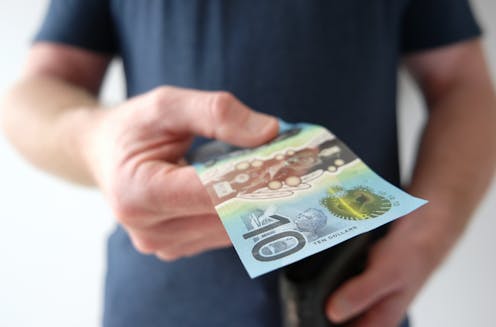
Trying to save money? Our research suggests paying in cash – while you still can

Cash is in crisis. In Australia, it’s now only used for 16% of in-person transactions, down from about 70% in 2007.

The situation is so dire that on Monday, independent federal MP Andrew Gee introduced a private member’s bill that would force businesses to accept cash or else face big fines.

Woman makes EFTPOS payment using phone
Digital wallets mean even physical bank cards are no longer required. Christiann Koepke/Unsplash

The reality is that over the past decade, technological advancements have utterly transformed the way we pay for goods and services.

Phones and smartwatches can now easily be used to pay by card, and buy-now-pay-later schemes and cryptocurrency payments offer further alternatives.

The shift away from cash only accelerated throughout the COVID pandemic, as health experts recommended avoiding using it for hygiene reasons.

Despite these big changes in how we spend money, Australians have perhaps been more focused on how much amid a stubborn cost-of-living crisis.

In light of this, our research team wanted to investigate how our choice of payment method can interact with our actual spending habits.

Our latest research offers a simple solution for anyone looking to save money — carry more cash!

Read more: Money transporter Armaguard is in peril. Could cash be dead sooner than we think?

We pay less when we pay cash

Drawing on both academic and industry sources, our research team combined the results from more than four decades of prior research on spending behaviour and payment methods into a large dataset.

This data spanned 71 research papers, 17 countries, and more than 11,000 participants. State-of-the-art meta-analysis techniques then allowed us to collectively analyse the results from all these prior studies, and re-examine their insights.

We found that cashless payments were indeed associated with higher levels of consumer spending compared to cash transactions, something that is referred to in the literature as the “cashless effect”.

This cashless effect was consistent across all other payment methods in the data set.

Put simply, it doesn’t matter whether you use a credit card, debit card or a buy-now-pay-later service – you are likely to spend more money using cashless methods than when you pay with cash.

The pain of paying

Under the traditional economic view that consumers behave rationally, there should be no differences in spending behaviour between different payment methods – money is money after all.

But the existence of the cashless effect shows that the payment methods we use do indeed influence our spending behaviour.

The leading theory to explain this effect attributes it to differences in the “pain of paying”, a concept first coined in 1996 that describes the emotions we feel when spending money.

Importantly, our choice of payment method can influence the level of pain felt.

Woman's hands open wallet showing two $20 notes
Spending cash means holding and losing a tangible object that we feel like we own. Michael Leslie/Shutterstock

When paying with cash, we have to physically count out notes and coins and hand them over. Humans seek to avoid losses, and paying by cash sees us physically lose a tangible object.

Conversely, nothing has to be handed over to pay cashlessly. We don’t lose anything tangible with a swipe or a tap, so it feels less painful.

Preliminary neurological evidence suggests that the “pain of paying” isn’t just an abstract metaphor, and we may feel actual psychological pain with each transaction we make.

Research employing functional magnetic resonance imaging (fMRI) scans to observe brain activity in consumers has shown that paying activates brain regions related to experiencing psychological discomfort.

Mother and a young child drive dodgem car together in theme-park
Using cash slows us down, helping us keep track of spending. StockLite/Shutterstock

Picture this: You’re at a theme park, excited for a fun day. You use your smartwatch to pay for snacks, souvenirs and rides. It’s all so convenient that you don’t realise how much you’re spending until you check your account later and see that you have completely blown your budget!

This is the cashless effect in action − if nothing is physically handed over, it’s easy to lose track of how much is spent.

A great tool for budgeting – while it lasts

The cost of living crisis has made spending control front-of-mind for many people. Our meta-analysis suggests that returning to “cold hard cash” whenever possible could be one valuable tool to help.

The increased friction felt when using cash could help people better control their money, even just by providing a moment to pause and consider whether a transaction is necessary.

This could help individuals make more mindful decisions, saving money while they can in an increasingly cashless world.

Authors: Lachlan Schomburgk, PhD Researcher in Marketing, University of Adelaide

Read more https://theconversation.com/trying-to-save-money-our-research-suggests-paying-in-cash-while-you-still-can-231499

Why Protein Bars Are A Convenient Option For Daily Nutrition And Energy

Maintaining balanced nutrition throughout the day can be challenging, especially for individuals with busy schedules, which is why protein bars hav...

Property Settlements After Separation: Key Considerations

Dividing assets after a separation is one of the more complex and emotionally charged aspects of the process. Understanding how property settlements...

Why Dust Control Matters During Bathroom Demolition

People usually expect bathroom demolition to be noisy.  No one thinks of dust — but it turns up everywhere. Inside cupboards. On couches. Along...

Why Roller Shutters And Outdoor Blinds Are Popular For Modern Properties

Many homeowners and businesses now install roller shutters to improve security, privacy, insulation, and weather protection across residential and ...

Slushie Machine Hire for Events: What to Check Before Booking

There's a moment at every great event when guests stop what they're doing and just enjoy something. A slushie machine is often that moment. It draws p...

Why AS/NZS Certified Sunglasses Are Essential for Australian Kids

Australia has some of the highest UV radiation levels in the world. That's not a warning label exaggeration; it's a measurable, documented fact that s...

Why People Regain Weight After Weight Loss?

Losing weight is hard; keeping it off is harder; and regaining it after all that effort is something many people go through more than most realise. ...

10 Benefits of Having a Frozen Yoghurt Machine for Your Business

Frozen yoghurt is a commercially viable dessert option for a wide range of food service businesses due to its versatility, efficiency, and consisten...

Why Slurry Hose is Essential For High-Performance Material Transfer

Handling abrasive and dense materials efficiently requires specialised equipment, which is why a slurry hose is a critical component in industries ...

Why Coworking Spaces In Melbourne Are Transforming The Way Professionals Work

The modern workforce is evolving rapidly, with flexibility, collaboration, and efficiency becoming central to how people work, which is why a coworkin...

The Everyday Wear and Tear Most Warehouse Storage Systems Experience

The modern warehouse is a dynamic, high velocity environment where industrial storage structures are subjected to immense, continuous physical stres...

Why Pendant Lights Continue To Be A Popular Choice In Modern Interiors

Lighting has become an essential design element in modern homes, influencing both the appearance and functionality of interior spaces. Many homeowne...

How Whiteboard Supports Structured Communication In Work And Learning Environments

Clear communication and structured planning are essential in both professional and educational settings, which is why a whiteboard remains a practi...

How A Cardboard Box Manufacturer Supports Modern Packaging Needs

Packaging has become an essential part of modern business operations across retail, manufacturing, logistics, and e-commerce industries. Many busine...

How Pallet Racking Helps Businesses Improve Warehouse Operations

Efficient warehouse management depends on reliable storage systems that support organisation, safety, and productivity. Many businesses use pallet rac...

Why I/O Controller Is Essential For Efficient Industrial Automation Systems

Modern industrial systems rely heavily on automation and precise data exchange, which is why an I/O controller plays a critical role in ensuring sm...

Why Modern Traffic Management Systems Are Important For Safer Roads

Cities and industrial facilities increasingly rely on advanced Traffic Light System technology to improve road safety, traffic flow, and operationa...

How Structured eCommerce Web Design Influences Online Buying Behaviour

A strong online presence begins with effective eCommerce web design that prioritises both functionality and user experience. Businesses entering or...
















