

Our 'bee-eye camera' helps us support bees, grow food and protect the environment
- Written by: Adrian Dyer, Associate Professor, RMIT University
Walking through our gardens in Australia, we may not realise that buzzing around us is one of our greatest natural resources. Bees are responsible for pollinating about a third of food for human consumption, and data on crop production suggests that bees contribute more than US$235 billion to the global economy each year.
By pollinating native and non-native plants, including many ornamental species, honeybees and Australian native bees also play an essential role in creating healthy communities – from urban parks to backyard gardens.
Despite their importance to human and environmental health, it is amazing how little we know how about our hard working insect friends actually see the world.
By learning how bees see and make decisions, it’s possible to improve our understanding of how best to work with bees to manage our essential resources.
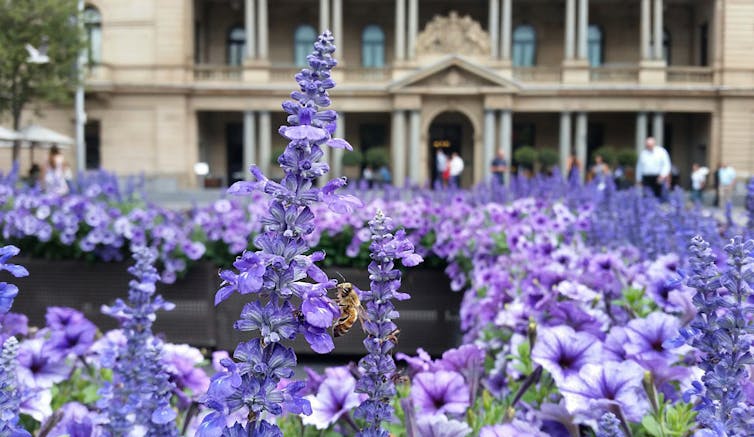 Insects in the city: a honeybee forages in the heart of Sydney.
Adrian Dyer/RMIT University
Insects in the city: a honeybee forages in the heart of Sydney.
Adrian Dyer/RMIT University
Read more: Bees get stressed at work too (and it might be causing colony collapse)
How bee vision differs from human vision
A new documentary on ABC TV, The Great Australian Bee Challenge, is teaching everyday Australians all about bees. In it, we conducted an experiment to demonstrate how bees use their amazing eyes to find complex shapes in flowers, or even human faces.
Humans use the lens in our eye to focus light onto our retina, resulting in a sharp image. By contrast, insects like bees use a compound eye that is made up of many light-guiding tubes called ommatidia.
The top of each ommatidia is called a facet. In each of a bees’ two compound eyes, there are about 5000 different ommatidia, each funnelling part of the scene towards specialised sensors to enable visual perception by the bee brain.
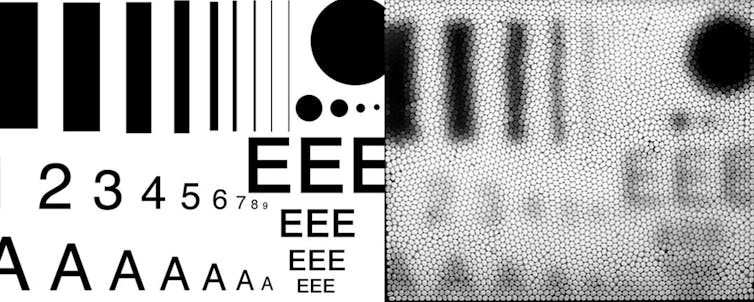 How we see fine detail with our eyes, and how a bee eye camera views the same information at a distance of about 15cm.
Sue Williams and Adrian Dyer/RMIT University
How we see fine detail with our eyes, and how a bee eye camera views the same information at a distance of about 15cm.
Sue Williams and Adrian Dyer/RMIT University
Since each ommatidia carries limited information about a scene due to the physics of light, the resulting composite image is relatively “grainy” compared to human vision. The problem of reduced visual sharpness poses a challenge for bees trying to find flowers at a distance.
To help draw bees’ attention, flowers that are pollinated by bees have typically evolved to send very strong colour signals. We may find them beautiful, but flowers haven’t evolved for our eyes. In fact, the strongest signals appeal to a bee’s ability to perceive mixtures of ultraviolet, blue and green light.
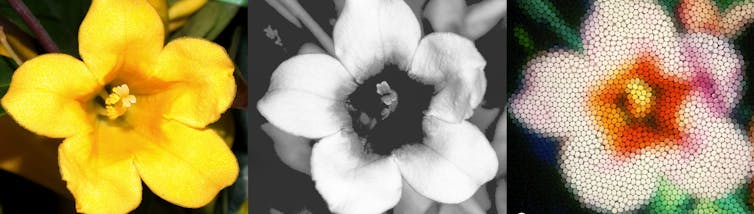 Yellow flower (Gelsemium sempervirens) as it appears to our eye, as taken through a UV sensitive camera, and how it likely appears to a bee.
Sue Williams and Adrian Dyer/RMIT University
Yellow flower (Gelsemium sempervirens) as it appears to our eye, as taken through a UV sensitive camera, and how it likely appears to a bee.
Sue Williams and Adrian Dyer/RMIT University
Building a bee eye camera
Despite all of our research, it can still be hard to imagine how a bee sees.
So to help people (including ourselves) visualise what the world looks like to a bee, we built a special, bio-inspired “bee-eye” camera that mimics the optical principles of the bee compound eye by using about 5000 drinking straws. Each straw views just one part of a scene, but the array of straws allows all parts of the scene to be projected onto a piece of tracing paper.
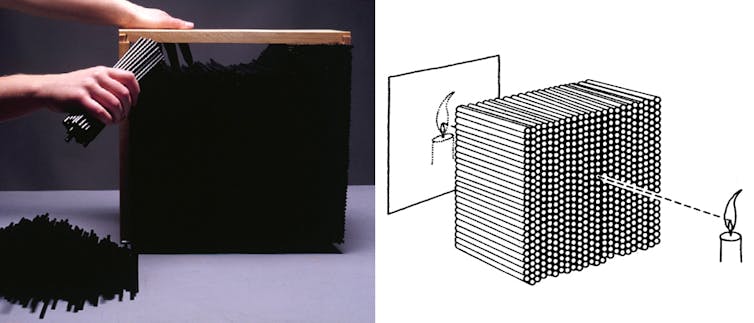 How a bee eye camera works by only passing the constructive rays of light to form an image.
Sue Williams and Adrian Dyer/RMIT University
How a bee eye camera works by only passing the constructive rays of light to form an image.
Sue Williams and Adrian Dyer/RMIT University
The resulting image can then be captured using a digital camera. This project can be constructed by school age children, and easily be assembled multiple times to enable insights into how bees see our world.
Because bees can be trained to learn visual targets, we know that our device does a good job of mimicking a bees visual acuity.
Student projects can explore the interesting nexus between science, photography and art to show how bees see different things, like carrots – which are an important part of our diet and which require bees for the efficient production of seeds.
Clip from “The Great Australian Bee Challenge, Episode 2.Read more: A bee economist explains honey bees' vital role in growing tasty almonds
Understanding bee vision helps us protect bees
Bees need flowers to live, and we need bees to pollinate our crops. Understanding bee vision can help us better support our buzzy friends and the critical pollination services they provide.
In nature, it appears that flowers often bloom in communities, using combined cues like colour and scent to help important pollinators find the area with the best resources.
Having lots of flowers blooming together attracts pollinators in much the same way that boxing day sales attract consumers to a shopping centre. Shops are better together, even though they are in competition – the same may be true for flowers!
This suggests that there is unlikely to be one flower that is "best” for bees. The solution for better supporting bees is to incorporate as many flowers as possible – both native and non native – in the environment. Basically: if you plant it, they will come.
We are only starting to understand how bees see and perceive our shared world – including art styles – and the more we know, the better we can protect and encourage our essential insect partners.
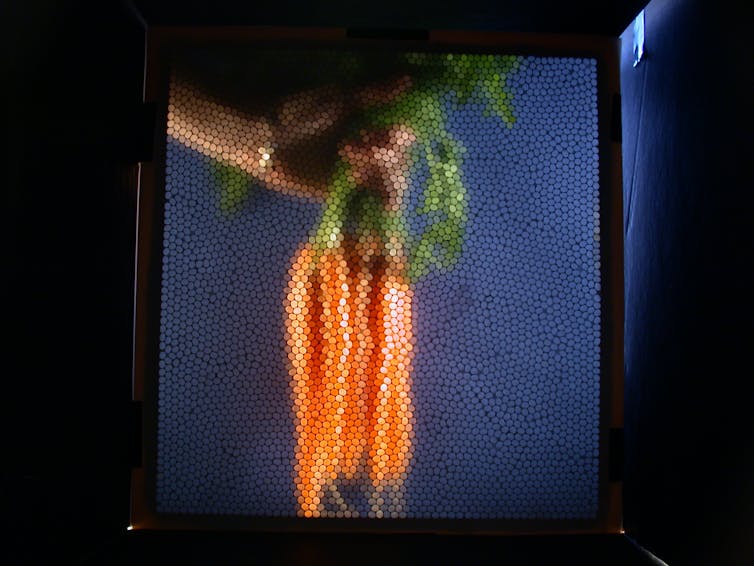 Looking at the fruits and vegetables of bee pollination; a bee camera eye view of carrots.
Sue Williams and Adrian Dyer/RMIT University
Looking at the fruits and vegetables of bee pollination; a bee camera eye view of carrots.
Sue Williams and Adrian Dyer/RMIT University
Authors: Adrian Dyer, Associate Professor, RMIT University


















