

We have a moral responsibility to help low-income nations restore coral reefs
- Written by: Mark Gibbs, Lead - Pilot Deployments Program (AIMS); Professor (Queensland University of Technology; Adjunct), Australian Institute of Marine Science
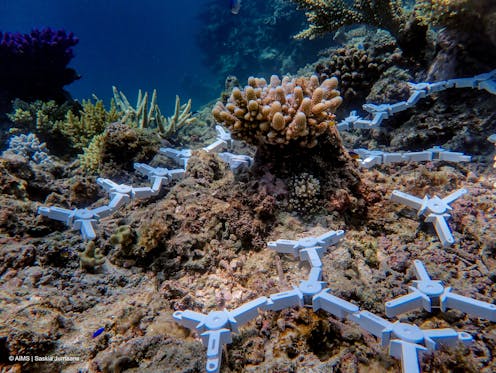
The fourth global coral bleaching event is underway. It won’t be the last.
Even if we reduce the greenhouse gas emissions driving climate change, excess heat will remain in the ocean.
I believe high-income nations such as Australia have a moral responsibility to help coral reefs build resilience to heat stress, wherever they are in the world. That includes making sure these methods are accessible to everyone.
High-income nations are largely responsible for climate change. They are also better equipped and resourced to manage adverse events on coral reefs. Australian scientists are leading research and development in this area, selecting heat-tolerant corals for intensive breeding programs in aquaculture facilities. These corals are then planted back into the wild, building reef resilience.
What is driving mass coral bleaching?
Greenhouse emissions are building up in the atmosphere, trapping more of the Sun’s heat before it can radiate back into space.
Globally, oceans are warming and the rate of warming is increasing, with serious consequences for marine life.
Heat stress is widely acknowledged as the biggest threat to coral reefs worldwide. One of the main symptoms is coral bleaching, which can lead to mass mortality events.
Unfortunately, there is now so much heat in the oceans that coral reefs will continue to suffer heat stress for decades even if global emissions cease.
Efforts to reduce carbon emissions have been too slow to avoid damage to coral reefs. But every fraction of a degree matters.
We need to reduce greenhouse gas emissions as fast as possible to “flatten the curve” of exponential heat stress. The survival of the world’s coral reefs depend on it.

Why are low-income nations more dependent on coral reefs?
Coral reefs support entire communities in low-income nations. Many people rely on the reef for food and income, from fishing and tourism.
Even in high-income nations such as Australia, remote Indigenous coastal communities rely on coral reefs. The reef is an essential part of their culture and way of life.
Reefs also offer coastal protection for low-lying communities, dampening wave energy. Many of these communities cannot afford to build and maintain large-scale coastal protection infrastructure such as sea walls. They are also unable to relocate to higher land.
 Coral reefs provide coastal protection, like a natural sea wall.
AIMS | Neal Cantin | South Direction Island
Coral reefs provide coastal protection, like a natural sea wall.
AIMS | Neal Cantin | South Direction Island
Why do we need to help coral reefs?
Coral reefs are found in more than 100 countries around the world. They are hotspots of biodiversity. While they cover less than 1% of the seafloor, they support at least 25% of all marine species.
Climate change is killing corals and eroding the capacity of these reef systems to provide essential ecosystem services.
Mass coral bleaching is also driving social inequality because low-income nations often rely on coral reefs for their food and livelihoods. But high-income nations have the greatest capacity to intervene and potentially improve reef resilience.
Countries such as Australia and the United States are increasingly investing in coral reef restoration projects, while low-income nations are mostly unable to do so without assistance.
That’s why high-income nations have a duty to intervene. We must develop ways to improve reef resilience and facilitate the application of these approaches across low-income nations and First Nations communities.
The effort required should not be underestimated. Developing ways to improve regional reef resilience is an enormous challenge.
These new approaches must be made available to communities with the greatest need. Protecting and restoring remote coral reefs could make all the difference, ensuring the future of coral reefs.
 Portable coral factories (ReefSeed) can be set up in remote locations to produce large volumes of young corals for targeted reef restoration.
AIMS
Portable coral factories (ReefSeed) can be set up in remote locations to produce large volumes of young corals for targeted reef restoration.
AIMS
How can we help reefs in low-income nations?
Many coral reef restoration projects are underway across the world’s tropics. These are small in scale and not designed to halt large-scale biodiversity loss from mass bleaching events. A global review of restoration methods found most focused on rearing and transplanting fast-growing branching corals.
High-income nations such as Australia are pioneering methods to produce and deploy large numbers of young corals that are more heat-resistant.
These new approaches draw on industrial mass production techniques such as those used in large-scale aquaculture operations. Applying process engineering principles such as lean manufacturing and adaptive supply chain management dramatically increases the rate of coral production.
After identifying naturally-occurring heat-tolerant corals in the wild, we have been propogating these varieties in aquaculture facilities. Then we put their offspring back on the same reefs to improve tolerance to bleaching events.
These processes are being developed in programs such as Australia’s Reef Restoration and Adaptation Program and the United Nations’ Coral Research & Development Accelerator Platform program.
Reef managers can then focus on maintaining crucial source reefs that supply neighbouring reefs through natural larval dispersal. During major spawning events these corals produce millions of eggs and sperm. The fertilised eggs are then transported on ocean currents to settle and grow on other reefs.
Coral restoration capacity building
These new approaches to coral restoration are similar to successful evidence-based conservation programs on land, for the recovery of threatened animal populations.
The main challenge now is how to implement these approaches in low-income nations. But this challenge is nothing new. Many development and aid programs face struggle to translate methods developed in high-income nations to low-income nations.
Successful implementation requires careful consideration of the methods and equipment required. Low-income nations and communities can be early adopters of new technology as long as it is reliable and user-friendly. If solutions are not fit for purpose, we risk “ecological imperialism”.
Coral restoration capacity building requires significant time and investment. But this investment is crucial for the survival of the worlds’ coral reefs.
Authors: Mark Gibbs, Lead - Pilot Deployments Program (AIMS); Professor (Queensland University of Technology; Adjunct), Australian Institute of Marine Science


















