

Are plant-based burgers really bad for your heart? Here’s what’s behind the scary headlines
- Written by: Evangeline Mantzioris, Program Director of Nutrition and Food Sciences, Accredited Practising Dietitian, University of South Australia
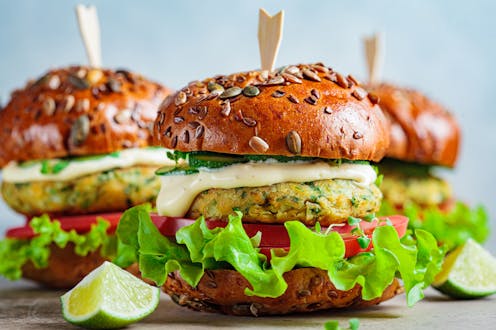
We’re hearing a lot about ultra-processed foods and the health effects of eating too many. And we know plant-based foods are popular for health or other reasons.
So it’s not surprising new research out this week including the health effects of ultra-processed, plant-based foods is going to attract global attention.
And the headlines can be scary if that research and the publicity surrounding it suggests eating these foods increases your risk of heart disease, stroke or dying early.
Here’s how some media outlets interpreted the research. The Daily Mail ran with:
Vegan fake meats are linked to increase in heart deaths, study suggests: Experts say plant-based diets can boost health – but NOT if they are ultra-processed
The New York Post’s headline was:
Vegan fake meats linked to heart disease, early death: study
But when we look at the study itself, it seems the media coverage has focused on a tiny aspect of the research, and is misleading.
So does eating supermarket plant-based burgers and other plant-based, ultra-processed foods really put you at greater risk of heart disease, stroke and premature death?
Here’s what prompted the research and what the study actually found.
Remind me, what are ultra-processed foods?
Ultra-processed foods undergo processing and reformulation with additives to enhance flavour, shelf-life and appeal. These include everything from packet macaroni cheese and pork sausages, to supermarket pastries and plant-based mince.
There is now strong and extensive evidence showing ultra-processed foods are linked with an increased risk of many physical and mental chronic health conditions.
Although researchers question which foods should be counted as ultra-processed, or if all of them are linked to poorer health, the consensus is that, generally, we should be eating less of them.
We also know plant-based diets are popular. These are linked with a reduced risk of chronic health conditions such as heart disease and stroke, cancer and diabetes. And supermarkets are stocking more plant-based, ultra-processed food options.
How about the new study?
The study looked for any health differences between eating plant-based, ultra-processed foods compared to eating non-plant based, ultra-processed foods. The researchers focused on the risk of cardiovascular disease (such as heart disease and stroke) and deaths from it.
Plant-based, ultra-processed foods in this study included mass-produced packaged bread, pastries, buns, cakes, biscuits, cereals and meat alternatives (fake meats). Ultra-processed foods that were not plant-based included milk-based drinks and desserts, sausages, nuggets and other reconstituted meat products.
The researchers used data from the UK Biobank. This is a large biomedical database that contains de-identified genetic, lifestyle (diet and exercise) and health information and biological samples from half a million UK participants. This databank allows researchers to determine links between this data and a wide range of diseases, including heart disease and stroke.
They used data from nearly 127,000 people who provided details of their diet between 2009 and 2012. The researchers linked this to their hospital records and death records. On average, the researchers followed each participant’s diet and health for nine years.

What did the study find?
With every 10% increase of total energy from plant-sourced, ultra-processed foods there was an associated 5% increased risk of cardiovascular disease (such as heart disease or stroke) and a 12% higher risk of dying from cardiovascular disease.
But for every 10% increase in plant-sourced, non-ultra-processed foods consumed there was an associated 7% lower risk of cardiovascular disease and a 13% lower risk of dying from cardiovascular disease.
The researchers found no evidence for an association between all plant-sourced foods (whether or not they were ultra-processed) and either an increased or decreased risk of cardiovascular disease or dying from it.
This was an observational study, where people recalled their diet using questionnaires. When coupled with other data, this can only tell us if someone’s diet is associated with a particular risk of a health outcome. So we cannot say that, in this case, the ultra-processed foods caused the heart disease and deaths from it.
Why has media coverage focused on fake meats?
Much of the media coverage has focused on the apparent health risks associated with eating fake meats, such as sausages, burgers, nuggets and even steaks.
These are considered ultra-processed foods. They are made by deconstructing whole plant foods such as pea, soy, wheat protein, nuts and mushrooms, and extracting the protein. They are then reformulated with additives to make the products look, taste and feel like traditional red and white meats.
However this was only one type of plant-based, ultra-processed food analysed in this study. This only accounted for an average 0.2% of the dietary energy intake of all the participants.
Compare this to bread, pastries, buns, cakes and biscuits, which are other types of plant-based, ultra-processed foods. These accounted for 20.7% of total energy intake in the study.
 This image was at the top of the media release.
Screenshot/Imperial
This image was at the top of the media release.
Screenshot/Imperial
It’s hard to say why the media focused on fake meat. But there is one clue in the media release issued to promote the research.
Although the media release did not mention the words “fake meat”, an image of plant-based burgers, sausages and meat balls or rissoles featured prominently.
The introduction of the study itself also mentions plant-sourced, ultra-processed foods, such as sausages, nuggets and burgers.
So it’s no wonder people can be confused.
Does this mean fake meats are fine?
Not necessarily. This study analysed the total intake of plant-based, ultra-processed foods, which included fake meats, albeit a very small proportion of people’s diets.
From this study alone we cannot tell if there would be a different outcome if someone ate large amounts of fake meats.
In fact, a recent review of fake meats found there was not enough evidence to determine their impact on health.
We also need more recent data to reflect current eating patterns of fake meats. This study used dietary data collected from 2009 to 2012, and fake meats have become more popular since.
What if I really like fake meat?
We have known for a while that ultra-processed foods can harm our health. This study tells us that regardless if an ultra-processed food is plant-based or not, it may still be harmful.
We know fake meat can contain large amounts of saturated fats (from coconut or palm oil), salt and sugar.
So like other ultra-processed foods, they should be eaten infrequently. The Australian Dietary Guidelines currently recommends people should only consume foods like this sometimes and in small amounts.
Are some fake meats healthier than others?
Check the labels and nutrition information panels. Look for those lowest in fat and salt. Burgers and sausages that are a “pressed cake” of minced ingredients such as nuts, beans and vegetables will be preferable to reformulated products that look identical to meat.
You can also eat whole plant-based protein foods such as legumes. These include beans, lentils, chickpeas and soy beans. As well as being high in protein and fibre, they also provide essential nutrients such as iron and zinc. Using spices and mushrooms alongside these in your recipes can replicate some of the umami taste associated with meat.
Authors: Evangeline Mantzioris, Program Director of Nutrition and Food Sciences, Accredited Practising Dietitian, University of South Australia


















