

Worried about PFAS in your drinking water? Here’s what the evidence says about home filters
- Written by: Ian A. Wright, Associate Professor in Environmental Science, Western Sydney University
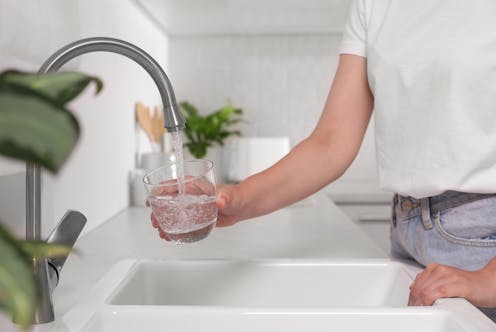
Recent news about PFAS “forever chemicals” in Australian drinking water supplies has been very confronting. Many people are asking how they can remove these contaminants from their home drinking water.
In short, it is difficult and expensive to do this effectively in your home.
The United States Environmental Protection Agency provides useful and clear advice about per- and polyfluoroalkyl substances (PFAS) and how they can be removed from drinking water.
One of the major challenges in removing PFAS chemicals from drinking water is the enormous number (more than 10,000) of individual chemicals in this group. US authorities warn these can cause cancer over a long period of time. No single filtration or treatment technology is 100% effective at removing them.
So, what are the options? And can you filter too much out of your drinking water?
Read more: There are 'forever chemicals' in our drinking water. Should standards change to protect our health?
Four treatment systems
US authorities have reviewed dozens of controlled studies on how to remove PFAS and other contaminants from drinking water. The costs involved in many of the treatment options that remove PFAS can be expensive. Many of the cheapest filters will not be effective.
There are four broad systems for treating drinking water to remove such contaminants in the home.
1. Activated carbon
The first two treatment systems use an adsorption process (rather than absorption) to attract and trap PFAS and other contaminants from water. Absorption is when one substance is absorbed into another, but adsorption is when particles stick onto the surface of another substance. Adsorption using “activated carbon” is a widely used industrial process for drinking water treatment to remove a range of substances.
Adsorption binds PFAS or other contaminants through ionic bonds using either negatively charged or positively charged particles. It can be used to filter water as “granular activated carbon” or as “carbon block filters”. These are two broad types of water filters that use activated carbon.
2. Ion exchange resins
This second adsorption treatment uses different formulations of resin (or polymers) to chemically attract and remove targeted contaminants in water. The ion exchange filters use very small “microbeads” that have a large surface area to attract and remove contaminants.

3. Reverse-osmosis
This process uses electrical energy to build pressure to force water through semi-permeable filtration membranes usually made of layers of polyester material. The membrane has minute holes that only allow water molecules to pass through. This system creates a waste liquid often called “brine”. It contains the accumulated chemical and other matter that could not pass through the membrane.
Reverse-osmosis is a popular technology used on a very large scale to purify water. For example, desalination plants use this system to remove salt from sea water for drinking water supplies.
Such systems are also widely available at smaller scales for home water treatment. They are widely used across regional Australia where water supplies are often very saline or contain other impurities. They can be installed into home plumbing or smaller bench-top systems.
4. Distillation
A fourth treatment system is “distillation” of water. This process uses heat to boil water to produce steam. It then allows the steam to cool and condense, and then collects the resulting purified water.
It is not commonly used, although is one of the oldest water purification systems. It does not always reliably produce pure water as many chemicals have a lower boiling point than water. As a result, they can also be evaporated, condense and contaminate the processed water.
The process of boiling water will not remove PFAS chemicals on its own.
There is such a thing as too pure
A word of warning: drinking demineralised water produced by reverse-osmosis or distillation can have a number of adverse consequences.
People need minerals, such as calcium and magnesium, provided by drinking water. While many essential minerals come from food and a balanced diet, a lack of these in water can upset a person’s electrolyte balance and can also trigger a range of health issues. If you do drink demineralised water, it would be wise to seek medical advice.
Also, demineralised water can be aggressive to plumbing, increasing the rate of corrosion of household pipes and appliances. This can dissolve metals from the plumbing into the drinking water, as demonstrated on a very large scale when a new water supply caused corrosion and increased lead content in Flint, Michigan.
 Treatment at the source of drinking water is a far better option long term.
AU USAnakul/Shutterstock
Treatment at the source of drinking water is a far better option long term.
AU USAnakul/Shutterstock
The bottom line
Searching for information on the best system for removal of PFAS chemicals from drinking water is difficult. Guidance from Australian government agencies and the water industry seems absent or inadequate. And finding impartial advice is tough.
My own recommendation, based on published studies, would probably be a reverse-osmosis, dual-stage filter installed “under the sink”.
A detailed 2020 study investigated drinking water and PFAS in more than 60 US homes. It showed near-complete removal by reverse-osmosis, dual filtration systems for all PFAS chemicals. Carbon filters were less efficient, with a maximum of 70% effectiveness in removing these pollutants.
Householders will also need to ensure PFAS filtration systems are regularly maintained. Along with installation, this can be very expensive. The most simple bench-top carbon filter system will cost A$100–$200. All filters clog up and require cleaning or renewal. Replacement filters costs about $30 to $80.
Under-sink reverse-osmosis systems are more expensive, ranging from $400 to over $1,000. And you’ll need to hire a plumber for installation. Again, the system requires cleaning and maintenance.
Australian governments should require regular testing of all town water supplies across the country. Many water supplies probably already meet the US’s tough new PFAS standards.
Finally, seek information on PFAS in your drinking water from your water provider. Home filtration where you are might just be a waste of money!
Authors: Ian A. Wright, Associate Professor in Environmental Science, Western Sydney University


















