

Extreme wildfires are on the rise globally, powered by the climate crisis
- Written by: Calum Cunningham, Postdoctoral Research Fellow in Pyrogeography, University of Tasmania
Wildfires are the new “polar bear”, routinely used by the media to epitomise the climate crisis and the threat of major natural hazards. This is despite most fire on Earth being harmless, even ecologically beneficial.
But are wildfires really getting more extreme? Climate sceptics have challenged this claim. They point to a global decline in the area burned and argue the attention given to wildfire is a distracting form of media confirmation bias.
Importantly, not all fire is equal. Most fires are small. Others release enormous amounts of energy. Energetically extreme fires have an outsized impact on the Earth system, injecting vast smoke plumes into the atmosphere comparable to volcanic eruptions. They release huge stores of carbon and cause major damage to ecosystems and societies, sometimes obliterating entire towns or suburbs.
So are these extreme fires getting worse? Yes they are, as our new research, published in the journal Nature Ecology and Evolution, shows. We chart the rapid growth of energetically extreme wildfires across the planet over the past two decades.
Extreme fires are on the rise
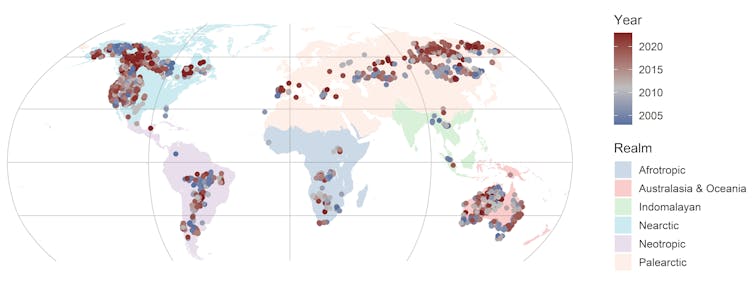
We analysed 88 million observations of wildfire from NASA’s MODIS satellites. These satellites pass overhead several times a day. They record fires and the energy they release – known as fire radiative power.
Using this 21-year dataset, we identified energetically extreme fires, defined as the top 0.01% for fire radiative power. Our findings conclusively show there has been a strong upward trend in extreme fire events over the past two decades. Their frequency and intensity more than doubled from 2003 to 2023.
The past seven years included the six most extreme in the 21-year period. This increase occurred in lockstep with global heating, with 2023 smashing temperature records and also having the most intense fires.
Northern hemisphere and Australia hit hard
The fastest increases were in the temperate conifer forest and carbon-rich boreal forest of the northern hemisphere. Recent fires there have released immense amounts of smoke and carbon, threatening to intensify warming.
Last year, extreme fires in Canada blanketed tens of millions of people in the eastern United States in smoke. The fires resulted in dangerous air quality, which is a bigger killer than the flames themselves.
While the frequency of extreme fires increased during both day and night, the rate of increase was fastest at night. We saw this same pattern in last year’s early-season fires in Queensland.
Increasing nighttime fire is significant because rising humidity at night usually slows the growth of fire. This trend means firefighters are getting less respite at night.
Australia was a major hotspot of intense fire. Our land of booms and busts was characterised by sporadic extreme years, such as the devastating 2019-2020 Black Summer bushfires. These coincided with a period of record heat and drought.
The area burned in 2023 in northern Australia was even larger than the extent of the Black Summer bushfires. These recent fires in arid Australia occurred a year after heavy rains and extensive grass growth. When the grass dries out, it provides fuel loads that allow very large fires to form.

What’s to blame?
There’s little doubt climate change is contributing to much of the global increase in extreme fire events. Climate change is causing the air over land to become drier, which in turn makes fuel dryer, allowing more complete combustion. It is also leading to longer summers and worsening fire weather.
Last year was 1.48°C hotter than pre-industrial levels. It gave us a glimpse of what a typical year of 1.5°C of warming (the targeted limit under the Paris Agreement) might look like.
The way we manage ecosystems likely also plays an important role in the increase in extreme fires.
In particular, many years of suppressing almost all fires has caused a build-up of fuel in some ecosystems. Attempting to suppress all fires paradoxically predisposes forests to burn under the very worst of conditions. Fire suppression becomes impossible, resulting in very large fires.
How do we manage fire in a hotter climate?
Fire is an essential part of nature, and the health of fire-adapted ecosystems depends on it. We need to adapt our management of fire to sustainably live alongside it in a heating climate.
Humans have a major effect on shaping fire regimes through the way we engineer and manage environments. A key part of managing fire in a heating climate must involve managing ecosystems so fires do not become overly hot.
The path forward must embrace old and new approaches. It must welcome the deep wisdom of Indigenous fire management. For millennia, Indigenous Australians skilfully cultivated low-intensity fire regimes. They did this through frequent use of fire fine-tuned to the local ecology.
How Indigenous fire management practices could protect bushland.But reintroducing low-intensity fire to ecosystems that have accumulated large fuel loads under long-term fire suppression is not always straightforward. Some emerging techniques like mechanical thinning offer promise for helping to reintroduce fire into overgrown situations in the bushland-urban fringe. When coupled with controlled fire, mechanical thinning could help reduce the fire risk of overgrown vegetation and allow cool fire regimes to be used again.
People may be uncomfortable with chainsaws or goats in their nearby patch of bush. But the new climate we are entering calls for open-minded and meticulous testing of all available tools. Like all ecological processes, the right mitigation approaches will depend on the local ecological context.
While the area burned on Earth may be declining in some locations, extreme fires are on the rise. We must respond with a multi-pronged approach. That includes making strong progress on slowing climate change while rapidly adapting our management of built and wild landscapes.
Authors: Calum Cunningham, Postdoctoral Research Fellow in Pyrogeography, University of Tasmania


















