

How quickly does groundwater recharge? The answer is found deep underground
- Written by: Andy Baker, Professor, School of Biological, Earth and Environmental Sciences, UNSW Sydney
You would have learned about the “water cycle” in primary school – water’s journey, from evaporation to rainfall to flowing in a stream or sinking into the ground to become groundwater.
Despite how simple it sounds, there are actually some large unknowns in the cycle – especially concerning groundwater.
We don’t know, for example, how fast aquifers – porous rock layers saturated with water – recharge. Or how much water actually makes it underground. And how much rain do you need to refill these underground reservoirs?
These questions are crucial because we rely very heavily on groundwater. It’s far and away the world’s largest source of fresh water we can access. There’s more water in the polar ice, but we can’t use it.
Our research team has been exploring a new approach to groundwater: going down to where the water is, using caves, tunnels and mines. We have installed a new network of groundwater sensors in 14 sites across Australia’s southeast – some more than 100 metres below the surface.
This is already giving us valuable data. For instance, in old mines in the Victorian gold mining town of Walhalla, we found it took more rain than we expected to start the recharge.

Why does groundwater recharge matter?
Worldwide, we are using groundwater much faster than it can naturally replenish. Researchers have found rapid declines in the water table of over 0.5 metres a year across many regions globally.
This is a real concern for Australia, the world’s driest inhabited continent. While the tropical north gets plenty of rain, it’s harder to come by elsewhere.
Across the continent, groundwater accounts for 17% of our accessible water resources. But it accounts for more than 30% of our total water use.
Groundwater is an essential resource, estimated to contribute A$6.8 billion to GDP.
In the Murray Darling Basin, groundwater extraction increased between 2003 and 2016, reaching 1,335 billion litres a year on average.
Native plants and animals in arid regions often rely entirely on groundwater bubbling up through springs.
Perth relied so heavily on groundwater that it’s depleting its aquifer, forcing the government to build desalination plants. Even now, Western Australia relies on groundwater for two-thirds of its water needs.
This is why recharge rates matter. If we’re using groundwater at the same rate it recharges or less, that’s sustainable use. But if we’re pumping out far more than it can refill, that’s unsustainable.
Groundwater recharges from rainfall which seeps through the soil into deeper layers where evaporation can’t get to it. It can also refill from surface waters. But recharge is difficult to measure accurately.
 Groundwater has long been important to Australian farmers.
Department of Climate Change, Energy, the Environment and Water
Groundwater has long been important to Australian farmers.
Department of Climate Change, Energy, the Environment and Water
How can we better track groundwater recharging?
Researchers in Darwin recently undertook the largest analysis to date of long-term rainfall recharge across Australia. They used 98,000 estimates of recharge rates, using data from bores and machine learning algorithms.
The result was surprising. They estimated the average recharge rate for the Australian continent was just 44 millimetres per year. But it differs a great deal depending on where you are. In humid, wet climates such as across the Top End, the water table rose by 203mm a year. But in arid climates, it was just 6mm.
For comparison, the typical annual rainfall in Sydney and Brisbane is just over 1,000mm per year.
This study poses a challenge to our understanding of groundwater recharge. The estimates in this study are substantially lower than studies relying on contemporary water balance models, which report more than double the amount of recharge for Australia.
One issue is the Darwin research was not able to show where the groundwater came from or how old the water is. You might think groundwater recharges quickly, but a quick recharge means it takes years. A slow recharge can take thousands of years.
This gap is a concern. Our water authorities need the most accurate data possible on annual recharge rates – and the age of the water.
 A sensor in Wollondilly Cave, New South Wales.
Andy Baker, Author provided (no reuse)
A sensor in Wollondilly Cave, New South Wales.
Andy Baker, Author provided (no reuse)
Our network of hydrological loggers are now gathering underground data in sites such as the gold mine in Stawell, in Victoria, and South Australia’s Naaracoorte Caves, famous for fossils, as well as mines and tunnels in New South Wales, Queensland and Tasmania.
Natural caves and groundwater are often fairly shallow. We wanted to get deeper data, which is why we chose mines. Our deep sites are over 100 metres underground.
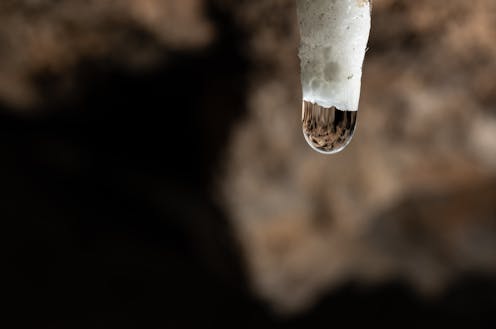
Our sensors can detect each groundwater recharge event by doing something very simple: counting drips from the ceiling, and comparing them to what’s happening on the surface, so we can see where and when groundwater recharges.
 This figure shows how loggers in underground tunnels, caves and mines capture groundwater recharge.
Anna Blacka, Author provided (no reuse)
This figure shows how loggers in underground tunnels, caves and mines capture groundwater recharge.
Anna Blacka, Author provided (no reuse)
Last month, we presented initial results, which show large variation.
Walhalla lies in the foothills of the Great Dividing Range outside Melbourne. It’s relatively rainy, with over 1,200mm per year.
Our sensors showed us the water table here had recharged 15 separate times over the 18 months to March 2024.
Despite the high annual rainfall, more than 40mm of rainfall over two days was needed to overcome dry summer conditions and cause recharge to start.
By contrast, Stawell’s gold mine is in an arid climate ~200 kilometres west of Melbourne, with under 500mm of rain annually. Even 100 metres underground, we could see water from rainfall moving through small pathways in the rock. But unlike Walhalla, we could not see the effects of individual rainstorms. By the time the water got that deep, any pulses were smoothed out.
We hope our data will be useful to groundwater researchers and water authorities, and expand how much we know about a resource we think little about – but which matters a great deal to how we live.
Read more: Decades of less rainfall have cut replenishing of groundwater to 800-year low in WA
Authors: Andy Baker, Professor, School of Biological, Earth and Environmental Sciences, UNSW Sydney


















