

Devastating coral bleaching will be more common, start earlier and last longer unless we cut emissions
- Written by: Camille Mellin, Senior Lecturer and ARC Future Fellow, School of Biological Sciences, University of Adelaide
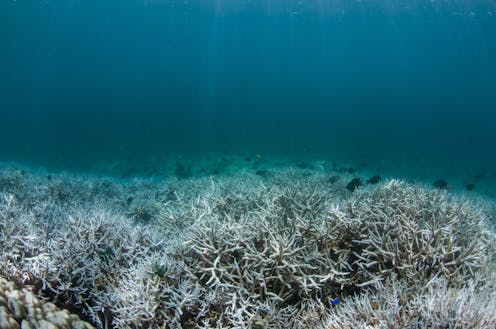
Coral bleaching is becoming much more common as a result of increasingly severe and frequent marine heatwaves. Four global mass bleaching events have happened since 1998. Two of these were in the past decade.
Unless greenhouse gas emissions are cut to slow global warming, our new research shows that, by 2080, coral bleaching will start in spring, rather than late summer. Some events will last into autumn. The Great Barrier Reef’s maximum annual heat stress will double by 2050 if emissions do not slow.
Marine heatwaves stress corals, which then expel the symbiotic algae living in their tissue. These corals are left white and weakened. While not all bleached corals die immediately, prolonged heat stress harms their health and reproduction.
Our research used daily data on sea surface temperatures (instead of monthly data that models typically use) and supercomputing to produce high-resolution projections of marine heatwaves. We showed the risk of coral bleaching will be greatest along the equator. That’s also where the most biodiverse coral reefs are found.
Coral reefs cover only 1% of our oceans, but host at least 25% of all marine species. More than half a billion people worldwide depend on coral reefs for food.
So coral reefs are vital for the health of the ocean and people. They are also among the ecosystems most at risk from climate change.
Longer bleaching season will hit spawning
The US National Oceanic and Atmospheric Administration monitors marine heatwaves globally. Seasonal coral bleaching alerts are based on this data. Predicting coral bleaching risk over entire decades has proved much more challenging.
Recent improvements in climate modelling now allow marine heatwaves and coral bleaching risks to be predicted with high accuracy. Using daily projections of heat stress from many global climate models, we show the severity and duration of coral bleaching will soon reach uncharted territory.
By mid-century coral bleaching is expected to start in spring for most of Earth’s reefs, rather than late summer as is typical today. In equatorial regions, corals will be at high risk of bleaching all year round by the end of the century.
In many regions, corals spawn only once a year. These spectacular mass spawning events happen in a single week following a full moon in spring.
By 2040, this spawning event could coincide with severe bleaching risk. This would greatly reduce their reproductive success, causing large-scale coral loss.
Equatorial regions most at risk
We show the future risk of severe coral bleaching is uneven globally.
The greatest risk is along the equator. Equatorial regions are home to the most biodiverse coral reefs, including conservation hotspots such as the Coral Triangle. To make matters worse, marine life in these regions is particularly vulnerable to accelerated climate change.
Many equatorial species are already living at temperatures near their upper tolerance. They also generally have low abilities to move to track shifting climates. This leaves them at high risk of extinction.
Our research shows equatorial regions are set to benefit least from efforts to curb emissions. We expect significant emission cuts will reduce the annual duration of severe bleaching conditions in all areas except these regions.
The projected highest climate impacts coincide with highest social reliance on coral reefs. This will challenge human populations that rely heavily on their local reefs for their livelihoods and nutrition.

Improving coral reef management
Our research identifies Earth’s reef regions that are at lowest risk of increased bleaching. This will help conservation managers and policymakers prioritise efforts to limit loss of coral reef biodiversity.
We predict much less risk of coral bleaching in regions such as the northern coasts of Venezuela and Colombia, Socotra Island (opposite the Gulf of Aden) and Alor Kecil in Indonesia. Seasonal upwellings occur here, bringing cooler water to the surface that’s likely to limit the severity of heatwaves.
Identifying these future havens for coral reefs will help maximise the success of coral conservation strategies such as assisted evolution, coral restoration or transplantation.
These strategies can help maintain healthy coral populations at local scales, particularly if used on reefs where future climate impacts will be lower. By pinpointing these havens, our research will strengthen coral conservation.
Our research includes a user-friendly web-based tool for mapping future coral bleaching. It will help pinpoint locations for effective management interventions.
Curbing greenhouse gas emissions is the main solution to reduce future climate impacts on corals. However, other strategies are also vital to maximise coral reefs’ adaptation to climate change.
Authors: Camille Mellin, Senior Lecturer and ARC Future Fellow, School of Biological Sciences, University of Adelaide


















