

perfectly preserved fossils of ancient sea critters found buried in volcanic ash
- Written by: John Paterson, Professor of Earth Sciences, University of New England
If you’ve ever visited the fossil gallery of a natural history museum — or its gift shop, for that matter — you’ve probably seen the armoured body remains (or exoskeletons) of an extinct group of animals called trilobites. These ancient marine arthropods lived in the world’s oceans from 521 million to 252 million years ago.
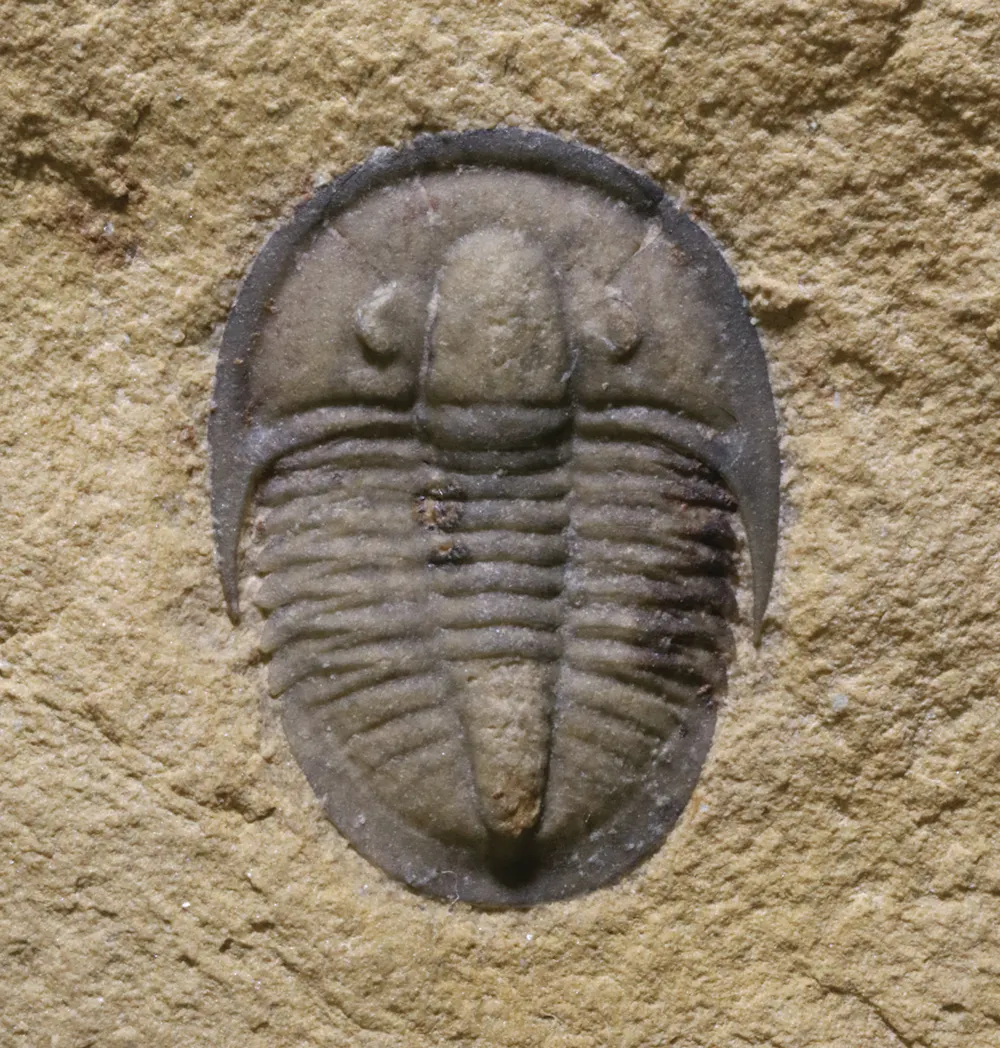
We know a great deal about the diversity, lifestyles and evolution of these iconic invertebrate fossils. More than 22,000 species of trilobite have been named.
This is largely because the trilobite exoskeleton was made of a mineral called calcite, which fossilised very easily. However, fossils showing soft body parts of these creatures, such as the antennae and walking legs, are far rarer. Even when these features have been found, they may be obscured by flattening or partly hidden by sediment.
In a new study, published today in Science, we document a remarkable discovery of Moroccan trilobites preserved in volcanic ash, representing the most anatomically complete examples ever found. These new specimens not only preserve the antennae and walking legs, but also mouth structures and even the entire digestive system in three dimensions.
A palaeontological Pompeii
The new trilobite fossils are Cambrian in age (around 509 million years old) and preserved as undistorted three-dimensional moulds within fine volcanic ash, not unlike the human bodies entombed at Pompeii in Italy by the eruption of Vesuvius in 79 AD.
We scanned the specimens with X-rays to reveal and reconstruct the exquisite anatomy in high resolution, right down to the tiniest bristles (less than a tenth of a millimetre long) on the walking legs.
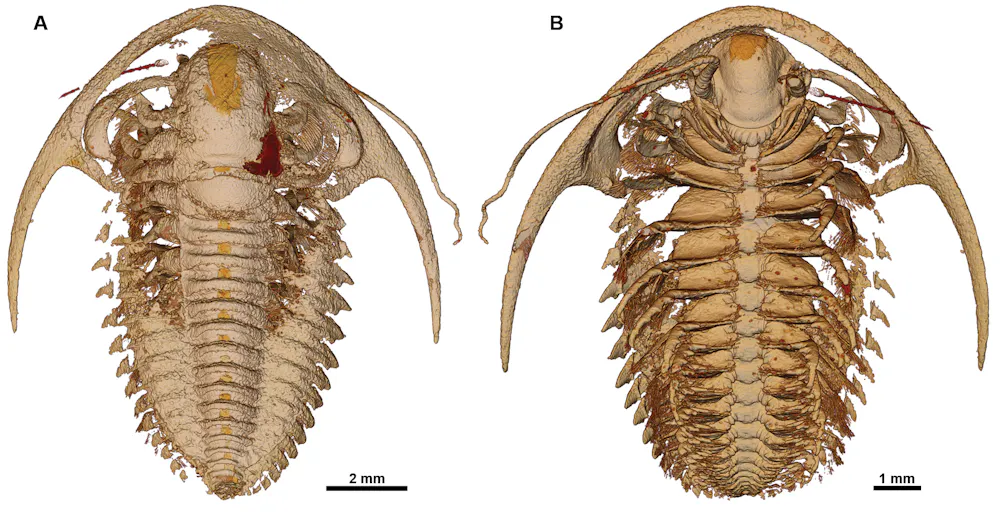 Reconstructions of the trilobite Protolenus (Hupeolenus) sp., showing the view from above (left) and below (right), including the antennae and walking legs, and other soft tissue structures.
Arnaud Mazurier / John Paterson
Reconstructions of the trilobite Protolenus (Hupeolenus) sp., showing the view from above (left) and below (right), including the antennae and walking legs, and other soft tissue structures.
Arnaud Mazurier / John Paterson
It may seem highly unlikely to find fossils preserved in volcanic ash, particularly their soft tissues. But ironically, it is the violent nature of eruptions that helps with this style of exceptional preservation.
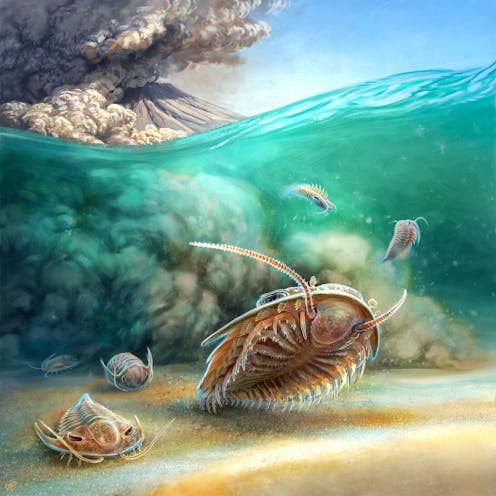
Explosive eruptions, specifically a type called pyroclastic flows, produce high-speed clouds of ash that can cover vast areas, including marine environments, in a very short amount of time. Such an event would have rapidly buried these trilobites, which were living in shallow waters near the shoreline, with the volcanic ash quickly moulding and cementing the animals in place.
 An artist’s reconstruction of the trilobites inhabiting a shallow water marine environment moments before being rapidly engulfed by a pyroclastic flow from a volcanic eruption that occurred more than 500 million years ago.
Katrina Kenny
An artist’s reconstruction of the trilobites inhabiting a shallow water marine environment moments before being rapidly engulfed by a pyroclastic flow from a volcanic eruption that occurred more than 500 million years ago.
Katrina Kenny
This entombment must have been almost instantaneous, as we also find tiny filter-feeding animals called brachiopods attached to these trilobites in positions they would have been in life, capturing a symbiotic relationship “snap frozen” in time.
Tantalising trilobites
Our discovery has revealed features previously unknown in trilobites.
For example, the new fossils show a sophisticated feeding apparatus. In particular, the first pair of head appendages behind the antennae possess what could be described as “spiny spoons”, used for chewing and scooping food into the mouth. Attached to these “spiny spoons” are antenna-like structures that may have acted as taste receptors or touch sensors.
Read more: Ancient marvels: the first shell-crushing predators ground up their prey between their legs
One specimen (see below) also reveals the entire digestive system, starting with the mouth opening, leading to an oesophagus, which then extends to an enlarged J-shaped stomach connected to a long intestine running the entire length of the body.
There is also a structure called the labrum, a kind of fleshy lip associated with the mouth that forms part of the oral chamber where food is processed.
Interestingly, the labrum has long been hypothesised to exist in trilobites, but never observed in fossils. This discovery now helps us better understand how arthropod mouthparts evolved across living and extinct forms.
 A side view of Protolenus (Hupeolenus) sp., highlighting the labrum (red) where the mouth is positioned, the hypostome (green) that protects the organs in the head, and the digestive system (blue).
Arnaud Mazurier / John Paterson
A side view of Protolenus (Hupeolenus) sp., highlighting the labrum (red) where the mouth is positioned, the hypostome (green) that protects the organs in the head, and the digestive system (blue).
Arnaud Mazurier / John Paterson
These fossils give palaeontologists a new “search image” to look for such anatomical features in newly collected trilobite specimens, or those already sitting in museum drawers. But perhaps more importantly, this discovery highlights volcanic ash deposits as underexplored sources for exceptionally preserved fossils.
Authors: John Paterson, Professor of Earth Sciences, University of New England


















