

Gaps in reporting of nitrogen fertiliser use on farms leave an incomplete picture of impacts on water quality
- Written by: Mike Joy, Morgan Foundation Senior Research Fellow in Freshwater Ecology and Environmental Science, Te Herenga Waka — Victoria University of Wellington
New Zealand’s rivers, streams, lakes and groundwater reservoirs are under pressure.
Some lakes are regularly plagued by algal blooms because of high levels of nutrients, particularly nitrogen. A significant number of New Zealanders are exposed to high levels of nitrates in their drinking water.
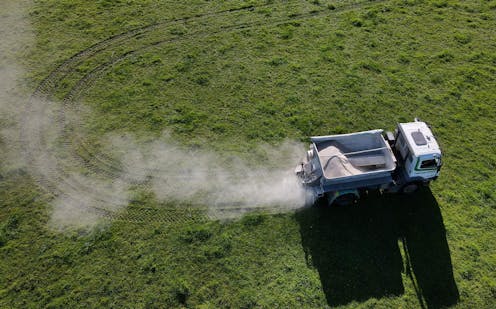
New Zealand has rules intended to address this. The National Environmental Standards for Freshwater require farms to report their use of synthetic nitrogen and to cap application at a maximum of 190kg per hectare per year.
But an official information request reveals only 61% of dairy farm operators had reported their synthetic nitrogen use for the financial year ending in June 2023. For the year ending in June 2022, only around 45% had reported.
The state of New Zealand’s freshwater
About 85% of waterways in New Zealand’s farming catchments now exceed the Australasian nitrate guideline threshold. Most are getting worse.
Likewise, a recent study revealed around 800,000 New Zealanders have drinking water supplies with potentially hazardous nitrate levels. The data show the major cause of this is nutrient run-off and leaching, mainly from intensive farming relying on nitrogen from synthetic fertiliser.
To put this into perspective, nutrient loads in some of our farmed catchments now rival some of the world’s most intensively used areas such as the Mississippi River and Yellow River catchments.
Synthetic nitrogen reporting rules
The National Environmental Standards for Freshwater cap synthetic nitrogen fertiliser application to land. Those who are unable to comply with the cap (190kg per hectare per year) need resource consent to exceed the limit.
The standards also require dairy farm operators, who may be contractors or owners, to report synthetic nitrogen fertiliser use to their regional councils, by the end of July each year. This reporting provides crucial information about the amount of nitrogen used across regions. It also shows where farms are exceeding the cap.
The government recently revealed initial plans to amend the Resource Management Act (RMA). Existing provisions require that resource consenting processes under the RMA prioritise the health of freshwater and human health needs (such as safe drinking water). The proposed changes would preclude this.
The removal of these requirements would allow decision makers to prioritise economic uses over the life-supporting capacity of water. The standards that are proposed to be repealed would have reduced the accumulation of nitrates in soil and freshwater.
The government has also signalled plans to remove Te Mana of Te Wai, a concept that refers to the fundamental importance of water which was first introduced in 2014 and strengthened in 2020.
If the proposed changes go ahead, the reporting rules on synthetic nitrogen use will be one of few remaining tools intended to address excessively high nitrogen losses caused by farm practices. This makes enforcement of the rules even more important.
Some dairy farm operators are not reporting
Reporting of synthetic nitrogen fertiliser use has been compulsory for operators of dairy farms with 20 hectares or more of grazed land since July 2022. Many operators have reported at least one year, if not two. Unfortunately, some have not reported at all.
This provides no surety that the cap is being complied with and an incomplete picture about how much nitrogen is being applied to land.
In response to an official information request, the Ministry for the Environment estimated that by 18 December 2023, around 61% of dairy farm operators had reported their synthetic nitrogen use, and only around 45% had reported during the previous year.
In regions with the largest growth in dairy farming and where nitrogen pollution is highest, compliance is far from complete.
By September 2023, Environment Canterbury advised they had received 808 reports from contiguous landholdings (parcels of land within a farm), across 771 farms. They were aware of 1,355 dairy effluent consents for farms in the region. This provides an indication of the scale of failure to report.
The Waikato Regional Council estimated about 37% of required farms had reported their synthetic nitrogen use. The Horizons Regional Council advised that, across the Manawatū-Whanganui region’s 761 dairy sheds, it had received 348 reports, indicating around 413 were outstanding. Reporting levels are higher in Southland where only 75 contiguous landholdings had failed to report.
Enforcement strategies are changing
Regional councils have so far taken an educational approach to enforcement. This makes sense to an extent, especially in areas where farmers are facing additional stress, such as those affected by Cyclone Gabrielle. In other areas, it is more worrying.
In the reporting year ending July 2022, Environment Canterbury was unable to identify farms that had not reported and could not follow up on these missing reports.
But regional councils may be moving towards providing direct individual support and considering formal enforcement strategies. Environment Canterbury is now able to identify those who have not reported and does follow up with them.
If councils and individuals both act during this current reporting round, we will be one step closer to improving waterways for future generations. For farm owners and operators, this will mean continuing to report their data or checking their contractors are doing so.
For councils, this will mean following up individually with those who do not report and considering enforcement action for the minority who haven’t reported after two years of support and education.
New Zealanders are worried about declining freshwater quality and health risks associated with nitrate levels. The response to these worries and the overwhelming evidence of increasing nitrate levels was to place a limit on the amount of synthetic nitrogen that could be applied. This won’t achieve anything if the reporting rules are not enforced.
Authors: Mike Joy, Morgan Foundation Senior Research Fellow in Freshwater Ecology and Environmental Science, Te Herenga Waka — Victoria University of Wellington


















