

New study shows mysterious solar particle blasts can devastate the ozone layer, bathing Earth in radiation for years
- Written by: Alan Cooper, Distinguished Professor, Charles Sturt University
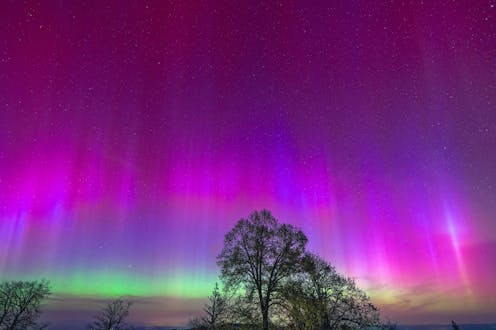
The remarkable aurora in early May this year demonstrated the power that solar storms can emit as radiation, but occasionally the Sun does something far more destructive. Known as “solar particle events”, these blasts of protons directly from the surface of the Sun can shoot out like a searchlight into space.
Records show that around every thousand years Earth gets hit by an extreme solar particle event, which could cause severe damage to the ozone layer and increase levels of ultraviolet (UV) radiation at the surface.
We analysed what happens during such an extreme event in a paper published today. We also show that at times when Earth’s magnetic field is weak, these events could have a dramatic effect on life across the planet.
Earth’s critical magnetic shield
Earth’s magnetic field provides a crucial protective cocoon for life, deflecting electrically charged radiation from the Sun. In the normal state, it functions like a gigantic bar magnet with field lines rising from one pole, looping around, and plunging back down at the other pole, in a pattern sometimes described as an “inverted grapefruit”. The vertical orientation at the poles allows some ionising cosmic radiation to penetrate down as far as the upper atmosphere, where it interacts with gas molecules to create the glow we know as the aurora.
However, the field changes a great deal over time. In the past century, the north magnetic pole has wandered across northern Canada at a speed of around 40 kilometres per year, and the field has weakened by more than 6%. Geological records show there have been periods of centuries or millennia when the geomagnetic field has been very weak or even entirely absent.

We can see what would happen without Earth’s magnetic field by looking at Mars, which lost its global magnetic field in the ancient past, and most of its atmosphere as a result. In May, not long after the aurora, a strong solar particle event hit Mars. It disrupted the operation of the Mars Odyssey spacecraft, and caused radiation levels at the surface of Mars about 30 times higher than what you would receive during a chest X-ray.
The power of protons
The Sun’s outer atmosphere emits a constant fluctuating stream of electrons and protons known as the “solar wind”. However, the Sun’s surface also sporadically emits bursts of energy, mostly protons, in solar particle events – which are often associated with solar flares.
Protons are much heavier than electrons and carry more energy so they reach lower altitudes in Earth’s atmosphere, exciting gas molecules in the air. However, these excited molecules emit only X-rays, which are invisible to the naked eye.
Hundreds of weak solar particle events occur every solar cycle (roughly 11 years) but scientists have found traces of much stronger events throughout Earth’s history. Some of the most extreme were thousands of times stronger than anything recorded with modern instruments.
Extreme solar particle events
These extreme solar particle events occur roughly every few millennia. The most recent one happened around 993 AD, and was used to show that Viking buildings in Canada used timber cut in 1021 AD.
Less ozone, more radiation
Beyond their immediate effect, solar particle events can also kickstart a chain of chemical reactions in the upper atmosphere that can deplete ozone. Ozone absorbs harmful solar UV radiation, which can damage eyesight and also DNA (increasing the risk of skin cancer), as well as impacting the climate.
In our new study, we used large computer models of global atmospheric chemistry to examine the impacts of an extreme solar particle event.
We found such an event could deplete ozone levels for a year or so, raising UV levels at the surface and increasing DNA damage. But if a solar proton event arrived during a period when Earth’s magnetic field was very weak then ozone damage would last six years, increasing UV levels by 25% and boosting the rate of solar-induced DNA damage by up to 50%.
Particle blasts from the past
How likely is this deadly combination of weak magnetic field and extreme solar proton events? Given how often each of them occurs, it appears likely they happen together relatively often.
In fact, this combination of events may explain several mysterious occurrences in Earth’s past.
The most recent period of weak magnetic field – including a temporary switch in north and south poles – began 42,000 years ago and lasted about 1,000 years. Several major evolutionary events occurred around this time, such as the disappearance of the last Neanderthals in Europe and the extinctions of marsupial megafauna including giant wombats and kangaroos in Australia.
An even bigger evolutionary event has also been linked to Earth’s geomagnetic field. The origin of multicellular animals at the end of the Ediacaran period (from 565 million years ago), recorded in fossils in South Australia’s Flinders Ranges, occurred after a 26-million-year period of weak or absent magnetic field.
Similarly, the rapid evolution of diverse groups of animals in the Cambrian Explosion (around 539 million years ago) has also been related to geomagnetism and high UV levels. The simultaneous evolution of eyes and hard body shells in multiple unrelated groups has been described as the best means to both detect and avoid the harmful incoming UV rays, in a “flight from light”.
We are still only starting to explore the role of solar activity and Earth’s magnetic field in the history of life.
Authors: Alan Cooper, Distinguished Professor, Charles Sturt University


















