

Honest brokers. Why mortgage broker commissions aren't the problem
- Written by: Mark Humphery-Jenner, Associate Professor of Finance, UNSW
The Hayne Royal Commission began and ended with strident criticism of the mortgage broking industry.
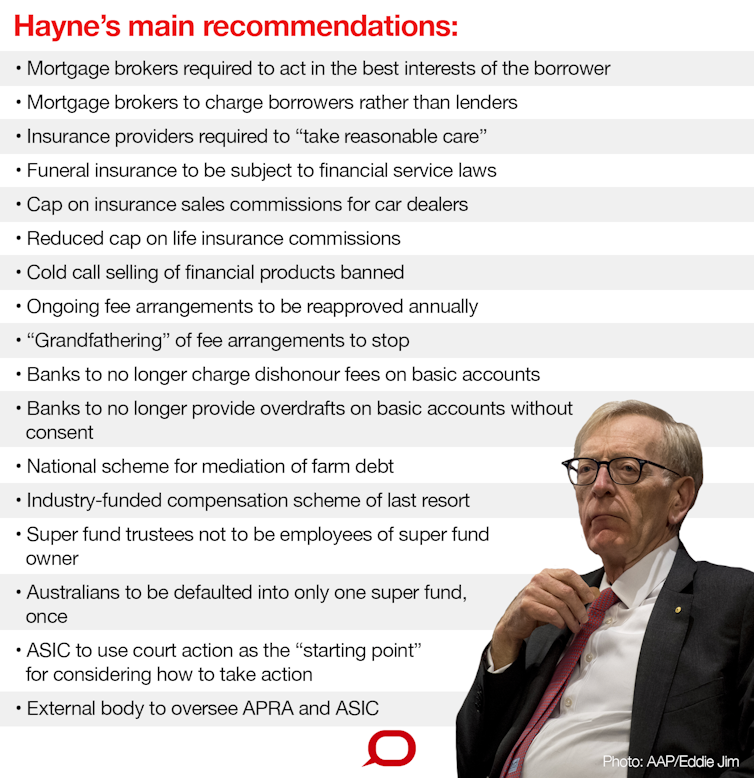
It recommended brokers be required to act in the “best interests” of intending borrowers, and that intending borrowers, rather than the successful lender, pay the broker’s fee.
So-called “trailing” annual payments from lenders would be outlawed as soon as possible and upfront commissions outlawed after two or three years.
It’s the only set of recommendations the government has been lukewarm about adopting, announcing instead that while brokers will be required to act in the best interests of borrowers and from July 1 2020 will no longer be able to accept new trailing commissions, decisions about upfront commissions will be delayed until a further review, to take place “in three years time”.
The government is right to be cautious.
What’s the problem with commissions?
Both the royal commission and the Australian Securities and Investments Commission are concerned commissions:
encourage brokers to recommend mortgages that borrowers cannot plausibly afford
cause the broker to recommend higher paying products over lower paying products, potentially to the detriment of borrowers.
So what’s the go with brokers?
Typically a borrower approaches a broker who works with banks to secure a loan.
According to ASIC, the method of payment is fairly standard:
the broker receives a commission from banks for each successful home loan. The commission is often divided into an upfront payment and a trailing commission, which is paid over time
the lender benefits because it can spread its commission expenses over time. It can also terminate commissions if it believes a broker has behaved badly
the commission rates are relatively similar across lenders, with upfront commissions typically ranging from 0.46% to 0.65% of the loan amount, about $3,000 on a $500,000 loan. Trailing commissions typically range from 0.1% to 0.35% of the ongoing loan, about $1,000 per year on a $500,000 loan
lenders can also offer bonus payments, loyalty payments and “soft dollar commissions” which take many forms, including overseas conferences and holidays, shopping vouchers and tickets to sporting events
loan aggregators can also play a role. They provide back-office support and ancillary services to brokers. Some are partly owned by banks. These banks receive a slightly larger share of loans from brokers who deal with these aggregators than from brokers that don’t.
In practice brokers often provide good service
ASIC research finds that regardless of the conflicted remuneration structure the interest rates brokers obtain for clients are not significantly worse (or better) than those obtained by borrowers who deal with banks direct.
Their clients are slightly different, on average two years younger than bank clients and with incomes about A$6,000 lower. Brokers’ clients borrow slightly more than direct bank clients and their loans are more likely to be interest only.
Although until legislation has not compelled brokers to act in clients’ best interests, other professional standards often do so.
And brokers are keen to get referrals and repeat business, which relies on brokers providing good service in the first place.
They’ve little incentive to push bad loans
Because banks compete for business, they tend to pay similar commissions, in much the same way as they tend to charge similar interest rates. It means that in practice there is isn’t much incentive for a broker to recommend one lender over another. This is especially so when you factor in the desire to get repeat business, and referrals, which they would lose if they pushed poor products.
And it is hard to recommend unnecessary loans. Borrowers usually come to brokers to arrange loans for homes they are already planning to buy. There aren’t that many extra dollars in recommending clients borrow more, and even if brokers did recommend higher loans they would still be subject to banks’ serviceability and equity checks.
At the moment banks are highly reluctant to lend large sums at high loan to valuation ratios.
All this means that commissions have a muted effect on brokers’ lending recommendations, with conflicts being ameliorated by the practical reality of commission homogenisation and the desire for repeat business and referrals.
And if commissions went…
If commissions went, brokers would have to be paid by borrowers.
Many borrowers would baulk at the fees, and would go to banks instead. This would increase banks’ costs, which could be passed on through additional borrowing fees. It would also increase the time borrowers must devote to sorting through potential lenders.
Some borrowers who lack financial expertise would then have to rely on banks’ advice, rather than brokers’; and, banks are hardly less independent about their products than are brokers.
It would be the smaller brokers that would suffer the most, some going out of business. Larger brokers would also be affected, but less so, due to economies of scale. The end result would be fewer brokers, and less access to advice.
It’d be an unintended consequence of what Hayne recommended, and perhaps an unnecessary one.
While there are always bad apples in every industry, removing commissions would be a blunt - and potentially unnecessary - instrument with plenty of downsides.
 The Conversation
Authors: Mark Humphery-Jenner, Associate Professor of Finance, UNSW
Read more http://theconversation.com/honest-brokers-why-mortgage-broker-commissions-arent-the-problem-111631


















