

how ancient Indigenous wisdom can transform our battle against climate change
- Written by: Nina Lansbury, Associate Professor in Public Health, The University of Queensland
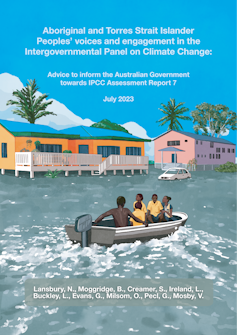
The theme of this year’s NAIDOC Week is “Keep the Fire Burning! Blak, Loud and Proud”. The organisers are calling for “a society where the wisdom and contributions of Indigenous peoples are fully valued and respected”.
Australia’s Indigenous peoples have gained intimate Knowledges of this continent through long-term observations and holistic thinking. They have connections to their traditional estate, known as Country, spanning thousands of generations. As climate change worsens, Indigenous peoples can offer valuable insights into sustainability and resilience.
Governments and others increasingly recognise how Indigenous Knowledges can helps us better monitor and adapt to a warmer world. This can lead to better understanding and decision-making.
When it comes to climate change in Australia, the fires of Knowledge are burning bright. It’s time Indigenous Knowledges are heard – and it’s time for action.
What are Indigenous Knowledges?
Indigenous Knowledges refer to the “understandings, skills and philosophies developed by societies with long histories of interaction with their natural surroundings”. These Knowledges emphasise the inextricable connections between mind, body and Country, as well as humans and non-humans.
The Knowledges held by Aboriginal and Torres Strait Islander peoples are highly relevant to the process of the Intergovernmental Panel on Climate Change (IPCC) – the United Nations body whose reports inform government responses to the climate threat, including policies and funding.
But only in the past two years have the vast Knowledges of Indigenous peoples around the world been meaningfully included in IPCC reports – largely because such data were not widely documented in peer-reviewed academic literature.
‘Respectful inclusion’
The authors of this article were on a team commissioned by the federal government to advise on ways to enhance Aboriginal and Torres Strait Islander peoples’ voices in the IPCC process.
Our team included three Aboriginal and one Torres Strait Islander scholars and three non-Indigenous allies. Three were authors on the sixth IPCC assessment report.
We delivered our advice to government in July last year, ahead of planning discussions for the seventh IPCC assessment report now being prepared.
Our report made 29 recommendations, including:
respectful inclusion in IPCC reports of Indigenous scientific data alongside Western scientific data
information in IPCC reports from Aboriginal and Torres Strait Islander communities that considers wellbeing in a holistic way, that is connected to Country, involves historical truth-telling and is Indigenous-led
set and engage a minimum number of Indigenous IPCC authors from Australia
provide climate change information to Aboriginal and Torres Strait Islander peoples through appropriate channels.
Our research involved a survey and an associated “extended yarning” method, which recognises Indigenous peoples’ preference for, and skills in, oral communication. The yarns involved conversations up to 90-minutes with Elders, Indigenous scholars and community leaders.
The report yielded many insights into how Indigenous Knowledges can help Australia track and cope with climate change. In the spirit of this year’s NAIDOC Week theme, we outline these below.
Identifying climate changes
We documented how Indigenous communities monitor climate changes. For example, a Melukerdee respondent from Lutruwita/Tasmania identified the effects on biodiversity:
I have seen changes in the patterns of seasons all around. Flowers bloom too early, crops are lost from summers that are too warm and too long, uncontrollable fires that are too hot ravage Country and leave animals homeless, the abundance of special cultural species reduces and diseases take out many key species of different ecological areas which have previously long stood resistant.
In fact, the IPCC’s sixth assessment report noted the value of engaging Indigenous knowledge holders in fauna field surveys and the benefits for conservation planning.
Adapting to a warmer world
The long-standing “relational thinking” of Aboriginal and Torres Strait Islander peoples is an important resource in the stewardship of Country.
The term refers to a worldview that humans are in a relationship with everything else on Earth. This thinking enables an understanding of how ecosystems respond to, adapt to, and recover from human-driven climate change.
One Aboriginal respondent told us:
There is limited recognition regarding First Nation peoples other than relegating us to ‘vulnerable communities’ in context of climate change. This disregards our over 65,000 years of sustainable practices and customary knowledge of the natural environment and thus our significant contribution to policy.
The IPCC’s sixth assessment report identified Indigenous Knowledges relevant to climate adaptation, including:
Indigenous fire management to reduce greenhouse gas emissions
Indigenous Ranger land management, including carbon abatement, weed management and recovery of threatened species
“cultural flows” in waterways that define when and where water is to be delivered, particularly in a changing climate.
Sharing climate information with all
Our report has been shared in written, verbal and animated formats to research participants and government decision-makers.
We engaged Wiradjuri artist Dr Tom Munro-Harrison to create both the report’s cover art, and an animation we are launching today. Munro-Harrison’s art seeks to promote Indigenous voices and perspectives on key issues, including climate change.
He says:
My graphic art practice acts as the site of this self-determining activity and process, where meaning-making and identity can be explored in ways that demonstrate the ongoing survivance, resurgence and modernity of my Wiradjuri culture.
Indigenous self-representation was crucial to our work. Munro-Harrison reflects this in the animation by using direct quotes from Indigenous cultural practitioners who informed the report. This legitimises primary sources of cultural practice in the form of Indigenous oral story.
Planning for the seventh IPCC assessment report is underway. The federal government has already shared key aspects of our advice with the IPCC international secretariat.
The IPCC has come far in recognising Indigenous Knowledges. For example, it is now seeking authors with expertise in how to integrate “different forms of climate-related knowledge and data, including Indigenous Knowledge”.
There is more work to do, and the task is urgent. Accelerating climate change means the value of these Knowledges is more pertinent than ever.
The authors would like to acknowledge the contributions of our report co-authors: Adjunct Professor Sandra Creamer AM (Waanyi Kalkadoon), Dr Vinnitta Mosby (Meriam Nation), and Professor Gretta Pecl (IPCC AR6 Lead Author).
Authors: Nina Lansbury, Associate Professor in Public Health, The University of Queensland


















