

Why saline lakes are the canary in the coalmine for the world’s water resources
- Written by: Babak Zolghadr-Asli, QUEX Joint PhD Candidate, Centre for Water Systems, University of Exeter, and Sustainable Minerals Institute, The University of Queensland
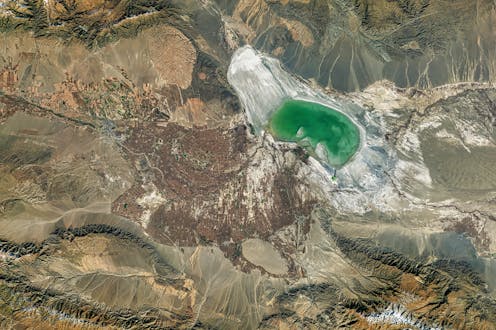
When it comes to inland surface water bodies, saline lakes are unique. They make up 44% of all lakes worldwide and are found on every continent including Antarctica. These lakes’ existence depends on a delicate balance between a river basin’s water input (precipitation and inflows) and output (evaporation and seepage).
The reason a lake turns saline is often because it doesn’t have a consistent stream outlet, leading to a build-up of dissolved salts from water inflows. The water levels of saline lakes are naturally unstable and these lakes are generally susceptible to any disturbance.
This heightened sensitivity makes saline lakes more responsive than freshwater lakes to natural and human-caused factors. The main cause of change in a saline lake is disturbances in its water balance. These can be the result of natural or human-induced factors that are local, such as droughts, pollution, and upstream water diversions, or global, such as climate change, decreasing precipitation and increasing temperature.
The rapid response of saline lakes to the changing conditions makes these lakes suitable candidates for reliably reflecting the regional, and potentially global, status of water resources, and revealing crucial changes in the water balance. Unsurprisingly, many of the world’s saline lakes are shrinking rapidly, a major warning about the sustainability of regional water resources.
How are saline lakes changing?
There have always been fluctuations in saline lakes. Unfortunately, more lasting changes have become more common in recent years due to regional human activities and global climate change.
Most lakes have been shrinking and their water quality has declined. In permafrost regions of the Arctic and the Tibetan Plateau, however, some salt lakes have expanded due to areas of ice melting in a warming climate.
Changes in saline lakes pose significant challenges. They can endanger local ecosystems and industries, threaten public health and cause broader socio-economic harm.
Iran’s Lake Urmia is a good example. Until a few decades ago, Lake Urmia was one of the the world’s largest saline lakes, but it shrunk rapidly due to unsustainable human activities. The resulting problems include a decline in tourism, dust and salt storms, falling agricultural productivity and a loss of biodiversity.
The Aral Sea, once the world’s fourth-largest inland water body, is another tragic example. Since the 1960s it has shrunk to a fraction of its former size largely due to poorly planned irrigation development in the region.
The consequences have been disastrous. Despite many efforts, it has not been possible to restore the lake to its former glory.
Our natural early-warning systems
Saline lakes, much like the canaries used to give coalminers early warning of dangerously poor air quality, could play a vital role in monitoring the health of our water resources.
To better understand this analogy, we must first step back in time to the depths of underground mines where coalminers battled a hidden danger: carbon monoxide. This gas could build up silently, without any warning, endangering the miners’ lives.
Miners devised an ingenious solution: canaries. These small birds, with their rapid breathing rate, small size and fast metabolism, were tiny detectors of danger. When carbon monoxide levels rose, the canaries would be the first to show signs of distress, giving the miners a crucial warning to evacuate before it was too late.
The natural world continues to offer us unexpected insights. Saline lakes, with their intricate ecosystems and unique characteristics, act as nature’s early-warning systems.
Just as the canaries signalled hidden dangers in coalmines, the behaviour of saline lakes can alert us to looming issues with our water resources.
The bigger picture demands our attention
Of course, it is crucial to act when lakes are shrinking, whether through preservation efforts or restoration projects. But we must not overlook the bigger picture. It would be like a miner focusing on a distressed canary when it’s a sign of a more serious problem.
The real challenge lies in delving into the root cause, much like improving poor air quality in mines rather than merely trying to revive the birds.
This highlights the urgent need for a fundamental shift to water management and getting to the root of the problem rather than just dealing with the surface issues. Unfortunately, real-world experience shows we’ve often failed to make much of an impact when tackling these issues. But we can learn from our past mistakes to make better decisions now and in the future.
In the quest to ensure water resources remain sustainable, paying attention to saline lakes would be a good starting point. We need to grasp their intricacies and accurately gauge the water budget of these lakes around the world. We can only do that by investing in continuous monitoring of their health and behaviour.
Authors: Babak Zolghadr-Asli, QUEX Joint PhD Candidate, Centre for Water Systems, University of Exeter, and Sustainable Minerals Institute, The University of Queensland


















