

A Shorten government could shift the country on important issues and show a little spunk
- Written by: Frank Bongiorno, Professor of History, ANU College of Arts and Social Sciences, Australian National University
This is part of a major series called Advancing Australia, in which leading academics examine the key issues facing Australia in the lead-up to the 2019 federal election and beyond. Read the other pieces in the series here.
What will a Shorten government be like? It’s hazardous to predict how an opposition party will govern once in office. Only an imaginative reading of the policy speech Bob Hawke delivered in the Sydney Opera House in February 1983 could have led anyone to expect that his would be a government of financial deregulation, tariff cuts and privatisation. John Howard promised we would “never ever” get a GST. God forbid that Tony Abbott should cut funding to the ABC.
Circumstances change. Government have second thoughts. And in practical politics some commitments do matter more than others, despite the scorn heaped on Howard for distinguishing core and non-core promises.
A Shorten government would occupy a political centre that the Coalition has foolishly vacated. Most of the damage was done by Abbott as prime minister. But Malcolm Turnbull’s failure to recalibrate was no less significant, his fate as a hostage to the right sealed at the 2016 election.
Shorten and his treasurer, Chris Bowen, would inherit an economy that, for all its vulnerability, has been touched more lightly than most by the global ordeals of the last decade. And Labor would govern a nation that has maintained a fair level of social cohesion. Here, the populisms of left and right disrupting European and American politics, and the rise of the political strongman, have had only the faintest echoes.
Shorten is no Jeremy Corbyn; he is not even a Jacinda Ardern. Australia has not experienced a fierce anti-migrant backlash. Yes, there are complaints about “congestion”, and conservative politicians and radio shock jocks are prepared to kick the African gang can along. But Australia’s politics lacks the desperation, and the loathing, associated with Brexit, Donald Trump and the creepier versions of contemporary xenophobia.
Read more: Shorten the consensus leader unites a fractured Labor, but it may not quite be enough
That should be an attractive field for a centre-left government, as good as it gets in a post-GFC world. But polls and surveys also indicate that trust in politics is low. That’s a problem for Shorten. Social democracy is a rational politics that demands a certain level of trust, or at least of popular consent.
If people are disengaged, it’s bad news for centre-left governments because it becomes easier for vested interests to buy undue influence. Politics loses its sense of proportion. The world as we know it will come to an end if this mining tax is implemented, or that tax break taken away. Every effort to reset priorities becomes a challenge to an entrenched interest with the cash and connections to make its oppression widely appreciated.
Still, to predict that Shorten will govern from the centre is to say almost nothing unless you are also willing to say what that centre might look like. The political centre likely to be occupied by a Shorten government in 2019 is a very different beast from its counterpart of before 2008. It will likely be a “radical centre”, to use a phrase favoured by Noel Pearson.
For one, it’s likely to be much more preoccupied with economic inequality than the Labor governments of the Hawke and Keating era. It will be a government more worried about income stagnation, wage theft and a housing market that has locked many out. Still, it will work hard to avoid the perception that it’s a soft touch. It might eventually increase benefits for those without a job. But it has, in opposition, given no sign that it is willing to risk the votes of the hard-working and the self-righteous in the interests of a little less cruelty to the unemployed.
Labor will continue to worry over low wage growth and, in government, it might try to widen the scope for industry-wide bargaining. This will raise the invariably sensitive issue of its relationship with the union movement, and especially with the ACTU under the dynamic leadership of Sally McManus.
A Shorten government’s relationship with the unions is a matter on which its leader is vulnerable to criticism, given his background as a leader of the Australian Workers Union. He will surely seek to avoid the impression that the unions are dictating terms, but the Change the Rules campaign being run by the ACTU will keep the pressure on. And with wages as flat as they are, and union coverage so low, this old bogey may well have run out of steam everywhere but in the Murdoch media.
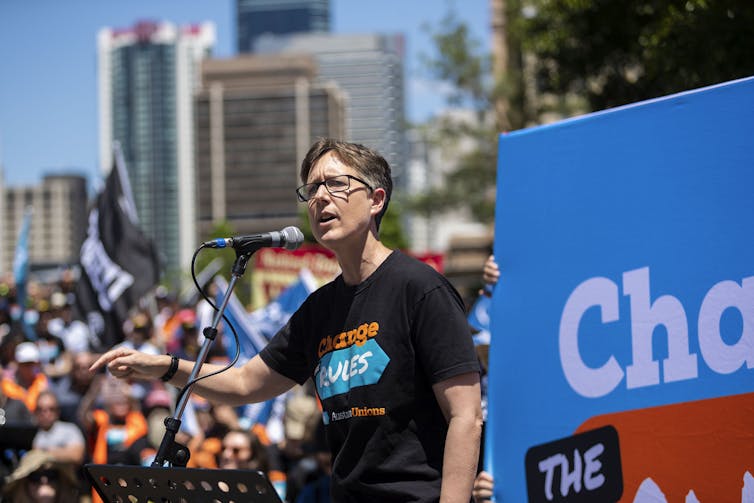 Shorten will face questions about his party’s relationship with trade unions, particularly the ACTU under Sally McManus.
AAP/Glenn Hunt
Shorten will face questions about his party’s relationship with trade unions, particularly the ACTU under Sally McManus.
AAP/Glenn Hunt
For this and other reasons, a Shorten government will be more frank than governments of the 1980s and 1990s about the ways that markets fail, and of the need for governments to intervene when they do. It will ride the ill-will towards the banks to strengthen regulation, although without making life too uncomfortable for the big four.
It will be more concerned with the need to create public goods as a pillar of continuing prosperity. It will oversee a modest expansion of the higher education sector and adopt a more coordinated approach, with more generous funding, to research policy. It will embrace science with enthusiasm – because it helps us prosper – and will feign enthusiasm for culture and the arts to keep quiet, if not happy, the luvvies, bookworms and eggheads. The Australian War Memorial will continue to do better than the National Library, Archives or Museum.
A Shorten government would regard climate change as the most pressing challenge of the age. But, unlike Rudd, Shorten understands that he will be unable to change his mind about that importance when the going gets tough, as it will. A Shorten government will resume the task of creating a carbon market – which it won’t call a tax – and it will hasten the take-up of renewable energy.
It will be rightly preoccupied with issues of gender equality, exploiting its competitive advantage over a Coalition hamstrung by a perception that it is unsympathetic and uncongenial to women. It will attempt modest experimentation around Indigenous recognition and a voice to parliament, and might flirt with a treaty and a truth-telling commission. It will set out a road map to a republic and probably end up in the usual bog as soon as talk of models begins. It will engage in as much or as little cruelty toward those seeking asylum as it feels it needs to keep the boats out, the votes in, and the feral commentariat off its back.
Read more: Grattan on Friday: What Labor has to fear is the Big Scare
At least as long as Trump remains in office, a Shorten government will be more sceptical about the alliance with the United States, and it will tread warily around China’s burgeoning global ambitions. Will a Prime Minister Shorten, like Prime Minister Gillard, discover a taste for international affairs? It’s hard to know, but there will be a significant level of interest in an electorally successful centre-left government given the continuing global crisis of social democracy.
A Shorten government will face a mean and tricky media environment. Especially in the light of Shorten’s apparent effort to keep his distance from the old man himself, the Murdoch press’s campaigning will be brutal; how effective, it’s harder to know. Legacy media increasingly preach to the converted. Nine, incorporating the media company formerly known as Fairfax, tacks to the right and seems unlikely to give a Labor government too many free kicks. The ABC, bullied by Coalition governments, may ironically find a renewed freedom, purpose and vigour in holding a Labor government to account.
Perhaps above all, this would be a government likely to be dependent on younger voters. Many are very angry with a Coalition that flaunts its contempt for them and their values, at the same time as it plucks them to featherbed older and better-off constituents with franking credits, superannuation concessions and negative gearing. A Shorten government will need to be responsive to younger Australians’ desire for good wages, job security and affordable education and housing.
Shorten does not, on the face of it, seem like the future leader of a transformative government. He has caution and pragmatism written all over him. He and his colleagues will be particularly keen to avoid the many unforced errors of the Rudd and Gillard governments. If Labor falters, and especially if it falls apart amid rancour and recriminations, the reaction of the voting public will be swift and merciless.
If elected, a Shorten government might do well to set a few priorities for its first couple of years and spend as much political capital as it dares pursuing them with vigour. Voters seem impatient for an end to policy gridlock and leadership shenanigans. They might be ready to reward a unified and purposeful government with a bit of spunk about it.
Authors: Frank Bongiorno, Professor of History, ANU College of Arts and Social Sciences, Australian National University


















