

6 things we’ve learned about Earth from meteorites and comets
- Written by: Francisco Jose Testa, Lecturer in Earth Sciences (Mineralogy, Petrology & Geochemistry), University of Tasmania
Apart from the Sun, its planets and their moons, our Solar System has vast amounts of space rocks – fragments left over from the formation of the inner planets.
A large concentration of asteroids forms a vast ring around our Sun, orbiting it between Mars and Jupiter. Fittingly, it’s called the main asteroid belt. Comets are icy bodies of dust and rocks that originated even farther away – in the Kuiper Belt beyond Neptune and the Oort Cloud of debris surrounding the Solar System.
Extraterrestrial rocks come in many sizes. Generally speaking, asteroids are space rocks larger than one metre, while the smaller pieces (from two millimetres up to one metre in size) are known as meteoroids.
Regardless of where they come from, once these foreign rocks make it to Earth’s surface, we call them meteorites. But they are much more than just simple rocks from far, far away.
They have allowed us to estimate the age of our planet, and changed the course of evolution more than once. Here are six major ways meteorites and comets have contributed to Earth’s history or our knowledge of it.
1. The age of our planet
About 4.5 billion years ago, a Mars-sized planet collided with the proto-Earth, changing the composition of our planet and forming our Moon.
During its first tens of millions of years, Earth was predominantly molten. It was too hot to form solid minerals and rocks, so the exact age of our planet remains unknown. But we do know it’s between the age measured from meteorites and the age of the oldest rocks we have been able to find and date.
The oldest minerals that have been reliably dated on Earth are tiny zircon grains found in Western Australia. The oldest one is 4.4 billion years old. However, scientists have also dated specks of calcium and aluminium found in meteorites, which yielded an older age of 4.56 billion years – the age of our Solar System.
So, thanks in part to the oldest age provided by a meteorite, our best estimate is that Earth formed around 4.54 billion years ago.
2. The building blocks of life
The most plausible theory for the beginning of life on Earth is based on simple organic compounds that formed in space and were brought to Earth by meteorites and other celestial bodies.
During the Late Heavy Bombardment, a period between 4.1 and 3.8 billion years ago when more impact events hammered our planet, Earth’s surface was partially solid.
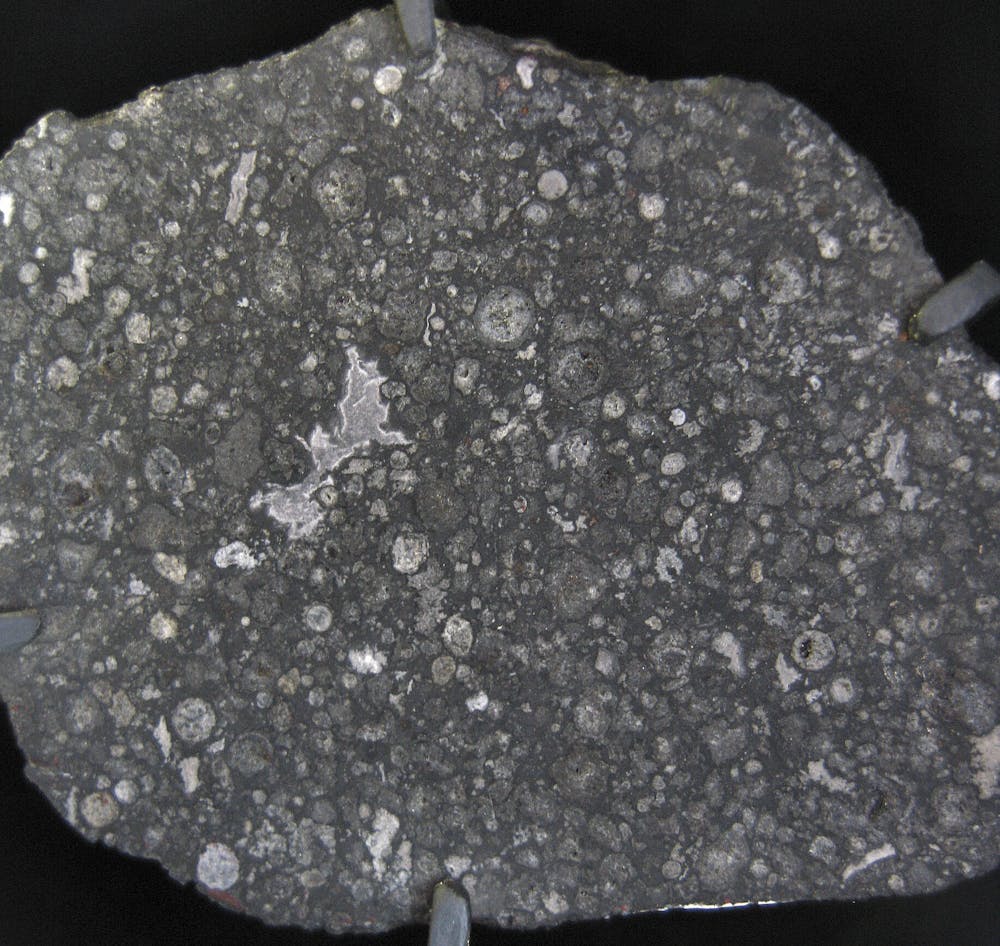
Amino acids, hydrocarbons and other carbon-based molecules arrived at our planet in carbonaceous chondrites (primitive meteorites, remnants from the early Solar System) and comets.
Once the early Earth was enriched with these organic molecules, chemical evolution followed. Eventually, life emerged on our planet. The earliest evidence is potential microbial life from 3.8 billion years ago, not long after the Late Heavy Bombardment.
Regardless of how life started, all theories agree on the need for a primitive ocean – or pools of water – that allowed early life on Earth to develop.
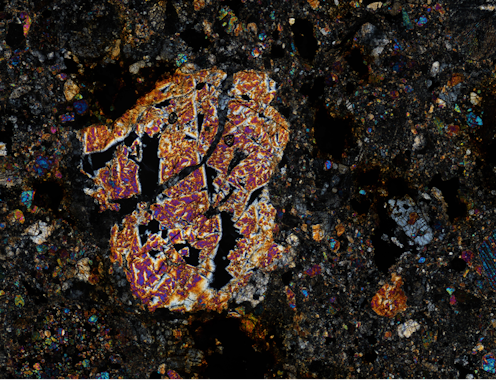
 Photomicrograph of an ordinary chondrite meteorite found in northwestern Africa containing small spherical particles of minerals called chondrules. Circled is a barred olivine chondrule.
Francisco Testa/From the author's personal collection
Photomicrograph of an ordinary chondrite meteorite found in northwestern Africa containing small spherical particles of minerals called chondrules. Circled is a barred olivine chondrule.
Francisco Testa/From the author's personal collection
3. How we got our oceans
Meteorites and comets also played a major role in the formation of Earth’s oceans and atmosphere. Large quantities of water were delivered to our planet during the Late Heavy Bombardment.
In addition, water was released from Earth’s interior through volcanic activity during the Hadean Eon, the first eon in our planet’s history.
Water vapour, along with other gases such as carbon dioxide, methane, ammonia, nitrogen and sulphur, formed the proto-atmosphere. Rain began to fall once the temperature dropped below the boiling point of water, forming our primordial ocean.
Yes – the water we drink today is at least partly of extraterrestrial origin.
4. Changing the course of evolution
The extinction of dinosaurs happened about 66 million years ago. It’s linked to the second-largest known meteorite impact on Earth, the deeply buried Chicxulub crater in Mexico.
In contrast, the Late Devonian extinction about 380 to 360 million years ago cannot be explained by a single impact. Several factors have been proposed as potential causes, including multiple impacts, climate change, depletion of oxygen (anoxia) in the oceans and volcanic activity.
Repeated times during Earth’s history, impact events have influenced the survival and evolution of life on our planet.
 The subtle impression of the Chicxulub impact crater is still visible on the Yucatán peninsula in Mexico today.
NASA/JPL
The subtle impression of the Chicxulub impact crater is still visible on the Yucatán peninsula in Mexico today.
NASA/JPL
5. Sampling Earth’s deep mantle and core
Scientists use a combination of methods to understand Earth’s internal structure: crust, mantle, core and their subdivisions. Seismology is the most important of them, which studies the propagation of seismic waves generated by earthquakes or artificial sources through Earth’s interior.
We have access to rock samples from the crust and upper mantle, but we will never be able to sample the deep mantle or solid core. Even if we had the technology, it would be astronomically expensive, and going down to such depths involves extreme pressures and temperatures.
Since direct sampling is impossible, scientists rely on indirect methods.
Pallasites and metallic meteorites are rocks from differentiated asteroids – ones that also have a mantle and core. Such space rocks are the closest we will ever come to sampling the deepest portions of our own planet. They help us understand its composition.
 A slab of a pallasite found in Sericho, Kenya in 2016. The darker patches are the olivine.
Francisco Testa/From the author's personal collection
A slab of a pallasite found in Sericho, Kenya in 2016. The darker patches are the olivine.
Francisco Testa/From the author's personal collection
Pallasites are rare, and contain a silicate mineral called olivine embedded in nickel-iron alloys. It’s thought pallasites form in the boundary between the core and mantle-like regions of differentiated asteroids.
Metallic or iron meteorites are mainly composed of the nickel-iron alloys kamacite and taenite. They are the core fragments of differentiated asteroids, giving us clues to our own planet’s core.
 Slab of Aletai iron meteorite, found in Xinjiang, China in 1898.
Francisco Testa/From the author's personal collection
Slab of Aletai iron meteorite, found in Xinjiang, China in 1898.
Francisco Testa/From the author's personal collection
6. Meteorite impacts gave us huge gold and nickel deposits
The Witwatersrand rocks in South Africa host the world’s largest known gold reserves. This would not be the case without the Vredefort impact crater – the largest known impact structure on Earth – formed about 2.02 billon years ago.
The impact saved these gold deposits from erosion by covering the entire area with ejected material, concealing the ore-bearing layers beneath. If an ore deposit erodes, the material disperses and it wouldn’t make for profitable extraction.
Witwatersrand is the largest gold-producing district in the world. Which means the ancient meteorite impact has made an indirect, lasting impact on our society through the availability of this precious metal.
But that’s not the only such event. The third-largest known impact crater on Earth is the Sudbury Basin in Canada, formed 1.85 billion years ago. It hosts giant nickel deposits because the impact disrupted Earth’s crust, partially melting it and allowing magma from the mantle to rise.
This led to the accumulation of nickel, copper, palladium, platinum and other metals, producing one of the richest mining districts on the planet.
The author would like to acknowledge helpful feedback on this article from Prof Noel C. White, University of Tasmania.
Authors: Francisco Jose Testa, Lecturer in Earth Sciences (Mineralogy, Petrology & Geochemistry), University of Tasmania


















