

Astronauts don’t eat enough because food tastes bland in space. We’re trying to work out why
- Written by: Julia Low, Senior Lecturer in Nutrition and Food (Sensory Science), RMIT University
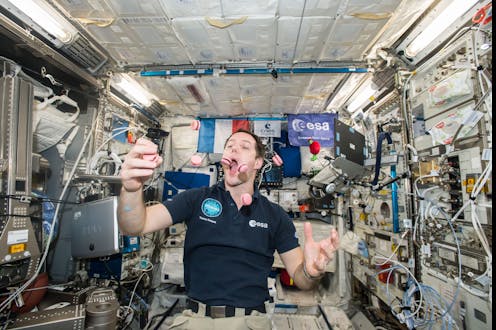
Astronauts often report that the joy of eating is lost in space. Food that tastes fabulous on Earth may become bland and boring in orbit.
In fact, despite carefully designed diets, space travellers often struggle to eat enough to meet their energy needs.
What’s going on here? We carried out some experiments on Earth to find out, using virtual reality (VR) and a simulated spacecraft environment to study how space travel might affect a person’s sense of smell and experience of food.
We discovered that some smells seem much more intense in a space-like environment – and earlier theories about how zero gravity affects the body can’t be the whole story. Our results, published in the International Journal of Food Science and Technology, could help design the space menus of the future.
Eating is a complicated experience
Eating is a multi-sensory experience that involves sight, smell, taste, hearing, and touch.
To enjoy the flavour of food – say, when biting into an apple – we need a combination of sensations, including taste (sweet, sour), smell (the complex combination of apple aromas), texture (the crunch), colour (green, red), and touch (firmness). If any of these senses is dulled, our enjoyment of food will not be the same.
The experience of food in space is very different from what we are used to on Earth.
One possible explanation for why space travellers experience taste differently involves the lack of gravity. Without gravity, bodily fluids are not drawn towards the feet but instead shift towards the head, leading to a sensation like having a blocked nose. If you’ve ever had a cold, you know how difficult it is to taste and enjoy food without your sense of smell.
But could there be other reasons?
The importance of environment
In space, the environment is unfamiliar and consistently monotonous. Could this change our perception of food?
Context heavily contributes to the eating experience. Studies have shown that eating the same meal in different settings can lead to varying opinions about the meal. Think about enjoying a picnic sandwich in a scenic park versus eating the same sandwich quickly at your work desk.
A spacecraft is an enclosed and confined environment, an airtight container in which you are surrounded by wiring and equipment and with no boundary between work and personal space. Imagine being in a pandemic-grade lockdown for multiple years with limited food and essential goods (and a persistent blocked nose).
One taste-test study compared airline meals consumed in three settings: a classic sensory laboratory environment (quiet, closed or semi-closed cubicles – like a voting booth), a semi-realistic aircraft environment simulated in a laboratory using aircraft furnishings, and an actual flight.
Passengers in the simulated aircraft environment enjoyed their meals about as much as passengers on an actual flight did. (Both of them liked it less than the people in the lab environment did.) This suggests the aircraft environment has a significant influence on food enjoyment.
Bringing space to Earth
Research involving humans in space is very challenging. Space missions typically involve at most six or seven crew members, which limits the sample size for experiments and the predictive power of the results.
Moreover, for food research, each person has unique sensory experiences and responses toward them. This makes it challenging to understand how different individuals perceive smells in space, let alone food aromas.
So we set out to recreate space on Earth. Using VR, we simulated the environment of the International Space Station.
The VR setup let us obtain data about participants’ feelings regarding food stimuli “in the moment”, rather than waiting for them to take off the headset and asking them questions afterwards. VR is a vital training environment for astronauts because of its unmatched ability to create a realistic sense of presence, crucial for studying what it is like to live in a spacecraft.

Our study is the first to involve a significant sample size (54 people) to capture the variation of individuals’ personal experiences of aromas and taste in simulated isolated settings.
In our study comparing everyday aromas, some scents were perceived differently in the virtual International Space Station environment compared to the partitioned booth environment.
Molecular magic of aroma
Aromas are a complex blend of molecules with unique chemical structures, influencing how they interact with the olfactory receptors in the nose to form distinctive smells.
Our study suggests that only specific aroma compounds are perceived differently in space-like environments. We found that sweet-smelling molecules tended to be perceived more strongly.
Vanilla and almond, which both contain the sweet, almond- or cherry-scented compound benzaldehyde, smelled stronger in our VR space station than in the control environment. By contrast, there was no difference in perception of the lemon aroma.
This knowledge could be used in designing space meals. For example, the sweet aromas could be used as flavour enhancers or additives to bring out other flavours and add depth.
Understanding how these aroma compounds interact with each other, and finding the right concentration levels is essential. And of course, no single flavour will suit everybody’s taste.
Earthly implications
A better understanding of how smell is perceived in space-like environments could inspire ways to create personalised diets based on each astronaut’s unique sensory experiences and preferences. By tailoring food aromas, we could encourage space travellers not only to eat more, but enjoy food more.
These solutions may also help people on Earth living in isolated or confined environments, such as nursing home residents, individuals on military deployment, and submarine crews.
Authors: Julia Low, Senior Lecturer in Nutrition and Food (Sensory Science), RMIT University


















