

How a century-old drug could revolutionise cobra bite treatment
- Written by: Tian Du, PhD candidate in venom genomics, University of Sydney
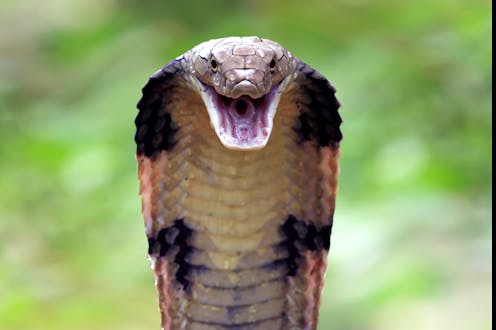
About 1.8 million people worldwide are bitten by snakes each year. Of those, up to 138,000 die and another 400,000 end up with permanent scarring and disability.
Many cobras have tissue-damaging venoms that can’t be treated with current antivenoms. We have discovered that cheap, readily available blood-thinning medications can be repurposed as antidotes for these venoms.
Using CRISPR gene-editing technology we learned more about how these venoms attack our cells, and found out that a common class of drugs called heparinoids can protect tissue from the venom. Our research is published today in Science Translational Medicine.
Snakebites are a serious problem
Snake venoms are made up of many different compounds. Generally, they target the heart, nervous system or tissue at the exposure site (such as the skin and muscle).
Much snakebite research understandably focuses on the most deadly venoms. As a result, venoms that are less deadly but still cause long-term problems – such as cobra venoms – have received less attention.
In the regions where cobras live, serious snakebites can have devastating effects such as amputation, leading to life-changing injuries and a loss of livelihood. The World Health Organization has declared snakebite a “Category A” neglected tropical disease and hopes to reduce the burden of snakebites by half by 2030.
The only current treatments for snakebites are antivenoms, which are made by exposing non-human animals to small amounts of the venom and harvesting the antibodies they produce in response.
Antivenoms save lives, but they have several drawbacks. Each one is specific to one or more species of snake, they are prohibitively expensive (when they are available at all), they need cold storage, and they must be administered via injection in a hospital.
What’s more, antivenoms can’t prevent local tissue damage. This is mainly because the antibodies that make up antivenoms are too large to reach peripheral tissue, such as a limb.
How cobra venom kills cells
Our team – at the University of Sydney in Australia, the Liverpool School of Tropical Medicine in the United Kingdom and Instituto Clodomiro Picado in Costa Rica – set out to look for other options to treat snakebites.
First, we wanted to try to understand how these venoms worked. We started with cobras, which are found across Africa and South Asia.
We took venom from the African spitting cobra, which is known to cause tissue damage, and performed what is called a whole genome CRISPR screen.

We took a large mixture of human cells and used CRISPR gene-editing technology to disable a different gene from across the whole human genome in each cell. CRISPR technology uses a special enzyme to remove or change specific parts of the DNA in a cell.
Then we exposed all the cells to the cobra venom, and looked at which ones survived and which ones died.
Cells that survived must have been missing whatever it is that the venom needs to hurt us, so we could quickly identify what these features were.
We found various cobra venoms need particular enzymes to kill human cells. These enzymes are responsible for making long sugar molecules called heparan and heparin sulfate.
Heparan sulfate is found on the surface of human and animal cells. Heparin sulfate is released from our cells when our immune systems respond to a threat.
The importance of these molecules intuitively made sense. Snake venoms have evolved alongside their targets, and heparan and heparin have changed very little throughout evolution. The venoms have therefore hijacked something common to animal physiology to cause damage.
How heparin decoys reduce tissue damage
Heparin has been used as a blood-thinning medication for almost 100 years.
We tested this drug on human cells to see if flooding the system with free heparin could be used as a decoy target for the venom. Remarkably, this worked and the venoms no longer caused cell death, even when the heparin was added to cells after the venom.
We also tested heparin against venoms from distantly related Asian cobras and it had the same protective effect. We also showed that injecting a smaller synthetic version of heparin called tinzaparin could reduce tissue damage in mice with an artificial “snakebite”.
To figure out how heparin was blocking the venom, we separated the venom into its major components. We found that heparin inhibits “cytotoxic three-finger toxins”, which are a major cause of tissue injury. Until now there were no drugs known to work against these toxins.
The next step will be to test the effects of heparin in people.
Cheaper, more accessible snakebite treatment
Our goal is to make a snakebite treatment device containing heparin-like drugs called heparinoids, which would be similar to the EpiPen adrenaline injectors often carried by people at risk of severe allergic reactions. These devices could be distributed to people who face a high risk of cobra bites.
Heparinoids are already inexpensive essential medicines used to prevent blood clots. The US Food and Drug Administration has approved them for self-administration in humans which may reduce the time required for the lengthy process of getting a drug to market. Heparinoids are also stable at room temperature, meaning the drugs can be more accessible in remote regions and delivered faster in the field.
Other studies have also confirmed the usefulness of repurposing drugs for treating snakebites. These drug combinations could herald a new age for snake venom treatment that doesn’t solely rely on costly antivenoms.
Our lab has previously used CRISPR screening to investigate box jellyfish venom and we’re currently looking at other venoms closer to home from bluebottles to black snakes. Our screening technique lets us uncover a wealth of information about a venom.
It’s early days, but we are finding many venoms rely on overlapping targets to attach to our cells. This research all feeds into the more lofty goal of making universal and broad-acting venom antidotes.
Authors: Tian Du, PhD candidate in venom genomics, University of Sydney
Read more https://theconversation.com/how-a-century-old-drug-could-revolutionise-cobra-bite-treatment-234277


















