

Only half of packaging waste is recycled – here's how to do better
- Written by: Ben Madden, Senior Research Consultant at the Institute for Sustainable Futures, University of Technology Sydney
Almost half of Australia’s packaging waste is not being recovered for recycling, according to the first comprehensive study to track the fate of used packaging materials.
Overall, 56% of packaging was recovered for recycling in 2017-18, according to our study, carried out at the UTS Institute for Sustainable Futures and published by the Australian Packaging Covenant Organisation, a not-for-profit group that aims to reduce the environmental impact of packaging and is leading the effort to implement the National Packaging Targets.
Only 32% of plastic packaging was recovered for recycling, whereas the figure for paper and cardboard was 72%.
 Total amounts of packaging waste generated and recovered in Australia for the 2017-18 financial year.
APCO/UTS ISF
Total amounts of packaging waste generated and recovered in Australia for the 2017-18 financial year.
APCO/UTS ISF
Used packaging materials such as glass, paper, metal and plastic make up 15% of all recyclable waste generated in Australia, according to our calculations based on available government data. By taking a snapshot of our current performance in recovering these materials, we can identify which areas are most in need of attention. This will help us work towards a “circular economy” approach in which packaging materials are reclaimed, reused and recycled, rather than thrown away.
Read more: Explainer: what is the circular economy?
The chart below shows that the most significant losses to landfill happen before waste is collected for sorting. Households and businesses are still throwing recyclable packaging, approximately 32% of total packaging consumed, into red bins instead of into recycling.
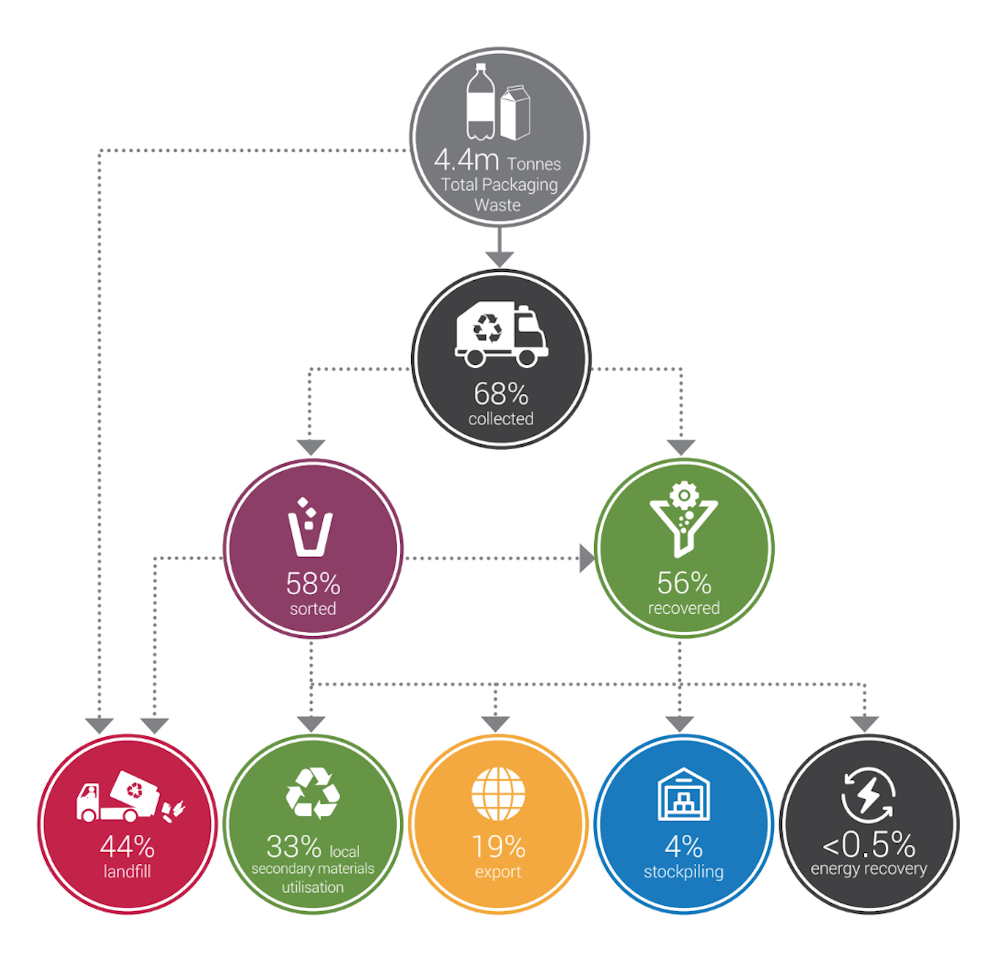 The fate of Australia’s recyclables.
APCO/UTS ISF
The fate of Australia’s recyclables.
APCO/UTS ISF
The 56% recovery figure includes packaging material recovered for export, as well as materials that are currently stockpiled. This includes glass which is not currently in high demand for local manufacturing.
Waste exported overseas represents a significant proportion – about 34% – of total packaging waste recovered. Evidently, there is a clear opportunity to improve local waste management practices and grow local demand for products that contain recycled materials. This would help make Australia’s packaging system more resilient to fluctuations in global markets.
The biggest recent market shock was the recycling crisis sparked by China’s decision to limit the imports of large amounts of recyclable materials.
Read more: A crisis too big to waste: China's recycling ban calls for a long-term rethink in Australia
In April last year, state and federal environment ministers and local governments reacted to that crisis with the launch of the National Packaging Targets. This included a pledge to pursue circular economy principles.
In practice, this means avoiding packaging waste, improving local recovery of recyclables, and increasing the demand for products that contain recycled materials. Already we have seen major brands such as Unilever commit to using at least 25% locally sourced recycled plastic in packaging such as shampoo bottles. This is a big step in the right direction, and aligns with the trending global agenda to eliminate plastic pollution.
However, developing a circular economy for packaging in Australia requires coordinated action across the whole supply chain. This includes manufacturers, brand owners, consumers, and the resource recovery sector.
Better source separation is important and this requires consumer education and awareness raising, as well as smarter design of packaging to make it easier to recycle. These strategies are already supported by the new Australasian Recycling Label, which could potentially be mandated for all types of packaging.
A further consequence of better source separation is a reduction in the contamination of the collected materials. This would improve the efficiency of the material recovery facilities (MRFs) that sort the mixed recyclables into separate streams for reprocessing.
What we also need is more and better data on packaging consumption and recycling infrastructure capabilities. Some future actions are clear, such as addressing problematic plastic packaging. Others decisions that might involve broad systemic interventions need more information about the best way to encourage packaging circularity. Key to success will be the willingness of all stakeholders to develop a collective, consistent and proactive approach to information sharing and problem solving.
This article was coauthored by Brooke Donnelly, chief executive of the Australian Packaging Covenant Organisation.
Authors: Ben Madden, Senior Research Consultant at the Institute for Sustainable Futures, University of Technology Sydney
Read more http://theconversation.com/only-half-of-packaging-waste-is-recycled-heres-how-to-do-better-112231


















