

White rice with side dishes isn’t really ‘traditional’ Japanese food. So where did we get this idea?
- Written by: Laura Emily Clark, Lecturer in Japanese, University of New England
At first glance, Netflix’s popular Japanese animation Delicious in Dungeon is a strangely food-obsessed dungeon-crawler fantasy tale.
Upon a closer look, however, it reveals itself as a striking parody of the popular “gourmet genre”. The series invites us to think critically about how food traditions are created and conformed to.
It also reminds us that food is highly political and that the “culinary nationalism” we see around the world – and particularly in Japan – is more complicated than most people realise.
A culinary high fantasy
Delicious in Dungeon was initially released as a comic book in 2014, before being adapted for TV by Japanese animation studio Trigger. Its distribution by Netflix this year has given the seinen (meaning “youth”) anime a global audience.
Despite being a dungeon crawler, the series has an unusually explicit focus on food. Our group of heroes must keep themselves fed while on their epic quest. Specifically, they must embrace (with varying degrees of enthusiasm) danjon meshii: slaying monsters and eating them.
The show’s creators use a range of visual and narrative tropes borrowed from the Japanese “gourmet” genre. Typically, works in this genre (including books, movies, shows, comics and more) feature a careful discussion of ingredients, a demonstration of their preparation and an evaluation on the final product.
The order in which this happens can vary depending on the specific work. For example, the popular Netflix show Midnight Diner typically provides the full recipe at the end of each episode.
Although the ingredients and method of preparation shown in Delicious in Dungeon are … unusual … the show still follows this pattern to a T. Whether the characters are making a mandrake and bat meat kakiage, or a basilisk egg omelette, they discuss the ingredients, prepare the meal and react as they eat it.
Even the characters who are the most uncomfortable with having to eat monsters have moments of eye-watering happiness when they taste the delicious flavours.

Conversations about food
By talking explicitly and consistently about food taboos (such as “must you eat the monsters you kill?”) and food values (such as “food should be shared with others”), Delicious in Dungeon draws our attention to a number of ideas that usually hide beneath the surface.
What is “natural” to eat? Why are some food practices considered taboo? And who gets to decide?
Our “foodways” – our cultural and social practices regarding the creation and consumption of food – are where community, connection and in-group/out-group dynamics are formed.
Food is constantly at the centre of battles of authenticity, tradition and values (never mind issues of scarcity and sustainability). As described by Japanese literature academic Tomoko Aoyama in her book Reading Food in Modern Japanese Literature:
the seemingly simple and ordinary may turn out to be surprisingly complex, once we pay attention to it […] Food has been discovered, invented, classified, and scrutinised, as well as enjoyed, consumed and devoured.
Policing tradition and authenticity
Since the early 2000s, various arms of the Japanese government have been on a quest to define (and protect) “authentic” Japanese food.
One eyebrow-raising example was a 2006 program created for the certification of authentic Japanese restaurants outside Japan. It has since been largely replaced by Japan’s non-governmental, non-profit Organisation to Promote Japanese Restaurants Abroad and the Ministry of Agriculture, Forestry and Fisheries promotion of businesses that use Japanese ingredients.
Perhaps the most significant change in Japanese food tradition was the successful UNESCO Intangible Heritage bid of 2013, which saw washoku enshrined as a “traditional dietary culture”.
The term washoku (“wa” meaning Japanese and “shoku” meaning food) emerged during the modern Meiji period (1868–1912) to describe food from Japan alongside a sudden influx of European foods. But it was an everyday term of no special significance; there was no uniform opinion of what “Japanese” food was.
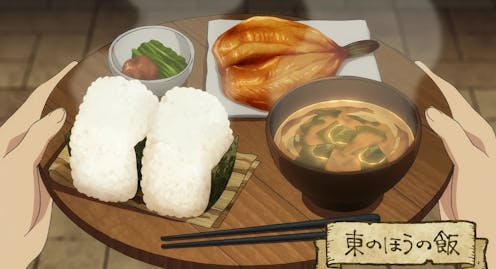
After the bid, a previously undefined range of food practices carried out by millions of people was reduced to a single meal which includes a serve of white rice with multiple side dishes.
 Although washoku has been enshrined as ‘traditional Japanese food’, it wasn’t popularised until relatively recently.
Nullumayulife/Flickr, CC BY
Although washoku has been enshrined as ‘traditional Japanese food’, it wasn’t popularised until relatively recently.
Nullumayulife/Flickr, CC BY
Washoku is essentially an “invented tradition” that was only recently awarded cultural significance and repackaged for an international audience. As Japanese culinary scholar Eric Rath explains:
Washoku is an idealised dietary lifestyle focusing on food popularised from the 1960s onwards, meant to impress audiences outside Japan and guide domestic eating habits.
In fact, many elements of modern Japanese cuisine didn’t become mainstream until the past 100 years. For instance, the vast majority of Japan’s population rarely ate pure white rice before the 1950s. It was the rice rationing of the wartime government that introduced white rice into people’s daily fare.
Before this period, there was massive variation in food practices and the types of food eaten depended on the region and climate. Generally speaking, however, a “traditional” Japanese diet from pre-modern times included single-pot meals combining millet and barley (sometimes mixed with rice) and local vegetables.
Another example of a dish considered purely Japanese, but which isn’t, is ramen.
 Ramen is the result of immigration and cultural intermingling.
Shutterstock
Ramen is the result of immigration and cultural intermingling.
Shutterstock
Ramen was developed in the early 1900s by Chinese immigrants in Japan, to serve to blue-collar workers. It underwent several changes and adjustments before it became the rich dish we know and love today.
Eating with your eyes
Regardless of the historical reality, our shared imagination of “Japanese food” continues to thrive in fictional worlds and the gourmet genre.
Netflix in particular has engaged with the genre through older hits such as Midnight Diner and more recent releases such as The Makanai: Cooking for the Maiko House.
 The first pre-Netflix Midnight Diner season premiered in 2009. The anthology was acquired by Netflix Japan in 2016.
Netflix
The first pre-Netflix Midnight Diner season premiered in 2009. The anthology was acquired by Netflix Japan in 2016.
Netflix
A number of novels translated from Japenese to English such as The Kamogawa Food Detectives by Hisashi Kashiwai can also be understood as part of this trend.
When we see the characters in Delicious in Dungeon debate how to best prepare their dishes, or gasp in pleasure at the wonders on their palates, we’re actually seeing a parody of the gourmet genre and a critique of culinary nationalism.
So the next time you encounter the words “traditional” next to food, you might want to ask yourself: what is this person trying to sell me – and why?
Authors: Laura Emily Clark, Lecturer in Japanese, University of New England

















