

Australia’s largest iron ore deposits are 1 billion years younger than we thought
- Written by: Liam Courtney-Davies, Postdoctoral Research Associate, University of Colorado Boulder
Iron ore is the key ingredient in steel production. One of the fundamental resources for the Australian economy, it contributes A$124 billion in national income each year.
This is not surprising, considering Western Australia is home to some of Earth’s largest iron ore deposits, and 96% of Australia’s iron ore comes from this state. Yet despite the metal’s significance, we still don’t know exactly how and when iron deposits formed within the continent.
In new research published in the Proceedings of the National Academy of Sciences, we answer some of these questions by directly measuring radioactive elements in iron oxide minerals which form the basis of these resources.
We found that several of Western Australia’s richest iron deposits – such as Mt Tom Price and Mt Whaleback – are up to 1 billion years younger than previously understood. This redefines how we think about iron deposits at all scales: from the mining site to supercontinents. It also provides clues on how we might be able to find more iron.

Where does iron ore come from?
Billions of years ago, Earth’s oceans were rich in iron. Then early bacteria started photosynthesising and rapidly introduced huge amounts of oxygen into the atmosphere and oceans. This oxygen combined with iron in the oceans, causing it to settle on the sea floor.
Today, these 2.45-billion-year-old sedimentary rock deposits are called banded iron formations. They represent a unique archive of the interactions between Earth’s continents, oceans and atmosphere through time. And, of course, banded iron formations are what we mine for iron ore.
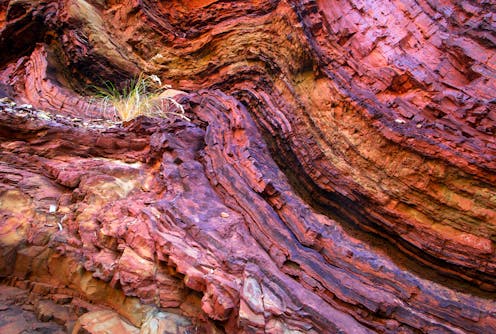
These sedimentary deposits have distinctive, rhythmic bands of reddish iron and paler silica. They were alternately laid down on the sea floor seasonally. Such remarkable rocks can be visited today in Karijini National Park, WA.
 Typical banded iron formation at Fortescue Falls in Kaijini National Park, Western Australia.
Graeme Churchard/Wikimedia Commons, CC BY
Typical banded iron formation at Fortescue Falls in Kaijini National Park, Western Australia.
Graeme Churchard/Wikimedia Commons, CC BY
The iron content of these banded iron formations is generally less than 30%. For the rock to become economically viable to mine, it must be naturally converted by later processes to around 60% iron.
The nature of this rock conversion is still debated. In simplest terms, a fluid – such as water – will both remove silica and introduce more iron during an “upgrading” process which transforms the rock’s original makeup.
The geochronology (age dating) of this chemical transformation and upgrading is not well understood, largely because the tools required to directly date the iron minerals have only recently become available.
Previous age estimates for the Pilbara iron deposits were indirect but suggested they were at least 2.2 billion years old.
What did we find out?
You may think of iron ore as rusty, red-coloured dust. However, it’s typically a hard, heavy, steely-blue material. When crushed into a fine powder, iron ore turns red. So the red landscape we see across the Pilbara today is a result of the weathering of iron minerals from beneath our feet.
 1.3-billion-year-old steel blue iron ore extracted from Hamersley Province, Western Australia.
Liam Courtney-Davies
1.3-billion-year-old steel blue iron ore extracted from Hamersley Province, Western Australia.
Liam Courtney-Davies
We extracted microscopic scale “fresh” iron minerals from drill core samples at several of the most significant Western Australian iron deposits.
Leveraging recent advancements in radiometric dating, we measured naturally occurring radioactive elements in the rocks. In particular, the ratio of uranium to lead isotopes in a sample can reveal how long ago individual mineral grains crystallised.
Using the newly generated iron mineral age data, we constructed the first-ever timeline of the formation of Western Australia’s major iron deposits.
We discovered that all major iron ore deposits in the region formed between 1.4 and 1.1 billion years ago, making them up to 1 billion years younger than previous estimates.
These deposits formed in conjunction with major tectonic events, especially the breakup and reemergence of supercontinents. It shows just how dynamic our planet’s history is, and how complex the processes are that led to the formation of the iron ore we use today.
Now that we know that giant ore deposits are linked to changes in the supercontinent cycle, we can use this knowledge to better predict the places where we are more likely to discover more iron ore.
Liam Courtney-Davies completed this research while at John de Laeter Centre, Curtin University.
Authors: Liam Courtney-Davies, Postdoctoral Research Associate, University of Colorado Boulder


















