

Your world is different from a pigeon’s – but a new theory explains how we can still live in the same reality
- Written by: Catherine Legg, Senior Lecturer in Philosophy, Deakin University
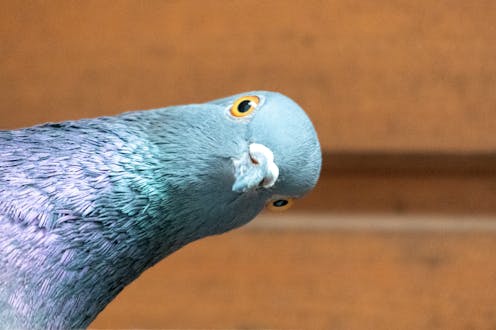
The human eye registers three colours of light: red, green and blue. But pigeons (and many other animal species) can also see a fourth colour, ultraviolet.
The “four-dimensional” colour space pigeons see may contain millions more colours than ours. To a pigeon, for example, many flowers show patterns that are invisible to us.
Despite the long history of close association between our species, we might say humans and pigeons live in quite different worlds. If different species effectively live in different worlds, does that mean our biology constructs reality?
The question of whether reality exists outside or inside our heads has troubled philosophers for millennia. In a recent paper, my colleague André Sant’Anna and I propose a pragmatic way to resolve this dilemma, based on inquiry and action.
How many worlds are there?
There is a long tradition in philosophy called “realism”. In the realist view, there is just one world with pre-given features that are independent of the mind observing them – and discovering these features is the job of science.
But if something is entirely independent of our minds, how can we know it with our minds? Isn’t this a contradiction in terms?
So there is an equally long history of philosophical argument that the features of reality somehow depend on experience. These thinkers claim that reality does not come pre-carved (at what Plato famously described as a natural set of “joints”). There are as many worlds as there are sets of experiences, and each set of experiences creates a unique perspective (or what Edmund Husserl called a “life-world”).
This deep dispute over the nature of reality and worlds has arisen in almost every generation of philosophers.
How do our bodies shape our experience of the world?
There is an increasingly popular alternative to traditional realism called “enactivism”, which draws inspiration from cognitive science.
Enactivism made its debut in 1990, in a book by Francisco J. Varela, Eleanor Rosch and Evan Thompson called The Embodied Mind. Bringing together scientific biology, Husserl’s life-worlds and Buddhist philosophy, the authors theorised that just as a living creature grows and repairs its own body, it “enacts” its own environment as having features of importance to itself, such as food or danger.

As Thompson later wrote,
a cognitive being’s world – whatever that being is able to experience, know, and practically handle – is conditioned by that being’s form or structure.
The limits of the life-world
On the face of it, though, enactivism leaves certain important questions unanswered.
 The stuffed body of Cher Ami on display in the Smithsonian.
US Signal Corps via Wikimedia
The stuffed body of Cher Ami on display in the Smithsonian.
US Signal Corps via Wikimedia
First, how do species successfully interact with each other when their perceptual capacities seem to put them in quite different life-worlds? For instance, during the first world war, a pigeon named Cher Ami heroically carried a message that saved the lives of 200 British soldiers despite being shot down by enemy fire, for which he was awarded a gold medal.
Second, it seems scientists should be able to investigate how different species’ different bodies create different perceptual experiences. But if all species – including ourselves – are “locked up” in their own life-worlds, such inquiry is impossible.
These two issues are what we set out to resolve in our recent paper.
Do shared experiences and actions create reality?
We propose a new alternative to the dilemma of understanding reality as either pre-given or located in subjective individual experiences, drawing on the ideas of pragmatist philosopher Charles Peirce. We argue for an inquiry-based realism, whereby reality depends on our minds but is still public and objective.
As we explain it, reality is grasped through pragmatic agreement. This means individuals align their expectations about what others will do in similar lived situations.
So, for instance, although a WWI soldier and a pigeon with their different eye structures perceive a shooting enemy quite differently, they pragmatically agree that he is dangerous when they both move away. As we saw with Cher Ami, humans and pigeons can also agree on the supreme importance of reaching “home base” with a delivery.
This highlights a key characteristic of pragmatist philosophy. It does not define cognition as a kind of consciousness, an idea that has led to apparently insoluble philosophical problems.
Rather, pragmatists view knowledge of reality as implicit in what we can do, most especially what we can do with others.
Pragmatic agreement with other species
Of course, there will be many matters on which different species do not currently have pragmatic agreement. For instance, while humans and pigeons both understand the danger of an enemy firing a gun, it would be lost on a dung beetle happily feeding in the same WWI trench.
But we should not hastily conclude from this that reality must always be plural. Peirce’s inquiry-based account of reality expresses an optimistic hope that over time we can find ways to bring species into ever greater pragmatic agreement.
 Unlike a human or pigeon, a dung beetle would not perceive somebody firing a gun as a threat.
Klimek Pavol/Shutterstock
Unlike a human or pigeon, a dung beetle would not perceive somebody firing a gun as a threat.
Klimek Pavol/Shutterstock
What is required is that we put ourselves into the same environments, do similar things, and develop shared goals. Thus Peirce defined truth as “the opinion which is fated to be ultimately agreed to by all who investigate”.
We believe our account provides a nuanced and original vision of reality for enactivism. It allows creatures’ unique perceptual powers a role in shaping their own reality, but it also allows that reality is objective, in a different way than traditional realism.
We are arguably only beginning to understand how to understand the realities in which non-human animals live. Peirce’s philosophy shows us how such understanding can be achieved over time. And if we can manage to increase our pragmatic agreement with other species, we stand to receive many gifts in widening the reality in which we ourselves live.
Authors: Catherine Legg, Senior Lecturer in Philosophy, Deakin University


















