

Not one, but two meteor showers are about to peak – here’s how to catch the stellar show
- Written by: Jonti Horner, Professor (Astrophysics), University of Southern Queensland
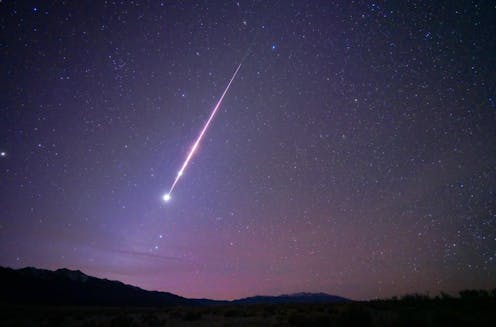
On any clear night, if you gaze skywards long enough, chances are you’ll see a meteor streaking through the sky. Some nights, however, are better than others.
At certain times of year, Earth passes through particularly dirty parts of its orbit, ploughing through debris left behind by comets and asteroids. During those times, we see that debris crashing into our atmosphere, and a meteor shower is born.
Some meteor showers are better than others. The faster the debris is travelling, or the more debris there is, the more meteors you will see. But generally, these showers are annual events – recurring whenever Earth returns to the same place in its orbit.
The end of July is one such time, with Earth going through several swathes of our Solar System’s debris at once.
Two of those showers reach their peak around July 31. While neither ranks among the very best showers of the year, taken together the two can put on a lovely show in the depths of our cold winter nights.
Earth orbiting around the Sun (blue circle) and intersecting with the two debris streams: Alpha Capricornids in pink and Southern Delta Aquariids in yellow. Video created on an Evans & Sutherland Digistar 7 system by Museums Victoria.The Southern Delta Aquariids: the fast ones
The first, and most active, of the two showers is the Southern Delta Aquariids. For stargazers in Australia and New Zealand, they are the third-strongest meteor shower of the year (after the amazing Geminids, in December, and the Eta Aquariids, which peak in early May).
The Southern Delta Aquariids are dust from comet 96P/Machholz – a dirty snowball that moves on a highly elongated and tilted orbit within the inner Solar System. 96P/Machholz is the largest object in a broad stream of debris which produces several meteor showers throughout the year.
The Southern Delta Aquariids are active for around six weeks, from mid-July to late August, and reach their peak on July 31. In a typical year, the shower is at its best for around 48 hours. During the peak, observers under perfect conditions can see up to 20 to 25 meteors per hour.

While many meteors from this shower are relatively faint (and so become harder to see if the Moon is above the horizon, or if you’re observing from a light-polluted site), the shower is known for producing some brighter meteors, particularly around their peak.
In addition, the Southern Delta Aquariids have produced at least two unexpected outbursts in the past, with enhanced rates observed in 1977 and 2003 – a reminder that meteor showers can sometimes throw up nice surprises!
The Alpha Capricornids: slow, with occasional fireballs
The Alpha Capricornids is a significantly weaker shower than the Southern Delta Aquariids – it produces fewer meteors per hour. Even at their best, on the nights of July 30 and 31, it is rare for observers to see more than four or five meteors from the shower in any given hour.
But where the Southern Delta Aquariids are plentiful, fast and often faint, the Alpha Capricornids are slow, and often bright. Indeed, the shower has a reputation for producing spectacular bright meteors and fireballs. Its meteors, infrequent as they are, are often the highlight of a winter night’s observing.
In 2010, two of the world’s leading meteor scientists identified the parent of the Alpha Capricornid meteor shower – a dim comet called 169P/NEAT. They suggest it’s just a small piece of a larger object which fragmented between 4,500 and 5,000 years ago.
Currently, Earth only passes through the very outer layers of a vast debris stream laid down by that ancient fragmentation. The scientists who identified it predict that in just 200–300 years we will instead move through the very centre of the stream.
If that comes to pass, the Alpha Capricornids will one day become by far the best meteor shower of the year.
Where and when should I look?
This year, the peak of both meteor showers falls mid-week, on Wednesday July 31. However, both showers have relatively broad peaks and will produce respectable numbers of meteors for a few days.
If you’re planning a camping trip on the weekend of July 27–28 or August 3–4, you might still get a decent show, particularly in the early morning hours after midnight.
But for the best rates you should head out on the nights of Tuesday July 30 and Wednesday July 31.
From across Australia and New Zealand, you can start observing from 9pm or 10pm, when the radiants for both showers – the place in the sky from which meteors appear to radiate – rise in the east. At first, rates from the showers will be low, but the higher in the sky the radiants rise, the more meteors will be visible.
The bright stars Altair and Fomalhaut are useful guides. As a bonus, the planet Saturn can be found in the same part of the sky, shining as bright as the brightest stars.
 Start looking for meteors around 10pm local time, when the Capricornus and Aquarius constellations are rising in the east, along with the planet Saturn. This view is typical for locations across Australia and New Zealand.
Museums Victoria/Stellarium
Start looking for meteors around 10pm local time, when the Capricornus and Aquarius constellations are rising in the east, along with the planet Saturn. This view is typical for locations across Australia and New Zealand.
Museums Victoria/Stellarium
The longer you’re willing to stay out, the better your chance of seeing meteors. As the night progresses, the radiants will move across the sky, climbing higher until they culminate in the north after midnight. The best rates will be visible when the radiants are highest: between around 11pm and 3am.
Head out somewhere well away from city lights. Our eyes take a significant amount of time to adjust to the darkness, so it’s best to watch for at least half an hour, if not longer – particularly since meteors are not equally spaced out. You can wait 20 minutes and see nothing, then spot several in just a minute or two!
If you’re fortunate enough to find a site where the sky is dark in all directions, you should look to the northeast in the evening, to the north in the hours around midnight, and then northwest in the pre-dawn hours.
 By the early hours of the morning, the constellations and Saturn can now be found high in the northern sky. This view is typical for locations across Australia and New Zealand.
Museums Victoria/Stellarium
By the early hours of the morning, the constellations and Saturn can now be found high in the northern sky. This view is typical for locations across Australia and New Zealand.
Museums Victoria/Stellarium
The darker the sky, the more you’ll see. By the peak of the two showers, the Moon will be all but out of the way, rising only a couple of hours before dawn.
As a result, this year is the ideal time to head out and watch an annual winter spectacle. And who knows, you might just get lucky and see a spectacular fireball caused by the debris shed by a dying comet 5,000 years ago.
Authors: Jonti Horner, Professor (Astrophysics), University of Southern Queensland

















