Meryl Tankard revisits Two Feet, the tragic story of a dancer's perfectionism
- Written by: William Peterson, Associate Professor, Flinders University
Review: Two Feet, Adelaide Festival
There are many reasons for a dance choreographer to revisit a work from their back catalogue. With Two Feet, an exhilarating two-hour work that brought audiences to their feet for the opening weekend of the Adelaide Festival, acclaimed Australian choreographer Meryl Tankard has added another.
When Two Feet premiered in 1988, Tankard herself played one of the early 20th century’s greatest ballerinas, Russian Olga Spessivtzeva. She has recreated the work for one of the most brilliant ballet dancers of the current generation, Russian Natalia Osipova.
Tankard has a long association with Adelaide, and it was during her tenure as Artistic Director of the Australian Dance Theatre (1993-1999) that the company developed a solid international reputation. Local audiences would recognise aspects of her quirky, homespun style in this work, while it also bears the traces of her six years as a featured dancer with Pina Bausch’s famed Wuppertaler Tanztheatre.
Spessivtzeva was a dancer known for her work with the Ballet Russes and Paris Opera Ballet from 1916-1934, and perhaps more famously, for a series of mental breakdowns. In 1934, following a successful Australian tour, she was found wandering down a deserted road outside of Sydney.
 Natalia Osipova plays fellow Russian ballerina Olga Spessivtzeva. Both dancers are renowned for their interpretations of Giselle.
Regis Lansac
Natalia Osipova plays fellow Russian ballerina Olga Spessivtzeva. Both dancers are renowned for their interpretations of Giselle.
Regis Lansac
The dancer’s most famous role was that of the title character in Giselle, one of the great 19th century romantic operas. And like Giselle, whose madness is expressed by the compulsion to dance to the point of being consumed by it, Spessivtzeva was known for her fanaticism and a perfectionism that ultimately proved too onerous for her body.
She famously identified with the character, and her interpretation of the role, which includes a tragic scene in which she literally dances herself to death, has remained a fixed reference point for all future Giselles.
Read more: Dada Masilo's Giselle is a courageous retelling for our times
Enter Osipova, who like Spessivtzeva, has been critically acclaimed for her Giselle. She has been lauded both for her raw, emotional approach to the character, but also for her high leaps, which make it appear as though she is flying across the stage in the ballet’s key dance scenes. In an interview late last year Tankard observed of Osipova, “she’s like a modern day Olga”.
Yet this is no autobiography of Spessivtzeva – we know little of her actual inner emotional life. Instead, with new sequences developed with Osipova, Tankard offers up a rich piece of dance theatre which riffs on what would today be recognised as Olga’s struggle with depression. Known for her obsessive repetition of dance exercises along the barre prior to performing, Olga’s mental illness is linked to the rigorous demands of dance training.
The internal logic of the work weaves a twisted but uncannily connected web connecting Osipova and her mental state with the extreme, cruel, and sometimes comic ways in which dance is taught and learned.
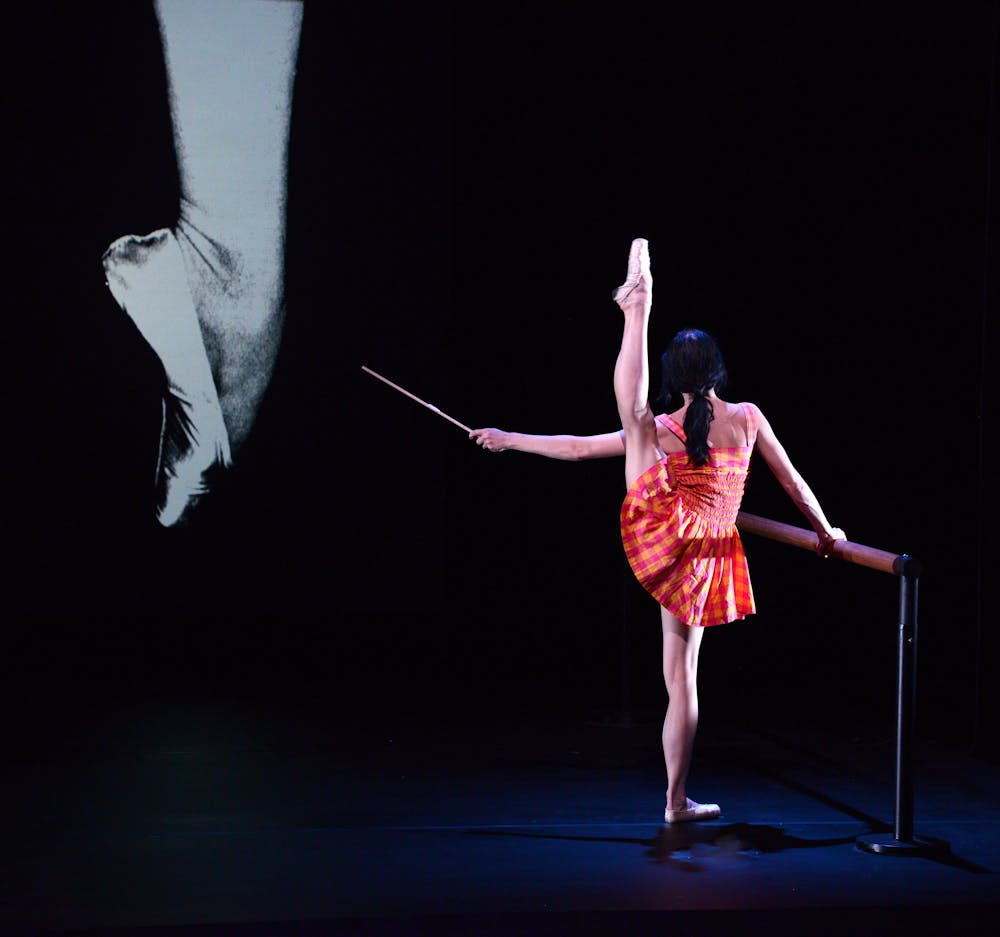 Spessivtzeva was known for her obsessive dance training along the barre.
Regis Lansac
Spessivtzeva was known for her obsessive dance training along the barre.
Regis Lansac
One of the comic sequences is drawn from a 1957 primer, Every Child’s Book of Dance and Ballet, which sets out with diagrams and writing how a young girl is to perform the absurdly over-mimed “Shrimp” dance. Osipova attempts to master the steps as they are authoritatively delivered via voice-over in English and Russian.
The instructions are frequently ridiculous, as the girl, net in hand, is instructed how to dance out the capture and eventual release of a large shrimp while acting cute for the audience. In its silliness, it is also vaguely menacing.
So too are some of Osipova’s own revelations, as when she reveals in one sequence that her mother frequently found her with her legs strapped behind her head to the bed post. As she demonstrates the pose, she tells us, “I never felt anything because I’m used to pain”.
Adding further depth to this richly layered show were the projections of Tankard’s long-time collaborator Regis Lansac. His photographic and video images created the physical world that commented on, shaped, encased, and made the dance possible.
 Regis Lansac’s photographic and video projections added a rich layer to Tankard’s production.
Regis Lansac
Regis Lansac’s photographic and video projections added a rich layer to Tankard’s production.
Regis Lansac
Nowhere were Lansac’s projections more magical and necessary than in the work’s final scene. Mirroring Giselle’s breakdown, Olga finds herself in a forest, where she dances herself into an emotional and physical breakdown. We feel the chill of the air as a forest of trees is revealed in the mist, then reflected in the light pool of water that floods the stage.
When Osipova, as Olga playing both Giselle and herself enters this world in a calf-length tutu, the juxtaposition of the elegant, Romantic world, and a menacing natural one elevate the drama. Osipova’s Olga is now a body that is contained, restrained, confined. Her movements are jerky, defeated, those of someone struggling in vain to discipline an uncooperative body.
As she falls, repeatedly, we are witnessing an excruciating beauty unfolding in front of us. There is no happy ending here, only the dancer and the audience alone together, in the dark.
Two Feet is playing as part of the Adelaide Festival until March 5.
Authors: William Peterson, Associate Professor, Flinders University