

Google AI


Modern Australian

what makes the Olympic surf break at Teahupo'o unique – and so challenging

  • Written by: Tom Shand, Honorary Senior Lecturer, Department of Civil and Environmental Engineering, University of Auckland, Waipapa Taumata Rau
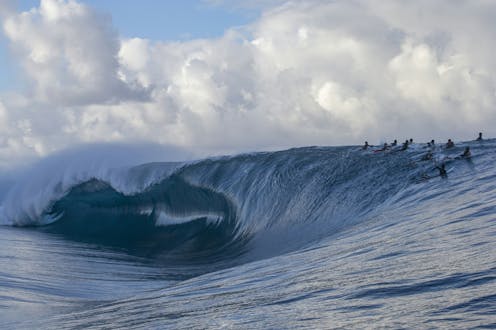
what makes the Olympic surf break at Teahupo'o unique – and so challenging

As the Olympics get going in earnest this week, not everyone’s attention is focused on host city Paris. Surf fans are heading to Tahiti, half a world away in French Polynesia.

Why? Well, apart from the French coast resembling a lake at this time of year, on the south-west coast of Tahiti Iti is a wave unlike any other on the planet: Teahupo'o, which translates somewhat ominously as “place of skulls”.

The wave is unique in the way it breaks. The lower part of the wave appears to drop away below sea level, with the top half folding over dramatically to create an almost cartoonishly perfect form.

It is both the weight of water in the plunging lip and the risk of injury or death for a surfer in the wrong position that make this one of the world’s heaviest waves (in both senses of the word).

To understand why the wave breaks like this, we need to start with bathymetry: the shape of the seabed that influences waves as they approach the shore. At Teahupo'o, a combination of factors comes into play.

Tahiti Iti coast viewed from above and out to sea showing mountain peaks, water craft and surfers
Olympic views: the surf break at Teahupo'o with Tahiti Iti in the background. Ryan Pierse/Getty Images

A one-of-a-kind wave

Waves arriving at Teahupo’o generally originate from intense “roaring forties” storm systems south of New Zealand. By the time the waves reach Tahiti they have become ordered swell, with wave heights of two to five metres and periods of 14 to 20 seconds between successive waves.

These types of long-period waves normally start interacting with the seabed at depths of around 200 metres. On most coasts, this depth would occur up to several kilometres offshore. But at Teahupo’o, it is much closer, just a couple of hundred metres.

This rapid change in depth forces the wave to “shoal” very quickly – the wave speed slows, the distance between waves compresses and the wave height increases.

The change is so abrupt that the wave is still very linear – it hasn’t had time to develop the peaked crest and flat trough (the lowest part of the wave) typical of waves in shallow water.

Clockwise from top left: location of the Teahupo'o surf break, form of the reef and mountains behind, bathymetry of the surf break, and notable reef features (elevation data from SHOM, satellite imagery from Airbus). Tom Shand, CC BY-NC-SA

Waves breaking on this type of steep slope would typically collapse, breaking from the middle of the wave and creating an unsurfable mess. But this doesn’t happen.

At around ten metres’ depth, a flatter shelf in the reef allows the wave to stabilise and “stand up” with a steep front face, before finally breaking as the reef rises again.

And break it does. Owing to the linearity, there is far more water in the crest (the part above water) then most waves, and a deeper trough in front.

This makes for the characteristic below-sea-level break at Teahupo'o, with the overturning lip being half the wave height, and a jet of compressed air forced out of the wave’s barrel after breaking.

The larger the wave, the closer to the steep offshore ramp it breaks, and the more extreme the plunging.

Big wave breaking with surfer visible within its barrel
A typical breaking wave at Teahupo'o: the thick lip and deep trough make it so powerful. Tim McKenna/Getty Images

A pro surfers’ paradise

A range of other unique features contribute to the way the wave breaks at Teahupo’o – and what makes it so challenging as a surfing wave.

A deep channel runs alongside the shallow reef shelf. The wave doesn’t break in this deeper area, allowing it to peel – to break in one direction (in this case towards the left looking towards the shore) – and enabling surfers to ride the wave before it finally closes out onto shallow reef.

A part of the shallow reef platform extends offshore, into the reef pass. This shallow area bends and focuses wave energy from the wider, deeper part of the wave back into the breaking wave. This happens particularly on more westerly orientated swells, increasing the intensity of breaking.

As well as this, the Teahupo'o wave breaks in a direction nearly opposite to the prevailing trade winds, keeping the wave face smooth.

A low tidal range also limits the times the reef is too deep or too shallow to surf. And the wave is near the Passa Hava'e reef pass, which helps the wave’s focusing and breaking. But because it isn’t right in the pass, the wave isn’t affected by high tidal or wave-induced currents.

New-generation wave models that simulate individual waves, rather than just average energy density, provide insight into what creates a surf break such as Teahupo'o (see figure below). These models provide insight into what happens as waves shoal and refract (bend and focus) over the seabed as they approach break point.

They also significantly improve our understanding of what makes a particular surf break unique. This can help in assessing the potential impact of human or natural modifications to the environment.

An example of the Celeris wave model simulating typical surfing conditions at Teahupo’o. The break point, peel angle and speed are able to be verified against satellite and drone imagery. (Elevation data from SHOM, satellite imagery from Airbus.) Tom Shand, CC BY-NC-SA

Authors: Tom Shand, Honorary Senior Lecturer, Department of Civil and Environmental Engineering, University of Auckland, Waipapa Taumata Rau


Read more https://theconversation.com/anatomy-of-a-wave-what-makes-the-olympic-surf-break-at-teahupoo-unique-and-so-challenging-235301

What Are the Benefits of Renovating an Older Home in Sydney?

Sydney has plenty of character homes, from Federation cottages to mid-century brick homes. Renovating rather than rebuilding can preserve what makes t...

Pool and Deck Design: How to Plan the Perfect Outdoor Living Space for Your Sydney Home

For many Australians, the backyard is where life happens. Summer barbecues, weekend swims and long evenings outdoors are all part of the lifestyle, ...

Is Solar Pool Heating Worth It? What Sydney Homeowners Should Know

There's nothing quite like a backyard pool on a hot Sydney day. But once autumn rolls in, many pools sit unused for months because the water is simp...

Planning a Luxury House Move: A Week-by-Week Timeline for Prestige Sydney Homes

Selling or buying a prestige home is a major milestone. Whether it's a waterfront residence in Birchgrove, a grand Federation home in Haberfield or ...

Downsizing or Upgrading Your Caravan? Here's How to Sell It Without the Hassle

Selling a caravan can feel like a major task, especially when you are unsure about its value, paperwork, or how to find a buyer. Whether you are dow...

The Best Overseas Adventure Holidays for Australians Who Love the Outdoors

Australia offers no shortage of incredible outdoor experiences, but sometimes the best way to satisfy your sense of adventure is to head overseas. A...

Cape Town Wine Shuttle: Winelands Tasting & Tours

Embark on an unforgettable journey through the picturesque Cape Winelands, where world-class wines and breathtaking scenery await. Our Cape Town Win...

Metal Fabrication: Choosing Metal Fabrication Melbourne Services for Custom Projects

What Modern Metal Fabrication Involves From individual components to complete structures, metal fabrication brings together processes such as desig...

Why Giant Rats Tail Grass Keeps Coming Back After Spraying

Giant Rats Tail Grass (GRT) is one of the most frustrating pasture weeds for farmers and lifestyle property owners. You spray an infested area, see th...

When Custom Cardboard Boxes Make Sense for Your Business

Custom cardboard boxes can be useful when a standard carton does not fit a product, packing method or presentation requirement particularly well. A ...

Full-Height vs. Pop-Top Caravan: Which Is Better for Family Travel across WA?

A pop-top caravan is an excellent choice for travellers who want the comfort of a caravan without committing to a larger, bulkier setup. With a lowe...

Bottle Label Printing: Key Factors for a Professional Finish

Why the Printing Method Matters When businesses need packaging or printed containers developed for a particular application, the right supplier can m...

Virtual Livestock Fencing and GPS Tracking: Improving Visibility Across Cattle Properties

What Virtual Livestock Fencing Means for Modern Cattle Management Managing cattle across extensive properties requires more than knowing where anim...

Sydney Pawnbrokers Explained: How Hocking Your Car Actually Works

Sometimes you need cash, and you need it soon. If you own a car, you may already have a way to get it. That's what people mean when they say they've...

Moving Interstate from the Gold Coast to Brisbane (or Back)? What Removalists Wish You Knew First

Have you talked to anyone who’s done the move? They say the same thing: the drive up the M1 is the easy part. It's everything around it that catches...

Why the Spring School Holidays Are a Great Time to Visit Coffs Harbour

The spring school holidays are a good time to spend a few days on the Coffs Coast. The weather is starting to warm up, there is plenty to do outdoor...

What to Do When an Older Car Is No Longer Worth Keeping in Melbourne

Ever looked at another repair quote and wondered whether your old car is still worth the trouble? It is a common turning point for Melbourne motoris...

Your Baby's First Year: A Local Guide to Feeding, Sleep, and When to Get Extra Support

Ask ten parents in a Brisbane mothers' group how their baby is feeding or sleeping, and expect ten different answers.  Someone's baby sleeps throug...















