Students don't feel safe on public transport but many have no choice but to use it
- Written by: Carolyn Whitzman, Professor of Urban Planning, University of Melbourne
The worst-case scenario has happened twice for young women using public transport in Melbourne in the past nine months. In June 2018, Eurydice Dixon, 23, was walking from the tram to her home, through a well-used park just north of the central city, when a young man is alleged to have stalked, raped and murdered her. In January 2019, another young man is alleged to have raped and murdered 21-year-old Palestinian exchange student Aiia Maasarwe 100 metres from the tram she took home from central Melbourne.
Even before these attacks, students reported feeling unsafe when using public transport. In April to June 2018, we undertook a survey, as part of a 17-city global study of tertiary students’ safety on public transport. We received over 500 completed surveys.
What did our survey find?
A large proportion of female students report a climate of fear on public transport. Just under half (45.1%) said they “rarely” or “never” feel safe on public transport after dark, compared to 11.3% of men.
Almost three in five women (58.9%) say they try to reduce their risk of victimisation in various ways. These include avoiding certain lines and stops, ensuring they are met at a stop and being constantly on alert. Just under half (45.4%) of female students report fear of victimisation as a reason for not using public transport.
This was not just a matter of perceptions. Almost four-fifths (79.4%) of female students and an equivalent proportion of LGBTI+ students said they had been victims of unwanted sexual gestures, comments, advances, exposed genitals, groping or being followed on public transport in the previous three years.
Over half (51.7%) of men reported having been victimised. These incidents were more likely to be gestures and comments rather than groping or being stalked.
Only 5.7% of those who had been victimised reported this to anyone in authority. This is hardly surprising. The public safety messages from police, transport authorities and tertiary educational institutions do not encourage the reporting of incidents. Instead, they emphasise the responsibility of potential victims to protect themselves.
The immediate response of police to the killing of Eurydice Dixon was this statement: “Make sure you have situational awareness. Be aware of your own personal safety. If you’ve got a mobile phone, carry it; if you’ve got any concerns, call the police.”
But both Eurydice Dixon and Aiia Maasarwe were allegedly carrying their phones and sending messages as to their whereabouts when attacked.
As Change.org executive director Sally Rugg said, these messages “suggest that the police can’t stop men from raping people, so it’s up to the women to take precautions, which is insulting to men, unhelpful and untrue”.
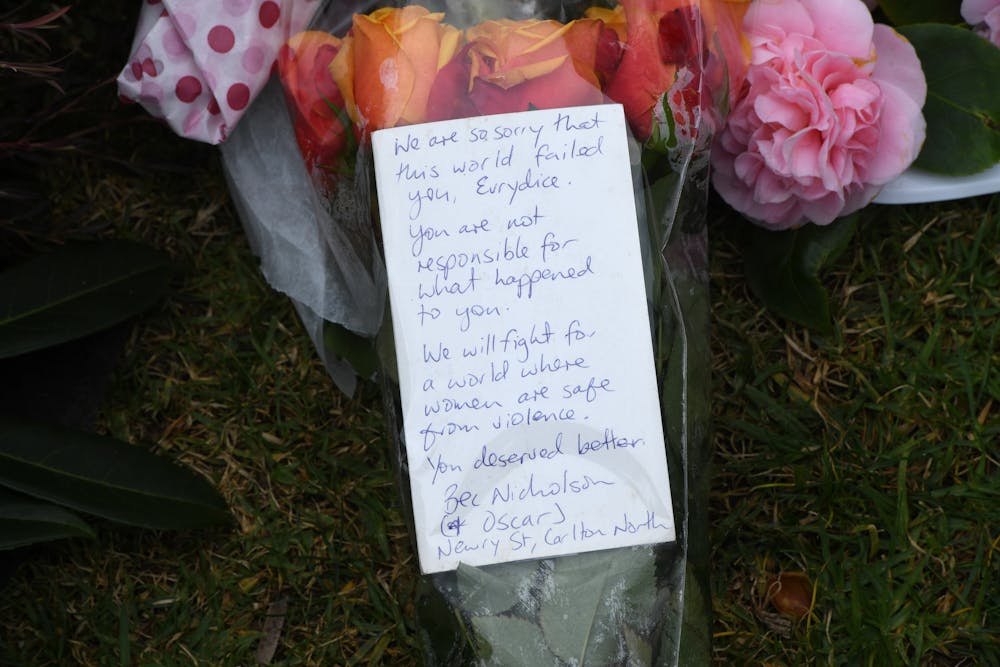 Outrage at any suggestion that Eurydice Dixon might have contributed to her death was rooted in women’s own widespread experience of harassment and violence.
Julian Smith/AAP
Outrage at any suggestion that Eurydice Dixon might have contributed to her death was rooted in women’s own widespread experience of harassment and violence.
Julian Smith/AAP
Counting the cost of student safety concerns
With 18 tertiary institutions located throughout Greater Melbourne, safe public transport access touches on issues of social justice, environmental sustainability and economic productivity. The situation in most tertiary institutions is one of car dependence. For instance, at the largest Deakin University campus, 61% of students and staff drove alone to work in 2012.
The outer suburbs fare worst – 50% of these areas have “very low” or “low” public transport frequency. Yet these suburbs have very high needs for public transport in terms of the proportion of adults without cars, including many tertiary students – a concept called “transport disadvantage”. Students living in middle and outer Melbourne tend to be more dependent on public transport and more likely to travel in the evenings, two risk factors for victimisation.
Tertiary students have a huge economic impact, through the revenue they generate for their institutions, their role in the workforce, the services they use and the purchases they make. The 2016 census recorded 1.4 million university students in Australia – 26% of them, or almost 400,000, international students.
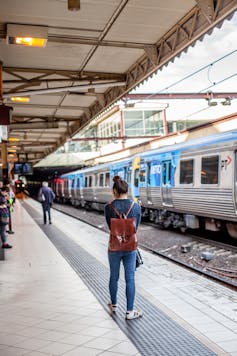 A national survey of university students found public transport is where sexual harassment is most common.
Dennis Diatel/Shutterstock
A national survey of university students found public transport is where sexual harassment is most common.
Dennis Diatel/Shutterstock
In 2016, the City of Melbourne had 227,000 students living and/or studying within the municipality, with 45,000 students calling it home. A third are international fee-paying students, who often live in high-priced apartments sold on the basis of safe and convenient access to campuses.
The issues of safety are nationwide. In 2016, a study involving 30,000 students in all 39 Australian universities underscored the high rates of assault and harassment of women and sexual minorities. Public transport was the most common location for sexual harassment – 22% of incidents, as opposed to 14% on university grounds and 13% in a university teaching space. And 57% of perpetrators of sexual harassment were identified as male students from their university.
We need a better approach
There are precedents for a better approach. In 2015, Transport for London, in partnership with police, launched its “Report it to Stop it” campaign.
The campaign built on a series of videos encouraging women to come forward in reporting unwanted sexualised staring, remarks, groping and stalking on public transport. The videos also show the consequences of reporting, with a man being identified and arrested for sexual harassment. A reporting hotline can be called or texted 24 hours a day, every day.
In the first year of the campaign, reports of harassment on public transport increased by 36%, with a 40% increase in criminal charges. An evaluation after the first year found 84% of women respondents agreed the campaign “made me feel more confident to take action against unwanted sexual behaviour if it occurred”.
Our report recommends that the Victorian government work with police, public transport providers and tertiary institutions on a coordinated campaign to encourage better reporting of sexually related crimes on public transport. This would include:
- investing in a common hotline
- creating publicity materials (including posters, videos, ad campaigns) to encourage reporting by both victims and witnesses
- employing consistent messaging on all these organisations’ websites that put the onus for safety where it belongs: on offenders not to offend, and on institutions to respond properly to offences. This should include public education on consequences of offences.
We also recommend that people who make reports be treated respectfully and their concerns treated seriously. All reports should be immediately followed up and all efforts made to arrest, charge and convict offenders. All public security and authorised officers, drivers and station attendants should be trained in how to respond to complaints and concerns.
Our third recommendation is that tertiary educational institutions have a role to play in cases where offenders as well as victims are students. Very clear messaging is needed on campus that offences on public transport as well as on campus are an institutional responsibility.
Our final recommendation is that state government recognise the impacts of infrequent, unreliable and inadequate transport services on the mobility and safety of people with lower incomes and less access to cars, including tertiary students. Authorities should consider partnering with ride-sharing services to make “the last kilometre” home from some public transport stops safer and more secure. Without a coordinated campaign to tackle the root causes of victimisation and fear, putting more CCTV, lighting and officers on trains is no longer enough.
Authors: Carolyn Whitzman, Professor of Urban Planning, University of Melbourne