

Australia fears being abandoned by America – but do the two countries need each other?
- Written by: Frank Bongiorno, Professor of History, ANU College of Arts and Social Sciences, Australian National University
In any presidential year, the Australian media – including social media – will suddenly generate a vast army of instant experts on American politics, all with a take you just have to read or hear. They’ll cover everything from laws governing electoral delegates in Arizona to the impact of demographic change on voting patterns in western Pennsylvania. In the 2024 US presidential year, when so much is at stake, that ramps right up.
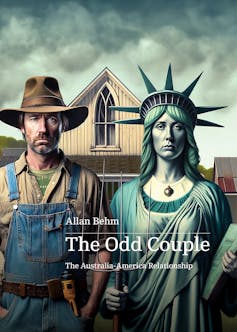
Allan Behm’s The Odd Couple, a study of the Australia–America relationship that also serves as a meditation on both countries, could hardly be more timely. It belongs to a rather different tradition than that of instant analysis with newly acquired (and dubious) “expertise”.
The Odd Couple: The Australia–America Relationship – Allan Behm (Upswell)
Behm is a considered and reflective commentator. An experienced former diplomat, public servant and (Labor) political adviser who now works at the Australia Institute, he is qualified to offer both well-informed critique and constructive suggestions for the relationship.
He has a way with words and is widely read, displaying a formidable cultural range that can take in the Argonauts, Davy Crockett and the Lone Ranger, the foundational documents of the United States, novels and poems from the 19th century, big thick books of political history and international relations, and much in between.

 A 2003 protest against the free trade agreement with the US.
Alan Porritt/AAP
Behm is also a critic of US adventurism in war and Australia’s supine behaviour in following the leader, notably in Vietnam and Iraq. These failures, among others, were the result of Australia’s inability to articulate a strong sense of its own national identity or interests. It has too often, and too readily, subordinated itself to the much larger and more powerful country.
He would like Australia to be more like Israel and Taiwan in the dogged pursuit of its interests with US policymakers, especially in working the Congress. Behm thinks we should invest more in diplomacy, recognising that power depends on culture, persuasion and a strong sense of national selfhood. It is not only about military firepower (including that of nuclear-powered submarines). He would like to see “a bit of jostling in the relationship”, less deference.
Behm’s argument that the relationship with the US is multifaceted is hardly new, but it is worth reiterating and updating. He has chapters dealing with the law, economics, culture, war and peace. All contain valuable insights, although the chapter on culture was the least focused – and (though this Gen-X reviewer surprises himself in saying so) a little hard on the Baby Boomers.
Deeper insecurities
Two themes are either absent or lightly touched on. Behm says little about intelligence sharing. And he touches only lightly on religion, which is surely central to any understanding of the American experience in general, and of the twists and turns of its politics in recent decades.
Behm is interested in the common histories of the US and Australia as settler societies founded on the dispossession of, and violence towards, Indigenous peoples. He detects a fundamental insecurity at the heart of each nation, based on this original sin.
The apparently “boundless self-belief” of the Americans with their claims to exceptionalism, and Australia’s “brasher kind of larrikinism” each express a “much deeper insecurity born of a shared inability to ‘belong to’ – as distinct from ‘to own’ – the continents on which they live”.
It is to Behm’s credit that he is not afraid of this kind of ambitious generalisation. That said, it carries the risk of inviting objection from the measurers and straighteners who review books. For example, I can’t help but suspect some complexity is being brushed over a little too lightly when I read: “The simple fact is that Australians no longer trust their governments. Nor do they trust one another.”
The most serious of our recent crises, the pandemic, surely revealed that, when the chips are down, Australians do largely trust their governments – and one another, too.
Behm gets the occasional historical detail wrong. The Myall Creek massacre was in 1838, not 1832, and Australia had no federal election in 1932. We are told at one point: “At the end of World War II, coal and iron ore declined as key exports.” In fact, neither had ever been key exports. But these are minor matters.
Behm has an intelligent understanding of the past, which he applies to a wise, witty and subtle analysis. The Odd Couple is a welcome contribution to a domain of public debate in Australia where too many people think it’s best simply to keep a lid on their opinions.
Authors: Frank Bongiorno, Professor of History, ANU College of Arts and Social Sciences, Australian National University
A 2003 protest against the free trade agreement with the US.
Alan Porritt/AAP
Behm is also a critic of US adventurism in war and Australia’s supine behaviour in following the leader, notably in Vietnam and Iraq. These failures, among others, were the result of Australia’s inability to articulate a strong sense of its own national identity or interests. It has too often, and too readily, subordinated itself to the much larger and more powerful country.
He would like Australia to be more like Israel and Taiwan in the dogged pursuit of its interests with US policymakers, especially in working the Congress. Behm thinks we should invest more in diplomacy, recognising that power depends on culture, persuasion and a strong sense of national selfhood. It is not only about military firepower (including that of nuclear-powered submarines). He would like to see “a bit of jostling in the relationship”, less deference.
Behm’s argument that the relationship with the US is multifaceted is hardly new, but it is worth reiterating and updating. He has chapters dealing with the law, economics, culture, war and peace. All contain valuable insights, although the chapter on culture was the least focused – and (though this Gen-X reviewer surprises himself in saying so) a little hard on the Baby Boomers.
Deeper insecurities
Two themes are either absent or lightly touched on. Behm says little about intelligence sharing. And he touches only lightly on religion, which is surely central to any understanding of the American experience in general, and of the twists and turns of its politics in recent decades.
Behm is interested in the common histories of the US and Australia as settler societies founded on the dispossession of, and violence towards, Indigenous peoples. He detects a fundamental insecurity at the heart of each nation, based on this original sin.
The apparently “boundless self-belief” of the Americans with their claims to exceptionalism, and Australia’s “brasher kind of larrikinism” each express a “much deeper insecurity born of a shared inability to ‘belong to’ – as distinct from ‘to own’ – the continents on which they live”.
It is to Behm’s credit that he is not afraid of this kind of ambitious generalisation. That said, it carries the risk of inviting objection from the measurers and straighteners who review books. For example, I can’t help but suspect some complexity is being brushed over a little too lightly when I read: “The simple fact is that Australians no longer trust their governments. Nor do they trust one another.”
The most serious of our recent crises, the pandemic, surely revealed that, when the chips are down, Australians do largely trust their governments – and one another, too.
Behm gets the occasional historical detail wrong. The Myall Creek massacre was in 1838, not 1832, and Australia had no federal election in 1932. We are told at one point: “At the end of World War II, coal and iron ore declined as key exports.” In fact, neither had ever been key exports. But these are minor matters.
Behm has an intelligent understanding of the past, which he applies to a wise, witty and subtle analysis. The Odd Couple is a welcome contribution to a domain of public debate in Australia where too many people think it’s best simply to keep a lid on their opinions.
Authors: Frank Bongiorno, Professor of History, ANU College of Arts and Social Sciences, Australian National University 

















