

How can I become a palaeontologist? 5 tips from a professional fossil hunter
- Written by: Vera Korasidis, Lecturer in Environmental Geoscience, The University of Melbourne
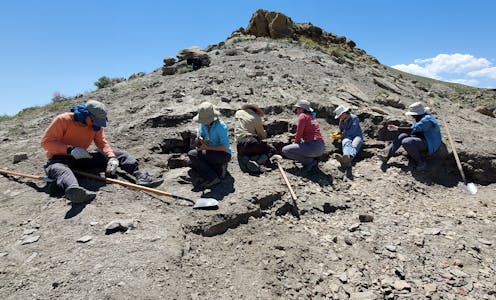
I’m a palaeontologist. That means I study fossils and learn about the ancient history of life on Earth.
People ask me lots of questions about being a palaeontologist. What do palaeontologists do all day? Why do they do it? How can I become a palaeontologist? And, of course, Where can I see some fossils?
Here are some answers about being a palaeontologist, and some tips for people who might want to become one.
What is a palaeontologist and what do they do?
Palaeontologists are scientists who study the history of life on Earth using fossils. Fossils represent the remains or traces of past life, preserved in rocks on or near Earth’s surface.
Palaeontologists use fossils to document the world’s plants and animals through time, to work out what ancient climates and ecosystems were like, and to understand evolution and ecology.
Palaeontologists have lots of different jobs. We work as researchers and lecturers at universities, researchers at research institutions and government organisations, as museum curators, collections managers, specimen preparators, exhibition designers, palaeo-artists, science educators and science communicators.
Palaeontologists don’t just go out to find and dig up fossils. We also study fossils brought up from hundreds of metres underground by drilling out long, skinny tubes of rock and dirt called “sediment cores”. We prepare the sediment cores very carefully and then study their physical and chemical properties to identify fossils.
Most of the time, palaeontologists share their research findings in scientific journals and at conferences. We are also involved in designing public exhibitions at museums and research centres.
Why do palaeontologists do all that?
The goal of palaeontology is to illuminate the grand history of life on Earth. From the beginnings of life more than 3 billion years ago to the present day, fossils record how it adapted or perished as the world changed.
Palaeontology also has lessons from the past that we can use today.
Looking deep into Earth’s history, we see examples of how giant carbon emission events – like those happening now – affected life on Earth. The fossil record repeatedly shows that large carbon releases result in substantial global warming, ocean acidification, and dramatic alteration of ecosystems on land and in the sea.
The effects of these past large carbon releases lasted a long time. To judge by what we see in the fossil record, if we burn all the fossil fuels available it could take 100,000 years for natural processes to soak up all the extra carbon from the atmosphere.
Much of what palaeontologists learn from the past confirms other scientists’ grim predictions of ecological disruption. However, fossils also show how ecosystems can return to equilibrium even after a very long period of altered climate if the species that make up the ecosystems survive.
Are there different kinds of palaeontologists?
Most palaeontologists have a special area of study. The most common areas are animal fossils (vertebrate or invertebrate palaeontologists), plant fossils (paleobotanists or palynologists) or microfossils (micropalaeontologists).
Some palaeontologists also study geological records to provide long-term perspectives on modern conservation and restoration issues (conservation palaeobiologists) and to figure out the details of ancient ecosystems (palaeoecologists).
How did you become a palaeontologist?
At high school I studied English, geography, economics, mathematics, chemistry and French. Next I completed a Bachelor of Science with an honours year, majoring in geoscience.
After that was a PhD in geology and a research fellowship at the University of Melbourne, followed by a postdoctoral research fellowship at the Smithsonian Institution in the United States.

Now I am a lecturer in environmental geoscience at the University of Melbourne and a research associate at the National Museum of Natural History, Smithsonian Institution.
How can I become a palaeontologist?
Here are my top tips for becoming a palaeontologist:
learn about the history of life and fossils through reading, visiting museums or parks with fossil displays and watching documentaries. If you can find fossils near where you live, try to identify them using books or internet resources
prepare in high school by studying science and maths. Geography and outdoor education are also very useful
complete a Bachelor of Science degree, majoring in a field such as geology, Earth science, zoology, ecology, evolutionary biology, marine biology or botany
next, obtain an Honours and/or Master’s degree in one of these fields
and finally, if you would like to become a researcher at a university or museum, you’ll probably need to complete a PhD.
Where can I see fossils in Australia?
Australia has plenty of exciting places you can visit to see fossils. A few highlights are:
Authors: Vera Korasidis, Lecturer in Environmental Geoscience, The University of Melbourne

















