

I heard there’s an aurora coming. How do I check?
- Written by: Hannah Schunker, ARC Future Fellow, University of Newcastle
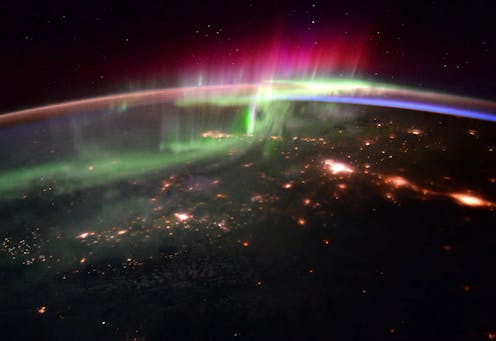
Few sights in the night sky are as awe-inspiring as aurora. The vibrant dancing lights – usually seen close to the planet’s poles – are produced by a wind of charged particles streaming from the Sun into Earth’s atmosphere. The resulting disturbances are called geomagnetic storms.
Earlier in 2024, the world was treated to an exceptional show of aurora borealis (northern hemisphere) and aurora australis (southern hemisphere). A particularly strong geomagnetic storm produced bright auroras visible at latitudes much closer to the equator than usual.
This has reignited public interest in aurora, and you might see more frequent headlines in the media promising auroras are returning to the night skies.
The Sun is going through a particularly active time, so the chances of aurora are good – but forecasting them is tricky business. Here’s how you can stay up to date.
The Bureau of Meteorology has issued an ‘aurora watch’! What does this mean?
For hopeful aurora chasers in Australia and Aotearoa New Zealand, the Bureau of Meteorology’s Australian Space Weather Forecasting Centre issues regional aurora outlooks, watches and alerts:
- aurora outlooks are warnings with lead times of 3–7 days
- aurora watches are warnings with lead times of up to 48 hours
- aurora alerts will follow if visible space weather activity at Earth actually occurs.
You can subscribe to all of these alerts on their website.
I’m checking the alerts – so what’s a K index?
The space weather website has a lot of information, so here’s what you need to look out for.
On the first page you see the “K index”. This is a measure of the disturbance of Earth’s magnetic field, and the first point of info we need for aurora predictions.
The value shown on the page is a three-hour average:
- less than 5 and green in colour means there’s only a mild disturbance to Earth’s magnetic field
- up to 7 and yellow in colour is classified as a moderate geomagnetic storm
- if it reaches 9 and is red in colour, this is a major geomagnetic storm.

Underneath the K index, you will see the current “solar wind parameters”: velocity is the speed of the wind towards Earth, and Bz is the magnetic field strength. If Bz is negative it means it is pointed from north to south, opposite to Earth’s magnetic field.
From the velocity of the solar wind (in kilometres per second) we can calculate when we expect it to reach Earth. From the strength of the solar wind’s magnetic field (in Tesla, T) and direction (positive or negative), we can estimate how it will interact with Earth’s magnetic field.
 An example of solar wind parameters listed on the aurora watch website.
Bureau of Meteorology
An example of solar wind parameters listed on the aurora watch website.
Bureau of Meteorology
To put it all together: for a strong geomagnetic storm, the solar wind would have a speed of about 700 km/s and a negative magnetic field with a value something like -20 nT.
So, in this case it would take about 35 minutes to reach Earth and generate a strong geomagnetic storm and aurora activity.
Now, let’s look at the 30 minute forecast
All this data is used to produce the United States National Oceanic and Atmospheric Administration’s (NOAA) 30 minute forecast.
 The NOAA 30 minute forecast provides a simple visual guide on what level of aurora we can expect for each hemisphere.
NOAA
The NOAA 30 minute forecast provides a simple visual guide on what level of aurora we can expect for each hemisphere.
NOAA
This animation of a green glow surrounding Earth’s poles gives a clear visual idea of where the aurora is likely to be strongest (usually on Earth’s night-time side).
If it’s red, the aurora is forecast to be very strong! The aurora doesn’t have to lie directly over Australia to be visible – you just need to be able to see it on the horizon looking south. This is why Tasmania and southern New Zealand generally have the best chance.
 NOAA aurora forecast on May 11 2024 showing a very high probability of aurora extending away from the South Pole.
NOAA
NOAA aurora forecast on May 11 2024 showing a very high probability of aurora extending away from the South Pole.
NOAA
There’s an aurora alert and the 30 minute forecast looks promising. What do I do now?
There are a few other things to consider before you rush outside to see an aurora.
Firstly, it needs to be dark, so a winter’s night in a dark location is ideal. Secondly, as those of us in Sydney and Newcastle are painfully aware, the sky must be clear of clouds.
Lastly, a direct view to the horizon in the south is generally needed for us in the southern hemisphere (it is very rare to see the aurora overhead so close to the equator).
Aurora usually last for between 15 to 30 glorious minutes, but if you’re super lucky this could extend to a few hours. So, plan to be looking south for some time.
I still didn’t see anything! Why?
Space weather forecasts are notoriously difficult. Solar physicists monitor the Sun to predict eruptions that might cause geomagnetic storms and phenomena like aurora, and the Sun’s magnetic field is constantly changing.
We have very few observations between the Sun and Earth, so we rely heavily on models of the solar wind to predict if and when an eruption at the Sun will arrive.
Only when the particles from the Sun reach 1.5 million kilometres from Earth can we actually measure the solar wind speed and magnetic field. This gives only about 30 minutes notice.
Even then, the measurements are made at a single point, known as L1. That measurement may not be representative of all of nearby space.
Researchers in solar physics, space physics and ionospheric physics are working towards piecing together each critical component in the space weather chain to make more precise forecasts. But for the time being, we are essentially limited to “nowcasting”. So keep an eye on social media for live aurora updates, too.
Authors: Hannah Schunker, ARC Future Fellow, University of Newcastle
Read more https://theconversation.com/i-heard-theres-an-aurora-coming-how-do-i-check-235869


















