

surfing pumps $2.71 billion into the Australian economy and boosts wellbeing
- Written by: Ana Manero, Research Fellow, Australian National University
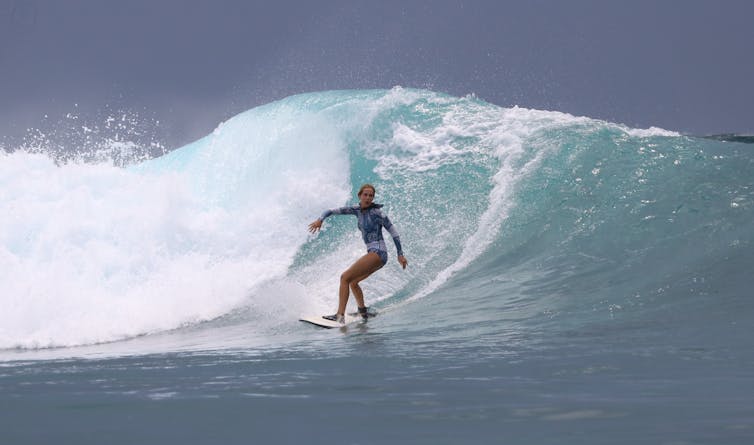
Ever since Polynesian pioneers took to the ocean on wooden rafts, people have been hooked on riding waves. Today, surfing is one of the world’s fastest-growing sports and one of the latest additions to the Olympic games.
Surfing is especially valuable to Australia. My new research shows surf-related expenditure contributes nearly A$3 billion to the Australian economy every year. And the mental health benefits to Australian surfers are in the order of $6 billion a year.
Yet many surf breaks are subject to coastal erosion, water pollution and other threats. The surfing event in Tahiti for this year’s Olympics is a case in point: it involved drilling into delicate coral reef to build a new judging tower.
It’s vital to recognise and measure the true benefits of surfing in dollar terms, so decision-makers realise it makes sense to invest in protecting Australia’s surf breaks.

The economics of surfing
Waves are essentially free. All you need is a surfboard and you’re set. Well, you might want to grab yourself a leg rope and a wetsuit too.
If you have a wave virtually at your doorstep, it’s likely you’re paying a real estate premium. Otherwise, you’re probably spending your weekends chasing waves up and down the coast. You may even have your family in tow. The costs soon add up.
Using an online survey of 569 Australian surfers, my team and I explored the influence of recreational surfing on the economy and people’s wellbeing. We found the average Australian surfer spends more than $3,700 a year, within Australia, on surfing-related purchases. Half goes on equipment, while the rest is spent on domestic travel. A further $1,975 is spent on international travel.
There are an estimated 727,000 Australian adult surfers, which brings the total spend to $2.71 billion every year being pumped into the domestic economy. If we factor in flow-on effects, such as business-to-business spending, the overall contribution of recreational surfing comes to $4.88 billion.
Economic impacts can inform government priorities and public decisions affecting coastal management. For example, the 2023 Margaret River Pro drew $8 million and 3,500 visitors to the region. These figures, as well as local and international support, encouraged the organisers to renew the contest until 2028.
Mental health and wellbeing
Besides direct economic impacts, surfing contributes to participants’ wellbeing in multiple ways.
In our survey, more than 94% of respondents reported improvements in their physical and mental health, as well as their ability to deal with stress and difficulty in their lives.
More than 75% of surfers reported an improvement in their sense of belonging to a community and ability to foster positive relationships.
One way to measure wellbeing in economic terms is by comparing workplace productivity and healthcare costs between groups. Previous research has quantified the benefits of being in nature to mental health, using data from national parks visits. When applying this approach to surfing, the researchers found gains in surfers’ mental health worth $7,650 per person per year – or $5.6 billion across Australia’s surfers.
Deadly but delicate
The first-time inclusion of surfing in the 2020–21 Tokyo Olympics was hailed as a landmark recognition of the sport’s cultural significance. A year later, surfing was admitted as a permanent Olympic sport.
But built infrastructure, such as ports and sea walls, human-induced climate change, coastal erosion and water pollution are endangering waves around the world.
The tiny village of Teahupo'o, in Tahiti, is home to one of the world’s “heaviest” waves. But some residents feared the Olympics would irreversibly damage their pristine environment. In response, visitor numbers were capped and construction minimised.
The world-renowned wave of Mundaka, in Spain’s Basque Country, disappeared in 2005 as a result of dredging activity in the nearby rivermouth. The wave eventually came back, but the area had already suffered a slowdown in economic growth, including the cancellation of a professional contest.
In Australia, three surf breaks were lost to construction of Perth’s Ocean Reef marina in 2022. Local residents’ calls for an artificial reef are now being considered.
Highlights from the Men’s Surfing at the 2024 Olympics.Protection for a precious resource
Australia is blessed with more than 1,440 surf breaks and a surf-loving culture.
But if we want those waves to exist for future generations, we must look after them now.
A good starting point could be to include surf breaks in the Australia State of the Environment Report. The review already evaluates pressures on recreational fishing, snorkelling and scuba diving – but not surfing, despite it attracting more participants than the other three sports combined.
Form a legal standpoint, only a few of our waves are protected: the iconic Bells Beach in Victoria comes under the Heritage Act 2027. A dozen of “surfing reserves” in New South Wales are safeguarded by the Crown Lands Act 1989. In Queensland, coastal protection policies are being developed for the Noosa and Gold Coast World Surfing Reserves.
Across the world, more countries are adopting protections for surfing’s recreational and environmental values. In Brazil, the waves at Doce River Mouth were recently granted special protection, as a new bill acknowledged the ocean as a living being with intrinsic rights.
The goal to better understand and protect the value of surf breaks is in line with the 2021–30 Oceans Decade, a United Nations initiative to leverage scientific knowledge for ocean sustainability.
It’s often said “only a surfer knows the feeling” of riding a wave, but research quantifying the benefits of surfing can help decision-makers appreciate the need to preserve a truly irreplaceable resource.
Authors: Ana Manero, Research Fellow, Australian National University


















