Which lines are priorities for Sydney Metro conversion? Hint: it's not Bankstown
- Written by: Mathew Hounsell, Senior Research Consultant, Institute for Sustainable Futures, University of Technology Sydney
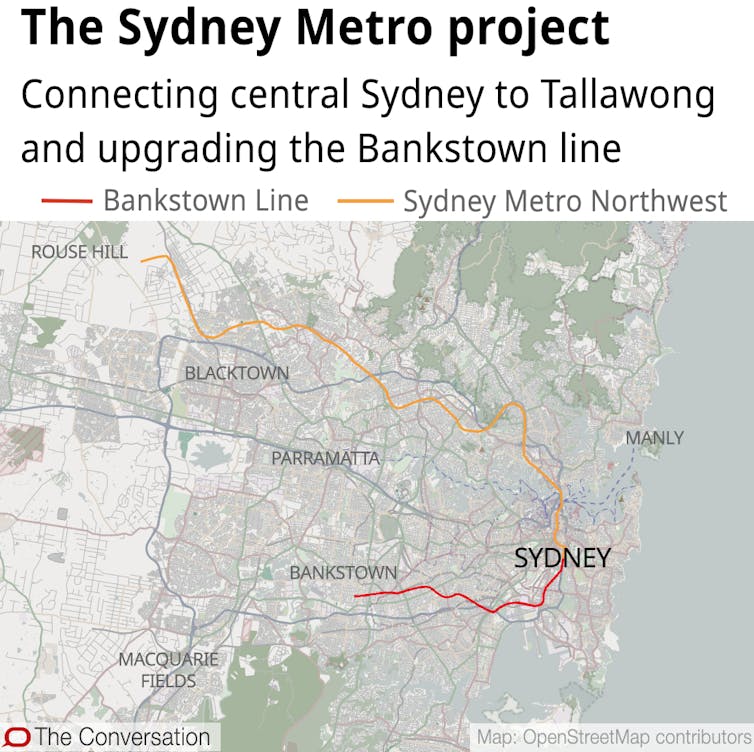
A rail line to the northwest growth areas of Sydney has been proposed many times. In 2010, the state government and bureaucracy sought discussions with Infrastructure Australia and the Commonwealth about funding an extension of the heavy-rail system from Epping on a North West Rail—Hills District Line. In 2012, the new transport minister (and now premier), Gladys Berejiklian, changed the plan, opting for a single-deck robotic privatised metro similar to those proposed by property developer and rail operator Hong Kong MTR. The government decided to close the Bankstown line for Sydney Metro conversion and upzone surrounding suburbs for “urban activation”.
 OpenStreetMap Contributors, CC BY
Read more:
Sydney Metro's Sydenham-to-Bankstown line – nirvana or nightmare?
Days before Christmas 2018, we transport analysts received a gift: an update to the station barrier counts dataset. The government had not released this annual snapshot since 2014. (An interactive data visualisation tool is available here.)
The below analysis uses average workday (Tuesday, Wednesday and Thursday) patronage to describe the changing demand across the Sydney rail network (click here for a map of the network) and determine where the need for transport infrastructure investment is greatest.
The analysis clearly show that the metro conversion of the Bankstown line should not be Sydney’s top-priority investment. The numbers make clear the need to invest the state’s limited funds in the western and southern corridors with matching investment in the CBD. The Bankstown project should be deferred.
Demand on Sydney’s western and Illawarra heavy-rail corridors has surged since 2004 (when barrier counts began). These are two of the city’s most important transport trunks. The Bankstown line has much lower patronage with modest growth.
Every transport infrastructure investment must deliver value for money by reducing operating costs and improving mobility. If we fail to invest wisely, Sydney risks becoming uncompetitive as talent and businesses leave for better-connected and more liveable cities.
Read more:
This is how Sydney's transport system has gone off the rails
The Bankstown decision from a 2012 perspective
To determine if the Bankstown conversion was the highest priority in 2012 we need to consider the information available to the minister at the time. Let’s start with the obvious questions: in 2012 was the Bankstown line or its major stations under significant load or growing quickly?
The above chart shows five of the top 20 stations were in the CBD, six were on the Eastern-Illawarra line, and nine were on the West and North lines. Bankstown line stations were not especially popular: Bankstown station was 27th most popular, Campsie 35th, Lakemba 53rd and Marrickville 63rd.
Another reason to justify the Bankstown line conversion would be rapid growth. However, in 2012 the ten stations with the fastest growth since 2004 were in the CBD and on the West, South, North and Airport lines.
From 2004 to 2012, Parramatta grew by 4,600 passengers on an average workday, and Hurstville by over 4,100. Growth at Campsie and Lakemba was a mere 1,000 passengers a day, and only half of that at Bankstown.
So when the development decision was made the Bankstown line stations were not major stations, nor under significant load, nor growing quickly. This raises questions about the Metro conversion investment.
The Bankstown decision from a 2018 perspective
Passenger demand grows on a train line for many reasons. In 2012, Berejiklian might have been aware of a coming surge in patronage on the Bankstown line. In 2018, have we seen such a surge?
Sydney railway patronage has indeed surged overall, growing by over 450,000 people on an average workday since 2004. By 2018, the distribution of these passengers had changed significantly. Ashfield, Epping, Hornsby and Kogarah slipped out of the top-20 stations to be replaced by Mascot (17th), Auburn (18th), Lidcombe (19th) and Museum (20th).
Bankstown line stations had become less important:
Bankstown slipped to 33rd most popular
Campsie rose to 35th
Marrickville was steady at 62nd
Lakemba plummeted to 67th.
From 2012 to 2018, Town Hall ranked first for patronage growth with a workday increase of 28,900 passengers. Parramatta was fourth with 15,400 and Hurstville 16th with 4,600.
On the Bankstown line Campsie ranked 33rd with growth of 2,000 and Bankstown 49th with 1,400. Estimated patronage at four of the stations – Wiley Park, Yagoona, Lakemba, Regents Park – actually fell.
After land around Canterbury was transformed into many massive apartments, patronage at the station grew by 1,300 workday passengers since 2012. Even with the development, it still had only 3,200 workday passengers, leaving the station 91st in the whole sprawling network.
Read more:
Our new PM wants to 'bust congestion' – here are four ways he could do that
Comparing sections of the network
Multiple stations operate in concert and to be thorough we also need to consider how sections of the network compare.
The ten Bankstown line stations from Marrickville to Bankstown had 36,800 workday passengers in 2012. By 2018 this had grown by 7,000 to 43,800 workday passengers. It is still a relatively quiet line.
The North line from North Strathfield to Epping had eight stations with 36,100 workday passengers in 2012. By 2018, this had grown by 12,700 workday passengers to 48,800.
Over the same period, the 13 stations on the Illawarra line from Arncliffe to Sutherland grew by 15,600 to 79,400 workday passengers.
The three Eastern Suburbs line stations from Kings Cross to Bondi had higher patronage in 2012 than the Bankstown line with 40,200 workday passengers. Patronage on those three stations alone also grew much faster, by 17,600 in six years to 54,800.
Patronage on the Western corridor (Macdonaldtown to Blacktown) has grown by 58,000 to over 225,000 workday passengers. On the Illawarra corridor patronage grew 25,000 to over 103,000.
Remember, patronage on the Bankstown line grew by only 7,000 in this 2012-18 period.
Looking at key stations between 2004 and 2018:
Bankstown patronage grew by 25%
Stanmore, which doesn’t have a lift and gets only one train every 15 minutes, grew by 33%
Burwood grew by 64%
Parramatta by 79%
Newtown by 100%
Homebush by 125%.
In the Illawarra corridor:
Hurstville station grew by 66%
Erskineville by 97%
Banksia, Carlton and Allawah stations all had over 100% growth.
The City Circle from Redfern to Circular Quay and back grew by 159,000 workday passengers from 236,000 in 2004 to 395,000 in 2018 – a 67% increase.
In 2012, the city’s first transport priority was another north-south harbour crossing. However, it was decided instead to build the Sydney Metro under the harbour and then take both of the CBD’s north-south heavy-rail corridors. This significantly increased the cost and complexity of expanding the heavy-rail system.
Sydney’s second transport priority was always a western relief line. Every transport investigation since the 1971 Sydney Area Transport Study has identified this need.
What next?
On February 11, the state Labor opposition promised $5 billion for the Western Metro, in addition to $3 billion previously promised by the federal Labor opposition.
On March 4, the state Coalition government announced $6.4 billion for a Western Metro, with the construction date to be brought forward.
The government announcement was made after the caretaker period for the March 23 state election had begun, so no technical or financial documentation was released. The government statement said the final business case was not complete, indicating that the Western Metro project was still in the early planning stages.
With a slowing economy and falling house prices there will be a post-election reprioritisation of NSW project spending. When this happens, the next government should give higher priority to the western rail corridor than the Bankstown corridor.
Postscript
Any discussion of infrastructure decisions should note the affected electorates. The seats around the Bankstown line and their vote tallies in the last state election are:
Summer Hill (Labor 70.13% two party preferred in 2015)
Canterbury (Labor 65.69%)
Lakemba (Labor 71.56%)
Bankstown (Labor 63.97%)
Auburn (Labor 55.93%)
Fairfield (Labor 67.79%).
OpenStreetMap Contributors, CC BY
Read more:
Sydney Metro's Sydenham-to-Bankstown line – nirvana or nightmare?
Days before Christmas 2018, we transport analysts received a gift: an update to the station barrier counts dataset. The government had not released this annual snapshot since 2014. (An interactive data visualisation tool is available here.)
The below analysis uses average workday (Tuesday, Wednesday and Thursday) patronage to describe the changing demand across the Sydney rail network (click here for a map of the network) and determine where the need for transport infrastructure investment is greatest.
The analysis clearly show that the metro conversion of the Bankstown line should not be Sydney’s top-priority investment. The numbers make clear the need to invest the state’s limited funds in the western and southern corridors with matching investment in the CBD. The Bankstown project should be deferred.
Demand on Sydney’s western and Illawarra heavy-rail corridors has surged since 2004 (when barrier counts began). These are two of the city’s most important transport trunks. The Bankstown line has much lower patronage with modest growth.
Every transport infrastructure investment must deliver value for money by reducing operating costs and improving mobility. If we fail to invest wisely, Sydney risks becoming uncompetitive as talent and businesses leave for better-connected and more liveable cities.
Read more:
This is how Sydney's transport system has gone off the rails
The Bankstown decision from a 2012 perspective
To determine if the Bankstown conversion was the highest priority in 2012 we need to consider the information available to the minister at the time. Let’s start with the obvious questions: in 2012 was the Bankstown line or its major stations under significant load or growing quickly?
The above chart shows five of the top 20 stations were in the CBD, six were on the Eastern-Illawarra line, and nine were on the West and North lines. Bankstown line stations were not especially popular: Bankstown station was 27th most popular, Campsie 35th, Lakemba 53rd and Marrickville 63rd.
Another reason to justify the Bankstown line conversion would be rapid growth. However, in 2012 the ten stations with the fastest growth since 2004 were in the CBD and on the West, South, North and Airport lines.
From 2004 to 2012, Parramatta grew by 4,600 passengers on an average workday, and Hurstville by over 4,100. Growth at Campsie and Lakemba was a mere 1,000 passengers a day, and only half of that at Bankstown.
So when the development decision was made the Bankstown line stations were not major stations, nor under significant load, nor growing quickly. This raises questions about the Metro conversion investment.
The Bankstown decision from a 2018 perspective
Passenger demand grows on a train line for many reasons. In 2012, Berejiklian might have been aware of a coming surge in patronage on the Bankstown line. In 2018, have we seen such a surge?
Sydney railway patronage has indeed surged overall, growing by over 450,000 people on an average workday since 2004. By 2018, the distribution of these passengers had changed significantly. Ashfield, Epping, Hornsby and Kogarah slipped out of the top-20 stations to be replaced by Mascot (17th), Auburn (18th), Lidcombe (19th) and Museum (20th).
Bankstown line stations had become less important:
Bankstown slipped to 33rd most popular
Campsie rose to 35th
Marrickville was steady at 62nd
Lakemba plummeted to 67th.
From 2012 to 2018, Town Hall ranked first for patronage growth with a workday increase of 28,900 passengers. Parramatta was fourth with 15,400 and Hurstville 16th with 4,600.
On the Bankstown line Campsie ranked 33rd with growth of 2,000 and Bankstown 49th with 1,400. Estimated patronage at four of the stations – Wiley Park, Yagoona, Lakemba, Regents Park – actually fell.
After land around Canterbury was transformed into many massive apartments, patronage at the station grew by 1,300 workday passengers since 2012. Even with the development, it still had only 3,200 workday passengers, leaving the station 91st in the whole sprawling network.
Read more:
Our new PM wants to 'bust congestion' – here are four ways he could do that
Comparing sections of the network
Multiple stations operate in concert and to be thorough we also need to consider how sections of the network compare.
The ten Bankstown line stations from Marrickville to Bankstown had 36,800 workday passengers in 2012. By 2018 this had grown by 7,000 to 43,800 workday passengers. It is still a relatively quiet line.
The North line from North Strathfield to Epping had eight stations with 36,100 workday passengers in 2012. By 2018, this had grown by 12,700 workday passengers to 48,800.
Over the same period, the 13 stations on the Illawarra line from Arncliffe to Sutherland grew by 15,600 to 79,400 workday passengers.
The three Eastern Suburbs line stations from Kings Cross to Bondi had higher patronage in 2012 than the Bankstown line with 40,200 workday passengers. Patronage on those three stations alone also grew much faster, by 17,600 in six years to 54,800.
Patronage on the Western corridor (Macdonaldtown to Blacktown) has grown by 58,000 to over 225,000 workday passengers. On the Illawarra corridor patronage grew 25,000 to over 103,000.
Remember, patronage on the Bankstown line grew by only 7,000 in this 2012-18 period.
Looking at key stations between 2004 and 2018:
Bankstown patronage grew by 25%
Stanmore, which doesn’t have a lift and gets only one train every 15 minutes, grew by 33%
Burwood grew by 64%
Parramatta by 79%
Newtown by 100%
Homebush by 125%.
In the Illawarra corridor:
Hurstville station grew by 66%
Erskineville by 97%
Banksia, Carlton and Allawah stations all had over 100% growth.
The City Circle from Redfern to Circular Quay and back grew by 159,000 workday passengers from 236,000 in 2004 to 395,000 in 2018 – a 67% increase.
In 2012, the city’s first transport priority was another north-south harbour crossing. However, it was decided instead to build the Sydney Metro under the harbour and then take both of the CBD’s north-south heavy-rail corridors. This significantly increased the cost and complexity of expanding the heavy-rail system.
Sydney’s second transport priority was always a western relief line. Every transport investigation since the 1971 Sydney Area Transport Study has identified this need.
What next?
On February 11, the state Labor opposition promised $5 billion for the Western Metro, in addition to $3 billion previously promised by the federal Labor opposition.
On March 4, the state Coalition government announced $6.4 billion for a Western Metro, with the construction date to be brought forward.
The government announcement was made after the caretaker period for the March 23 state election had begun, so no technical or financial documentation was released. The government statement said the final business case was not complete, indicating that the Western Metro project was still in the early planning stages.
With a slowing economy and falling house prices there will be a post-election reprioritisation of NSW project spending. When this happens, the next government should give higher priority to the western rail corridor than the Bankstown corridor.
Postscript
Any discussion of infrastructure decisions should note the affected electorates. The seats around the Bankstown line and their vote tallies in the last state election are:
Summer Hill (Labor 70.13% two party preferred in 2015)
Canterbury (Labor 65.69%)
Lakemba (Labor 71.56%)
Bankstown (Labor 63.97%)
Auburn (Labor 55.93%)
Fairfield (Labor 67.79%).
Authors: Mathew Hounsell, Senior Research Consultant, Institute for Sustainable Futures, University of Technology Sydney