

the surprising 150-year history of long-range medical treatment
- Written by: Debbie Passey, Digital Health Research Fellow, The University of Melbourne
In 1874, a surgeon in South Australia telegraphed wound care instructions for a patient 2,000 kilometres away. A few years later, in 1879, a letter in The Lancet medical journal suggested physicians use the telephone to cut down on unnecessary patient visits.
As the telephone and telegraph spread, the idea of telemedicine – literally “healing at a distance” – inspired science fiction writers to conjure up new ways of treating patients across great distances.
Real-world technology has developed in tandem with scifi speculation ever since. Today, certain kinds of telemedicine have become commonplace, while other futuristic tools are in the offing.
The radio doctor and the teledactyl
In his 1909 short story The Machine Stops, English novelist E.M. Forster described a telemedicine apparatus that, when telegraphed, descends from the ceiling to care for patients in the comfort of their home. His story is also the earliest description of instant messaging and a kind of internet – both important for real-life telemedicine.
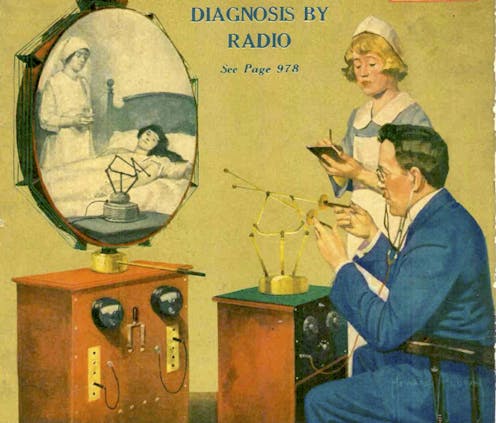
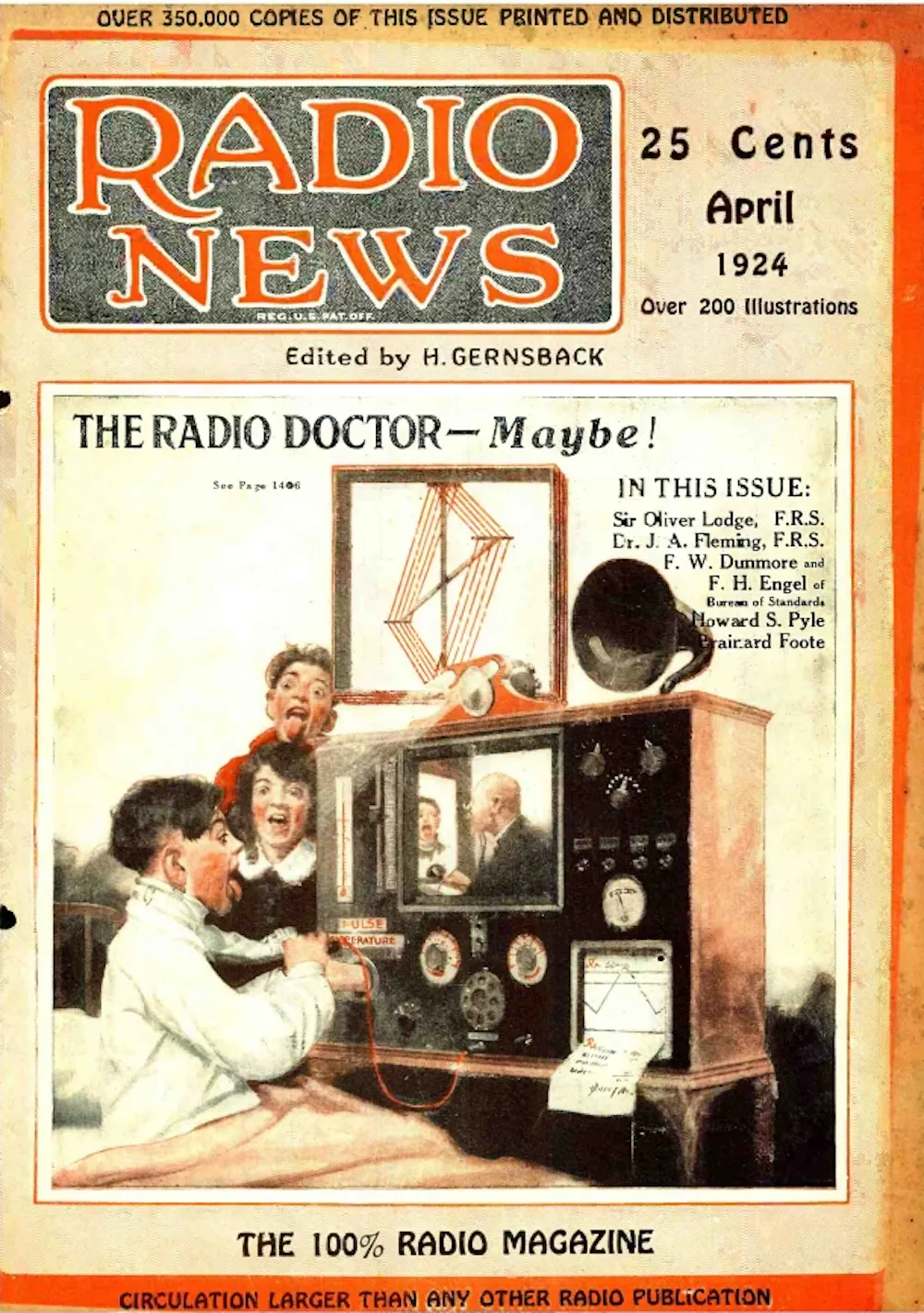
In 1924, Radio News magazine printed a cover story showing the future “Radio Doctor”. The cover depicts a physician examining a patient through a screen. Although the magazine story itself was a bizarre fiction that had little to do with a radio doctor, the imagery is evocative.
In a 1925 cover story for Science and Invention, US writer Hugo Gernsback describes a device called “The Teledactyl” (from tele, meaning far, and dactyl, meaning finger). The device uses radio transmitters and television screens to allow a doctor to interact with a patient. The added twist – the physician touches the patient using a remotely controlled mechanical hand set up in the patient’s home.
 In 1925, Science and Invention magazine described a device called ‘The Teledactyl’.
Science and Invention / World Radio History
In 1925, Science and Invention magazine described a device called ‘The Teledactyl’.
Science and Invention / World Radio History
Gernsback was a futurist and pioneer in radio and electrical engineering. Nicknamed the “Father of Science Fiction”, Gernsback used fictional stories to educate readers on science and technology, and often included extensive scientific details in his writings. He helped establish science fiction as a literary genre, and the annual Hugo Awards are named after him.
From seafarers to spacefarers
The radio was important for early telemedicine. In the 1920s, physicians across the globe started using the radio to evaluate, diagnose, treat, and provide medical advice for sick or wounded seafarers and passengers. The radio is still used to provide medical consultation to ships at sea.
In 1955, Gernsback returned to the idea of distance medicine with “The Teledoctor”. This imaginary device uses the telephone and a closed-circuit television with mechanical arms controlled by the physician to provide remote patient care. Gernsback said the doctor of the future “will be able to do almost anything through teledoctoring that he can do in person”.
In 1959, psychiatrists in Nebraska started using two-way closed-circuit televisions to conduct psychiatric consultations between two locations. This is considered one of the first examples of modern-day telemedicine. Early telemedicine networks were expensive to develop and maintain, which limited broader use.
In the 1960s, NASA began efforts to integrate telemedicine into every human spaceflight program. By 1971, a telemedicine system was ready for trial on Earth – in the Space Technology Applied to Rural Papago Advanced Healthcare (STARPAHC) program. Using a two-way television and radio connection and remote telemetry, the program connected Tohono Oʼodham people (then known as Papago) with nurses and physicians hundreds of miles away.
The internet and a pandemic
It wasn’t until 1970 that the word telemedicine was officially coined by US doctor Thomas Bird. Bird and his colleagues set up an audiovisual circuit between the Massachusetts General Hospital and Logan Airport to provide medical consultations to airport employees.
From the 1970s onward, telemedicine started gaining more traction. The internet, officially born in 1983, brought new ways to connect patients and physicians.
Satellites could connect physicians and patients across greater distances without the need for two-way closed-circuit televisions. The cost to develop and maintain a telemedicine network decreased in the 1980s, opening the door to wider adoption.
In his 1999 science fiction novel Starfish, Canadian writer Peter Watts describes a device called the “Medical Mantis”. This device allows a physician to remotely examine and perform procedures on patients deep beneath the ocean’s surface. In the early 2000s, NASA’s Extreme Environment Mission Operations started testing teleoperated surgical robots in undersea environments.
The evolution of telemedicine has kept pace with advances in information and communication technology. Yet, throughout the 1990s and early 2000s, telemedicine remained little used.
It took the global COVID pandemic to make telemedicine an integral part of modern healthcare. Most of this is consultations via video call – not so far away from what Gernsback envisioned a century, though so far without the robotic hands.
What’s next? One likely factor pushing real-world telemedicine to match the dreams of science fiction will be developments in human spaceflight.
As humans progress in space exploration, the future of telemedicine may look more like science fiction. Earth-based monitoring of astronauts’ health will require technological breakthroughs to keep pace with them as they travel deeper into space.
Authors: Debbie Passey, Digital Health Research Fellow, The University of Melbourne

















