

do the laws of war still have a fighting chance in today’s bloody world?
- Written by: Marnie Lloydd, Senior Lecturer in Law and Co-Director New Zealand Centre for Public Law, Te Herenga Waka — Victoria University of Wellington
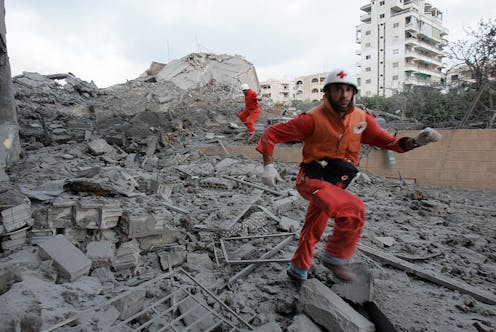
Today marks 75 years since the adoption of the Geneva Conventions on August 12 1949. In theory, these rules of war are universally agreed by every nation. In practice, they are routinely violated everywhere.
With an estimated 120 armed conflicts worldwide, more than 450 armed groups and 195 million people living in areas under their control, the protection of the vulnerable is as vitally important as ever.
As the news headlines remind us daily, however, international humanitarian law can seem like too little, too late when faced with military might and political indifference.
This year also marks other, less hopeful, anniversaries: ten years since the genocide against the Yazidi by ISIS in Syria, and ten years of war in Ukraine. Geopolitical tensions are escalating in the Middle East and the South China Sea.
Given the modern technologies used on today’s battlefields (and in cyberspace), and the violation of even basic humanitarian protections, is there much to celebrate in 2024? Are the Geneva Conventions still fit for purpose for today’s wars – and tomorrow’s?
Humanitarian values
All societies have cultural, religious or legal rules of some kind around war. But in the aftermath of World War II’s extreme horrors, the world agreed to a detailed set of codified rules governing armed conflict.
Despite differing political views and experiences of war, countries agreed to the Geneva Convention rules by striking a balance between military need and humanitarian ideals for the treatment of civilians, captured enemy soldiers and the dead.
The 1949 Conventions remain the core of international humanitarian law, or the laws of armed conflict. This body of law has been expanded over the years by other treaties and protocols dealing with civil war, chemical weapons, antipersonnel landmines, torture and enforced disappearances.
Designed to help prevent a spiral of tit-for-tat atrocities, many of the rules work due to reciprocal respect between combatants: treat our soldiers well when captured and we will do likewise.
But they also demand the humane treatment of people caught up in war, even if one warring party has breached those rules or started the war in violation of the United Nations Charter that prohibits aggression.
Four conventions, 400 articles
The Geneva Conventions include more than 400 articles, setting out detailed rules for the treatment of prisoners, protecting hospitals and medical staff, allowing humanitarian aid, and prohibiting torture, rape and sexual violence.
In fact, four conventions were adopted in 1949. The first three’s provisions built on existing laws protecting wounded soldiers on the battlefield, at sea and when captured as prisoners.
The key fourth convention sought to protect civilians living under the power of an adversary, such as in occupied territory.
A single article provided fundamental rules about the humane treatment of people during a civil war – the first time international law had dared to regulate violence occurring within a country rather than between two or more.

War and peace
Some say international humanitarian law took the wrong approach back in the 1860s when the very first Geneva Convention was adopted, because it accepted war and gave up on insisting on peace.
As the scholar Samuel Moyn has argued, this has forced us to choose between the ideal of opposing war in the first place and opposing the crimes that take place within it.
Humanitarian law also accepts a minimum level of harm to civilians as “collateral damage” during an attack on a military target. In other words, not all civilian deaths are war crimes.
And some articles in the conventions seem old-fashioned today – tobacco is mentioned together with food and water for prisoners of war, for example.
But in my own experience working with the International Committee of the Red Cross, I have seen international humanitarian law in action. When respected, it can save and improve lives.
Eternal vigilance
Warring parties everywhere still allow the Red Cross to visit thousands of detained people, and to negotiate about improving their treatment.
Combatants make agreements for prisoner swaps, hostage release, return of the dead, and the provision of medical care to wounded enemy soldiers.
Sometimes, countries investigate war crimes allegations. And the conventions make it possible for warring parties to make other agreements for even greater protections.
And while the Geneva Conventions, and international humanitarian law more generally, are far from perfect, the rules seek a basic limit on the worst humanity has to offer, insisting on some fundamental human dignity.
To ensure they are at least not actively breached, and ideally their protections extended, countries must do three key things:
It is precisely in the gravest situations, when politics and other laws have failed to prevent war, that these rules are most needed. Greater respect for them would go a long way to saving lives and preventing the horrors we see in today’s conflicts.
Authors: Marnie Lloydd, Senior Lecturer in Law and Co-Director New Zealand Centre for Public Law, Te Herenga Waka — Victoria University of Wellington


















