

could steep-sided hilltops offer safe haven to our threatened species?
- Written by: Patrick Finnerty, Postdoctoral research fellow in conservation, University of Sydney
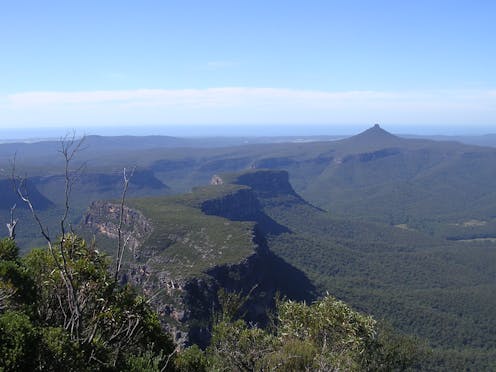
Species are disappearing at an alarming rate around the world. But Australia’s extinction crisis is especially severe – since European colonisation, we have lost about 100 species of animals and plants. The loss of 33 mammal species is largely due to canny invasive predators such as foxes and cats as well as destruction of habitat.
To try to stem the losses, many scientists and conservationists are turning to rewilding. This promising approach involves reintroducing species to their former habitats or relocating them to new areas where they have a better chance of survival.
To date, rewilding in Australia has worked best on islands free of foxes and cats and in fenced-off safe havens, which act like islands on the mainland.
But is there a way we could bring back vulnerable native species beyond the fence?
In research published today, we show how the humble mesa has potential to act as a reintroduction site for threatened species. You might associate these flat-topped, steep-sided landforms with American gunslinger westerns. But Australia has plenty of its own mesas.

What’s special about mesas?
By our count, there are now 23 fenced safe havens across Australia, and the number has been growing in recent years.
These sites work. But they require ongoing human input. You have to fence the land, make sure it stays fenced, and control for feral predators. When funding runs out, the havens can fall into disrepair and predators may eventually break back in.
We need supplementary approaches to add to our rewilding toolkit – outside the fences.
The reason we began investigating mesas is their shape. By definition, a mesa is an isolated flat-topped landform, elevated from its surrounding landscape by steep sides. The Spanish word “mesa” translates to “table” in English, reflecting their distinctive shape. But don’t be confused – a mesa is different to a tableland such as the Atherton Tablelands in northern Queensland. A mesa is generally smaller and stands alone.
We theorised the steep, largely vegetation-free sides of a mesa could act as natural barriers, slowing down fox and cat incursions. Better still, the isolation of these landforms might give extra protection to species vulnerable to fire.
Luckily for us, these landforms aren’t reserved for lonely cowboys on horseback and an Ennio Morricone soundtrack. We scoured satellite images and found 91 mesas just in New South Wales, each with a flat top larger than ten hectares.
 Accessing this remote mesa with our gear required a helicopter drop.
WWF Australia, Author provided (no reuse)
Accessing this remote mesa with our gear required a helicopter drop.
WWF Australia, Author provided (no reuse)
Sky-islands: putting mesas to the test
To test our theories, we chose Mount Talaterang. This remote mountain in Morton National Park has a flat top of 317 hectares, making it one of the largest mesas we found in New South Wales.
We set up cameras on top of the mesa as well as in the surrounding bushland at the bottom of the steep slopes and gathered four months of data.
The results were exciting. As we had hoped, the top of the mesa was almost entirely free of invasive mammals. There were no foxes or rabbits. Feral cats were present atop the mesa, but in significantly lower numbers than in the lowlands. Better still, we spotted higher numbers of small native mammals such as antechinus species and spotted-tailed quoll atop the mesa than in the bush below.
By contrast, we spotted far more invasive mammals in the bush below the mesa. Specifically, we sighted foxes 633 times, and cats 338 times, whereas no foxes were recorded on the mesa, and we recorded only 5 sightings of cats.
On the mesa, we captured 26 instances of antechinuses and 20 of quolls, but saw zero antechinus and only one quoll in the lowlands.
 We set up camera traps on top of the mesa and in the bushland below.
Leonie Sii/WWF Australia, Author provided (no reuse)
We set up camera traps on top of the mesa and in the bushland below.
Leonie Sii/WWF Australia, Author provided (no reuse)
What’s next?
These findings come from a single mesa, so we should be cautious about drawing wide conclusions. But because the difference is so pronounced, we hope our research spurs greater interest in testing whether mesas such as Mount Talaterang could offer a wilder way of rewilding, where we harness natural landforms for protection.
Mount Talaterang lies within Morton National Park. This park covers part of the historic range of locally threatened or regionally extinct species such as the southern brown bandicoot, long-nosed potoroo, parma wallaby, and the eastern quoll, which may be suitable future rewilding candidates.
 Our cameras captured spotted-tail quolls and other rare native animals atop the mesa.
WWF Australia, Author provided (no reuse)
Our cameras captured spotted-tail quolls and other rare native animals atop the mesa.
WWF Australia, Author provided (no reuse)
To boost the chances of successful rewilding, we need to know more about what life would look like for these threatened species if we release them on a mesa. Would there be enough food? Are there reliable water sources? Will climate change make it harder to survive on top of these landforms?
Mesas crop up around the world, from South Africa to South America and Europe. But the rewilding potential of mesas in these regions has not yet been explored, to our knowledge.
We hope our research triggers new interest in these “sky islands” and other ways of rewilding species which we can use to supplement the proven methods of traditional fenced havens and islands.
Rob Brewster (WWF-Australia), Francesca Roncolato (WWF-Australia), Tom Jameson (University of Cambridge) and Mathew Crowther (University of Sydney) contributed to this research. WWF Australia partly funded this research through its Australian Wildlife and Nature Recovery Fund
Read more: So you want to cat-proof a bettong: how living with predators could help native species survive
Authors: Patrick Finnerty, Postdoctoral research fellow in conservation, University of Sydney


















