

Satellites are making the night sky brighter – as a launch site, NZ has a duty to combat light pollution
- Written by: William Grant, Lecturer in Law, University of Canterbury
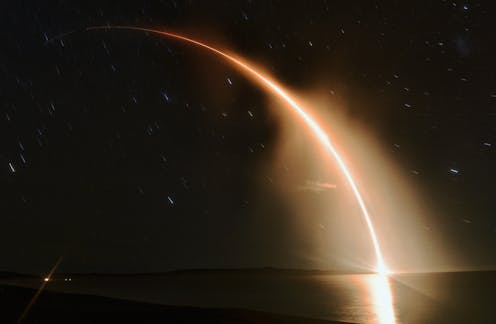
New Zealand’s space sector has been developing rapidly since the first rocket lifted off in 2017. It now contributes about NZ$1.7 billion in revenue, with plans to grow to $10 billion by 2030.
Last year, New Zealand hosted seven rocket launches, all by the US-listed but local company Rocket Lab. It was in response to Rocket Lab’s initial proposal for a launch site that New Zealand developed a regulatory system from scratch in less than two years to meet obligations under international law.
All launch nations have to register every object they send into space, and continue to supervise those objects to ensure no damage or loss occurs to another country’s objects or activities. They also have a responsibility to compensate for any harm.
As well, countries must prevent contamination of outer space and Earth’s environment, and ensure space activity does not interfere with other countries’ rights to free access and participation.
A 2020 review of New Zealand’s space legislation found the regulatory regime was by and large fit for purpose. But it raised substantive concerns about the regulation of new technologies, including satellite constellations and miniature satellites.
The recommendations prompted broader consultation on New Zealand’s space policy and aerospace strategy. This saw a backlash against the absence of Māori voices on the particular concern of light pollution from space.
The commercialisation of space
A 2019 report found New Zealand’s space industry is driven almost entirely by commercial activity, characterised by a mix of startups and entrepreneur-run, privately-funded companies.
The country’s space legislation is well suited to developing a space industry quickly, in particular the commercial and entrepreneurial sector.
However, awareness is growing of the impact of light pollution on Earth’s environment and ecosystem, human health and astronomy.
While urbanisation and indiscriminate use of artificial light are among the culprits, activities in space are another significant source of light pollution.
With every satellite placed into orbit, its reflective surface increases the ambient glow of the night sky. By 2021, human activity in outer space had resulted in a 10% increase in the brightness of the night sky compared to the illumination by natural sources.
While the space law review was more narrowly focused on satellite constellations and the associated light pollution, all satellites are part of what is a cumulative problem: individual countries, acting independently, collectively contribute to worsening light pollution.
New Zealand’s dark skies
The big concern is that light pollution interferes with the interests of other countries trying to study outer space. Increased pollution is obscuring observational astronomy and littering data with artificial shimmers and streaks of light.
Rising glow in the night sky is of particular concern for Māori and other Indigenous communities whose knowledge systems rely on unaided visual access to the stars.
With 14 astronomical observatories and seven “dark sky sites” recognised by Dark-Sky International, New Zealand has a national interest in addressing regulation and mitigation of light pollution.
The country’s bicultural foundation is protected under Treaty of Waitangi obligations. It recognises the unique relationship Māori have with the night sky and the mātauranga (knoweldge) contained within it.
The rising of Matariki, the cluster of stars also known as Pleiades, has been celebrated as a public holiday since 2022 in recognition of the event’s importance to Māori and the nation.
Regulation must address light pollution
As a launch state, New Zealand must have due regard to the interests of other states to participate in the exploration of outer space, regardless of economic or scientific advancement.
While New Zealand is a relatively new launch nation, it is a desirable destination. How New Zealand approaches the licensing of satellites may help guide binding behaviours developing in international law.
There is a tension between the national interest in maintaining dark skies and the economic value of the space industry. Being over-prescriptive with licensing requirements will inevitably deter potential companies from launching from New Zealand.
The flip side is that without some requirement for companies to address how their satellites are contributing to light pollution, there is no market force driving innovation in this area.
There have been some attempts by private commercial actors to mitigate the impact of their satellites. But these attempts have remained largely underdeveloped. Efforts by SpaceX to reduce the impacts of its mega constellations have proven ineffective.
The nature of the new space age, launched by a 2004 competition to help jump-start private spaceflight, ensures private companies are more motivated to develop technology to reduce costs in the long run. Without a strong shift in the regulatory environment, there is no real drive for investment in technologies to mitigate light pollution.
As New Zealand continues to develop a regulatory framework, the issue of light pollution has to be taken seriously. And Indigenous voices are important, because traditional astronomical knowledge is fundamental to the reclamation and continuation of Indigenous knowledge.
Authors: William Grant, Lecturer in Law, University of Canterbury


















