

Classical music is not isolated from politics. Melbourne Symphony Orchestra should know this
- Written by: Peter Tregear, Principal Fellow and Professor of Music, The University of Melbourne
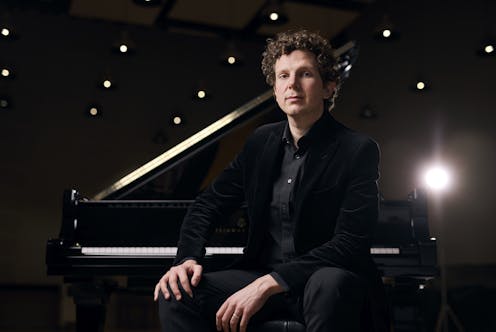
This morning, the Melbourne Symphony Orchestra (MSO) announced it was an error to cancel a scheduled concerto performance by British-Australian pianist Jayson Gillham.
Its decision, and the issues leading up to it, raises the issue of what the relationship of classical music to politics is – or, rather, what it should be. For many, the two realms simply should not mix. But it is naive to think classical music – or indeed any art – happens entirely separate from politics.
A musical controversy
The furore started Sunday, when Gillham performed a solo piano recital for the MSO that included the world-premiere of a short piece by composer Conor D'Netto, Witness.
Netto’s website states Witness is “dedicated to the journalists of Gaza”. When he came to perform it, Gillham elaborated on the dedication by drawing the audience’s attention to the more than 100 Palestinian journalists who have been killed in the current conflict.
Gillham’s introduction, however, appears to have elicited complaints to the orchestra’s management. The MSO responded by informing subscribers that Gillham’s appearance tonight, August 15, was to be cancelled.
The email said Gillham’s remarks had been made “without seeking the MSO’s approval or sanction” and were “an intrusion of personal political views on what should have been a morning focused on a program of works for solo piano”.
But if the MSO sought to distance itself from the perception of a partisan position on the Israel-Gaza conflict, or to affirm classical music’s right to be considered to be above politics more generally, it comprehensively failed to do so.
For some it appeared not only to have taken a particular side in this conflict, it had also sought to silence the voice of a musician it employed.
At one level, one can understand how the MSO might have got itself into this difficult position. The repertoire it performs and promotes is not usually connected explicitly to contemporary external events. Music, in any event, cannot present political ideas to us in the more direct ways that art forms like sculpture, painting or poetry can.
Classical music, in particular, seems to invite us to put politics to one side when we engage with it. Rather, we are drawn to contemplate more elusive or elevated qualities or ideas, such as formal beauty, objectivity, nobility or gravitas.
That, however, is also precisely why classical music can still serve political ends – even (or maybe especially) when we think it doesn’t.
The politics of the apolitical
Ludwig van Beethoven’s Symphony No. 9, first performed in 1824, may well have been composed in part as a response to the repressive political climate of post-Napoleonic Vienna.
It quickly came to be received as a hymn to our common humanity. But this did not stop it from being subsequently appropriated by violent political regimes such as Hitler’s Germany and Mao’s China – as well as by political movements opposed to them.
And today, the Ode to Joy theme from the symphony is the official anthem of the European Union.
The sheer range of the causes this music has been associated with does not mean the work itself must have no political meaning. Rather, that meaning lies precisely in this capacity to convey a notion of universal human value onto the particular cause it is being associated with.
It remains a political work, it’s just we have been conditioned not to hear it as such.
Not just a risk, but also an opportunity
This helps us understand the contradiction behind the MSO’s statement asserting “a concert platform is not an appropriate stage for political comment”. The orchestra has done precisely that on many previous occasion (such as in a fundraising concert for Ukraine it mounted in 2022, or in its expressions of support for the Voice to Parliament last year).
But it also helps us understand why, when a composer or performer (or in the case of Witness, both) seeks actively to reveal the political content in their work, it can still jar, or even upset us.
This power of classical music to elevate but also to obscure our attention and sympathy represents both an ever-present opportunity, and risk, for orchestras and their listeners alike.
It is one I think the West-Eastern Divan Orchestra (named after Goethe’s collection of poems of 1819, themselves inspired by the 14th century Persian lyric poet Hafez), sets out explicitly to exploit.

Founded by scholar Edward Said and conductor/pianist Daniel Barenboim in 1999 to help celebrate the 250th anniversary of Goethe’s birth, the orchestra (now based in Spain) is substantially made up of young Arab and Israeli musicians. Through performing orchestra works together, these musicians are enabled to confront presumptions about the “other”.
As Barenboim once observed,
The Israeli kids, for instance, couldn’t imagine that there are actually people in Damascus and Amman and Cairo who can actually play violin and viola.
Here, the medium of Western classical music serves as a platform from which they can begin to imagine new, better, social formations.
While it is understandable the MSO might normally seek to refrain from similarly committing to a particular political cause in the same way, it should also not be adverse to recognising its work will always exist in, and engage with, a broader social and political context.
Like all art forms, classical music can also serve to draw our thoughts to, or circumscribe, who we consider to be worthy of our political attention, and why.
If anything, Gillham and D'Netto have served to affirm the continuing importance and value of the art form the MSO is there, ultimately, to champion.
Authors: Peter Tregear, Principal Fellow and Professor of Music, The University of Melbourne


















