

is ‘wokeness’ killing comedy – or are ageing comedians crying wolf?
- Written by: Alexander Cothren, Lecturer, Flinders University
In late April, comedian Jerry Seinfeld went on the New Yorker Radio Hour and re-opened the debate that refuses to die. While spruiking his debut film, Unfrosted, Seinfeld went on a tangent about how, he believes, political correctness has ruined comedy:
It used to be you would go home at the end of the day, most people would go, ‘Oh, Cheers is on, oh, M*A*S*H is on, Mary Tyler Moore is on, All in the Family is on.’ You just expect that, ‘There’ll be some funny stuff we can watch on TV tonight.’ Guess what? Where is it? Where is it? This is the result of the extreme left and PC crap, and people worrying so much about offending other people.

This is not the first time Seinfeld has made a similar claim. In 2015, he said he wouldn’t do stand-up gigs on college campuses because “they’re so PC”. And he’s far from alone in thinking comedy is under attack. Bill Burr, Chris Rock, John Cleese, Sarah Silverman and Bill Maher are among the many famous comedians to declare that some combination of political correctness, cancel culture and wokeness is killing comedy.
But while such claims make for flashy headlines, actual evidence for comedy’s demise is scarce. In this latest example, Seinfeld blames the dearth of funny TV on hand-wringing producers desperate to avoid offending progressive audiences:
When you write a script and it goes into four or five different hands, committees, groups, ‘Here’s our thought about this joke,’ well, that’s the end of your comedy.
Yet when his interviewer, David Remnick, pressed Seinfeld by asking “have you had that experience?”, he had to admit, “no”.
So is there any truth to claims that modern sensitivities are strangling comedians’ ability to be funny? Or are ageing comedians just crying wolf when people stop laughing at their dated material?
Modern audiences
Before we head into the weeds of the most recent instance of a recurring debate, a couple of ground-rules need to be observed.
First, it’s true that being offended is a popular position to hold at the moment. It is also playing different from usual. There have been many moral panics in the past, and periods of reaction where humour has been an important medium for releasing the grip of censoriousness, for instance from the 1950s to the 1960s or perhaps more pertinently in Britain during the move from Oliver Cromwell’s 1650s to the riotous public culture of Charles II in the 1660s.
(Read Rochester’s poem equating the royal sceptre with Charles II’s penis and the present King Charles’s identification with a tampon is positively staid by comparison.)
What is unusual today, however, is that offence at ill-directed laughter used to be largely a conservative political reaction to perceived liberal provocation. It thus tended to the reactionary in political terms.
But in recent decades, those offended by comedy are more likely to be the cultural left with their progressive causes. The so-called “woke” have claimed righteousness (especially on representations of race and gender), and the traditional wowsers are annoyed into scornful laughter.
Thus many conservatives have made a break towards the right to offend which, on its good days, is the fresh air of calling out a new emperor for wearing no clothes. Unfortunately, on its many bad days it can be the angry insistence on a right to reproduce and compound oppressive stereotypes that merely ridicule the less privileged with a view to putting them back in their box.
At its very worst, claims of cancel culture are an attempt to silence diverse voices. In response to Seinfeld’s comments, the actor Julia Louis-Dreyfus – who played Elaine on Seinfeld – responded by saying,
When I hear people starting to complain about political correctness […] to me that’s a red flag, because it sometimes means something else.
Other commentators have helpfully spelled out what that “something else” is: a dislike of non-white, non-male, or non-heterosexual voices in the public sphere. Writing for The Root, Danielle Butler explains how complaints about political correctness or cancel culture can act as “dog whistles” for those feeling “discomfort with the kinds of people who now have a voice and their audacity to direct it towards figures with more visibility and power”.
A traditional conservative purpose of satirical humour – to put a jumped-up underling back in their place – has had its comic licence revoked in many contexts in the 21st century. This is a change in manners and, in our view, a good one.
Comedians should not expect to get away with a traditional mother-in-law or dumb Irishman joke, let alone something blatantly homophobic or racist. These jokes are boring and morally dubious, and comedians should try harder to amuse us than kicking down by reflex.
However, this is not to say having progressive politics will reliably inoculate your humour from being boring or sanctimonious. Adam Hills and Charlie Pickering have their funny moments, but finding them among their overall piety can be a bit like sitting through four hours of Wagner for the four minutes of musical genius.
 Charlie Pickering arrives for the 2024 Australian Academy of Cinema and Television Arts awards in Queensland.
Darren England/AAP
Charlie Pickering arrives for the 2024 Australian Academy of Cinema and Television Arts awards in Queensland.
Darren England/AAP
The space for harsh humour has not disappeared. The 21st century is not obviously a kinder, better era than any earlier century.
But this change of manners makes the license of harsh humour narrower than it used to be. Some will be outraged by a caricature of Gina Rinehart, others by the Bill Leak cartoon of an Aboriginal father. Neither of these images was censored, though both attracted a lot of criticism. While it is no fun being the meat in any of these sandwiches, it seems to us healthy that such things remain matters of public debate rather than subject to formal legal or administrative constraint.
Criticism is not censorship
A second important piece of context is that censorship is not at issue here. To be “cancelled” is an unpleasant experience, but it is categorically different from being censored. Outside authoritarian societies, people are not often outlawed for making offensive jokes. The offended may complain and their allies deplore the jokes – social media automates this level of reaction like never before – but they cannot force them to be suppressed.
A comedian or commentator who complains about PC killing comedy is a victim not of censorship but of a change in manners that is leaving their preferred form of humour behind. If fewer people laugh and some disapprove of your work, the easiest explanation is that the world has been overrun by fun police with a fear of being laughed at.
Real police are much scarier. For example, although Iranian/Persian culture has a thousand-year tradition of satire, you see very little of it in the Iranian press under the current Islamic regime, because the Ayatollahs have efficient means of acting on their outrage. Similarly in Egypt, the cartoonist Ashraf Omar has recently been hauled in by the authorities and jailed for his work.
Historian and author Kliph Nesteroff has written about the history of censorship and outrage in comedy, and he defines a clear line between them: “If it is illegal to say something, that is censorship […] If somebody protests what you say, that is not censorship.”
Real censorship is Lenny Bruce being convicted in 1963 on obscenity charges. Real censorship is George Carlin being arrested in Milwaukee for saying the infamous “Seven Dirty Words”. Real censorship is what faces stand-up comedians and cartoonists today in Russia, China or Iran.
Comedians are doing just fine
For proof that real censorship is not the issue, consider the list of supposedly impinged comedians who are, upon closer inspection, actually doing just fine. Perhaps the most high-profile example in recent years is Dave Chappelle.
Once a liberal-darling for his nuanced racial comedy, Chappelle has received criticism over his transphobic jokes in his Netflix specials Sticks and Stones and The Closer, which led to resignations and walkouts by trans employees at Netflix.
During his 2022 Saturday Night Live monologue, Chappelle touched on the personal impact of the controversy, saying, “It shouldn’t be this scary to talk about anything”.
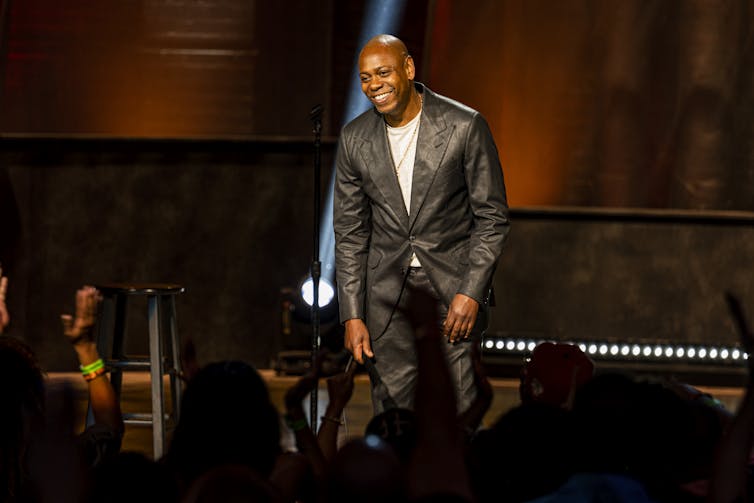
Yet what was the actual impact on Chappelle’s career? A single venue cancelling a show in Minneapolis (don’t fret, a replacement venue was quickly found). Meanwhile, both Sticks and Stones and The Closer won Grammy Awards and Chappelle’s lucrative relationship with Netflix continued unabated. At a 2021 appearance at the Hollywood Bowl, Chappelle himself declared, “If this is what being cancelled is like, I love it”.
 Dave Chappelle performing in 2021. So much for being ‘cancelled’.
Mathieu Bitton/Netflix
Dave Chappelle performing in 2021. So much for being ‘cancelled’.
Mathieu Bitton/Netflix
Other high-profile “cancellations” have also notably fizzed out. In 2019, Shane Gillis was dropped from the cast of Saturday Night Live for making racist and homophobic jokes on a podcast. His career quickly rebounded and in 2024 he returned to guest host the show.
In 2018, Kevin Hart decided to back out of hosting the Oscars due to public anger over old homophobic jokes and tweets. Hart recently received the Mark Twain Prize for American Humor in 2024 and his estimated net worth is just shy of half a billion.
The truth is that, far from derailing their careers, many comedians are thriving in an era of supposed increased sensitivity.
Political scientist Bryant W. Sculos includes popular figures like Joe Rogan and Bill Maher in what he describes as a
large cottage industry of successful cultural workers making names for themselves precisely on the basis of standing against the scourge of so-called ‘cancel culture’.
See the recent example of Joe Rogan’s Netflix special, Burn the Boats, in which the comedian-podcaster-sort of antivaxxer, claims to have gotten “cancelled so often during COVID that sometimes I would find out by accident”.
In their review of the special, Jesse Hassenger notes that this must be a special “Joe Rogan type of cancelled, which is where you command an audience of millions, a salary of millions and a Netflix standup special”.
 Joe Rogan: Burn the Boats. Joe Rogan at the Majestic Theatre in San Antonio, Texas.
Troy Conrad/Netflix © 2024
Joe Rogan: Burn the Boats. Joe Rogan at the Majestic Theatre in San Antonio, Texas.
Troy Conrad/Netflix © 2024
It appears that railing against the death of comedy is an effective route to making a buck in comedy. As comedian Gary Gulman notes,
The people who are saying you can’t say anything are the people who are saying everything on Netflix for $20 million a whack.
This actually makes perfect sense, as theorists have long argued against the fallacy that an increase in boundaries or taboos could ever damage comedy.
In the introduction to their edited collection, Beyond the Joke, Sharon Lockyer and Michael Pickering explain how “humour is only possible because certain boundaries, rules and taboos exist in the first place”.
The truth is that comedy, in any era, needs its woke mobs. As Lockyer and Pickering write, “making offensive jokes about others with total impunity would mean that there are no boundaries to push at any more”.
Comedian Ricky Gervais has admitted as much, tweeting in 2019 that “PC culture isn’t killing comedy. It’s driving it. As it always did”.
 Ricky Gervais: PC culture isn’t killing comedy. It’s driving it.
Matt Crockett/Netflix
Ricky Gervais: PC culture isn’t killing comedy. It’s driving it.
Matt Crockett/Netflix
Outrageously lazy
Far from being erased by censorship, attention-grabbing and offensive jokes are easier and more lucrative to make than ever. The result is once cutting-edge comedians delivering lazy and stale material that is more focused on feeding red meat to the anti-woke crowd than actual joke craft.
In an interview for The Guardian, trans comedian Anna Piper Scott decries the laziness that has affected comedians like Chappelle:
Honestly with transphobic jokes, I’m more offended as a comedian than I am as a trans person […] They’ve been done to death. Every joke is like, ‘Oh, I identify as being a dog.’
In her New York Times review of Chappelle’s The Closer, Roxanne Gay describes being not offended but bored by the spectacle of a “faded simulacrum of the once-great comedian” stooping to “the kind of comedy you might expect from a conservative boomer, agog at the idea of homosexuality”.
Australian comedian Bec Shaw had a similar reaction in her Sydney Morning Herald review of Gervais’ 2022 Netflix special SuperNature, which featured jokes about trans people identifying as prams:
Is this really what everyone’s fighting so hard for the right to say? You can’t have the gall to get up on stage with those unfunny-the-first-time-five-years-ago jokes and then say that being woke is what is ruining comedy.
In Shaw’s opinion, it’s far more difficult – and therefore artistically braver – to try and get a laugh without rehashing old stereotypes:
Young comedians refusing to take the trodden path should be admired – they are figuring out how to do comedy without the tried and tested way of punching down and making the easy joke.
As researchers, we find the question of how comedians create and adapt their material for the new expectations of modern audiences to be far more interesting than these recycled debates on the death of comedy.
After finishing his attack on PC culture, Seinfeld himself beautifully encapsulated the difficult job of being a comedian that keeps up with ever changing tastes,
They move the gates like [… in skiing]. The gates are moving. Your job is to be agile and clever enough that wherever they put the gates, I’m going to make the gate.
Well, stop whingeing then, Jerry, and get back out on the slopes.
Authors: Alexander Cothren, Lecturer, Flinders University


















