

An exposé of whatever-it-takes culture, Eric Beecher’s The Men Who Killed the News is an idealistic book for the times
- Written by: Denis Muller, Senior Research Fellow, Centre for Advancing Journalism, The University of Melbourne
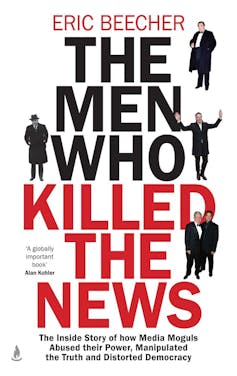
Eric Beecher is a rare beast: a combination of journalist, media owner and idealist. In 1984, aged 33, he became the youngest-ever editor of the Sydney Morning Herald and he has worked around the world as a journalist. He is currently chair and the largest shareholder in Private Media, owner of several Australian news websites, including Crikey.
With The Men Who Killed the News, he has produced a book that is at once a cry of indignation at the media’s abuse of power and an attempt to chart a future for journalism.
The cry of indignation comes first. In a pacey compression of press history going back to the late 19th century, Beecher vividly illustrates how newspaper moguls from William Randolph Hearst in the 1880s to Rupert Murdoch today have cynically debased the profession of journalism in pursuit of wealth and power.
He draws on a wide range of histories, creating a kind of one-stop shop for the reader who wishes to understand how public trust in the media has eroded to the point where Donald Trump is able to make the “fake news” label stick.
Review: The Men Who Killed the News – Eric Beecher (Scribner)
The men who killed the news belong to two technological ages.
The first belong to the age of industrialisation, which enabled the rapid daily production of tens of thousands of newspapers and the creation of a vast monopoly on public access to news and information. These men include not just Hearst and Murdoch, but Joseph Pulitzer, Henry Luce and A.O. Sulzberger in the United States, and Lords Beaverbrook, Rothermere and Northcliffe in Britain.
The second belong to the age of the digital revolution, which has created two behemoths whose power is greater by several orders of magnitude than all the legacy moguls combined: Mark Zuckerberg and Elon Musk.
The factors common to all, Beecher convincingly argues, are abuse of power, manipulation of the truth and distortion of democracy.

 Digital titans like Mark Zuckerberg have accrued power exceeding that of the old print-media moguls.
Susan Walsh/AAP
Impact of the internet
The erosion of public trust through centuries of ethical failure is the first of two great themes that run through the book. The other is commercial failure caused by the effect of the internet and social media on the revenue and informational monopoly long enjoyed by newspapers, radio and television. Here the men who killed the news exhibit desperation, complacency and hubris on a historically grand scale.
The desperation is seen in the way great newspaper dynasties, such as the Graham family at the Washington Post, have had to sell out to digital billionaires, in their case to Amazon founder Jeff Bezos, to financially rescue their papers. It is a pattern repeated across the US and Europe.
The complacency and hubris are illustrated by the account Beecher gives of being commissioned by a director of Fairfax, when it still owned the Sydney Morning Herald, the Age and the Australian Financial Review, to write a report on the future of the business.
This was in the middle of the first decade of the present century, when the evidence was beginning to show the internet having a measurable impact on advertising revenues. At the time, the Sydney Morning Herald and the Age were still carrying about 200 broadsheet pages of classified advertising a week, generating combined annual profits of about $200 million. But the company had no internet strategy and no media experience on the board.
Digital titans like Mark Zuckerberg have accrued power exceeding that of the old print-media moguls.
Susan Walsh/AAP
Impact of the internet
The erosion of public trust through centuries of ethical failure is the first of two great themes that run through the book. The other is commercial failure caused by the effect of the internet and social media on the revenue and informational monopoly long enjoyed by newspapers, radio and television. Here the men who killed the news exhibit desperation, complacency and hubris on a historically grand scale.
The desperation is seen in the way great newspaper dynasties, such as the Graham family at the Washington Post, have had to sell out to digital billionaires, in their case to Amazon founder Jeff Bezos, to financially rescue their papers. It is a pattern repeated across the US and Europe.
The complacency and hubris are illustrated by the account Beecher gives of being commissioned by a director of Fairfax, when it still owned the Sydney Morning Herald, the Age and the Australian Financial Review, to write a report on the future of the business.
This was in the middle of the first decade of the present century, when the evidence was beginning to show the internet having a measurable impact on advertising revenues. At the time, the Sydney Morning Herald and the Age were still carrying about 200 broadsheet pages of classified advertising a week, generating combined annual profits of about $200 million. But the company had no internet strategy and no media experience on the board.
 Eric Beecher.
Simon & Schuster
In his report, Beecher raised the prospect of a “catastrophe scenario” as classified advertising migrated online, virtually wiping out the company’s profits. He recommended the urgent creation of a digital operation to compete alongside the parent company.
At this, “a visibly agitated director” strode to the head of the boardroom table, picked up a vast lump of newsprint that was a Saturday paper, dropped it on the table with a loud thud, and said he never wanted anyone coming into the boardroom again saying that people would look for a house or car or job “without this!”
It is no surprise that, in 2018, what was left of the Fairfax empire ended up in the hands of Nine Entertainment, an organisation with an editorial culture about as far removed from that of the Fairfax newspapers as can be imagined.
Looking to the future, Beecher confronts the central question facing the institution of the media: can journalism fulfil its democratic function without being propped up by financial subsidies?
The answer, of course, is no. Journalism has always been subsidised, either by advertising, as in commercial media, or by taxpayers in the case of public sector broadcasting.
Eric Beecher.
Simon & Schuster
In his report, Beecher raised the prospect of a “catastrophe scenario” as classified advertising migrated online, virtually wiping out the company’s profits. He recommended the urgent creation of a digital operation to compete alongside the parent company.
At this, “a visibly agitated director” strode to the head of the boardroom table, picked up a vast lump of newsprint that was a Saturday paper, dropped it on the table with a loud thud, and said he never wanted anyone coming into the boardroom again saying that people would look for a house or car or job “without this!”
It is no surprise that, in 2018, what was left of the Fairfax empire ended up in the hands of Nine Entertainment, an organisation with an editorial culture about as far removed from that of the Fairfax newspapers as can be imagined.
Looking to the future, Beecher confronts the central question facing the institution of the media: can journalism fulfil its democratic function without being propped up by financial subsidies?
The answer, of course, is no. Journalism has always been subsidised, either by advertising, as in commercial media, or by taxpayers in the case of public sector broadcasting.


















